AI in Healthcare
HIPAA-Compliant AI: How to Use LLMs With PHI Safely
How to build HIPAA-compliant AI: when LLM providers need a BAA, data minimization, de-identification, audit controls and a reference architecture.
October 16, 2026Read more
Explore how ai improves diagnostic accuracy in healthcare with real-world image analysis and predictive modeling.
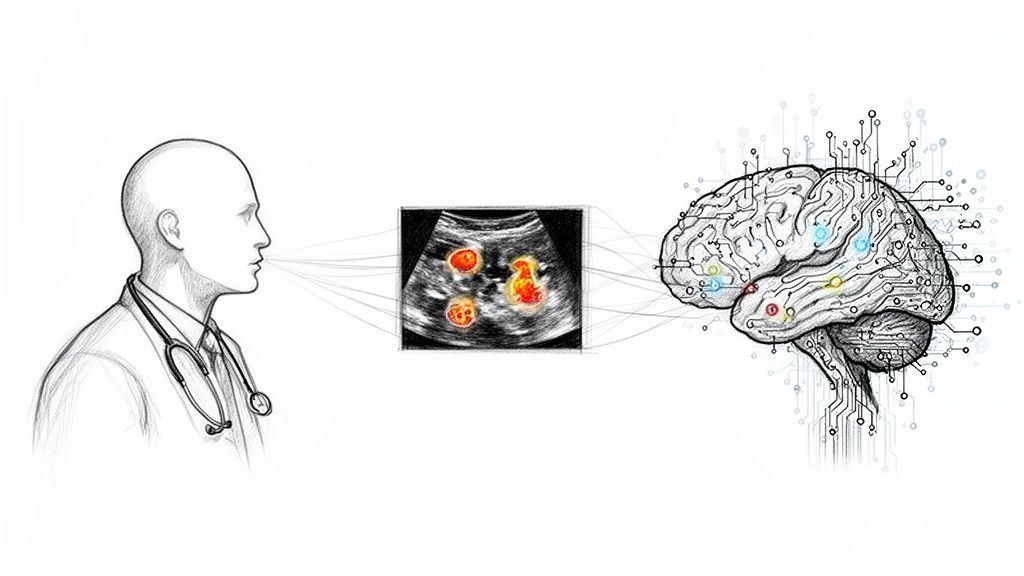
Artificial intelligence is making a real difference in healthcare diagnostics by giving clinicians a powerful new kind of partner. It works by analyzing vast amounts of medical data to spot subtle patterns that are often invisible to the human eye. The biggest wins happen when AI's analytical horsepower is combined with human expertise, creating a powerful duo that cuts down on errors and gets patients answers faster.
In medicine, getting the diagnosis right is everything. A mistake or a delay can change a person's life for the worse, while an accurate, early diagnosis can save it. For decades, this critical task has rested solely on the shoulders of dedicated medical professionals who interpret a complex mix of scans, lab results, and patient histories. While their skill is essential, even the best doctors are human and can be affected by things like fatigue or cognitive bias.
This is where the idea of "augmented intelligence" truly shines. It’s not about replacing clinicians but about making them better. Think of it like giving a radiologist a pair of glasses that can highlight suspicious patterns they might otherwise overlook, or giving a pathologist a tireless assistant who has instantly reviewed millions of similar slides. This collaborative spirit is the key to how AI improves diagnostic accuracy in healthcare.
At its heart, using AI in diagnostics is about building a stronger, more resilient team—one where human and machine work together. The evidence for this approach is piling up.
Study after study shows that when you pair a clinician with an AI system, diagnostic accuracy goes up—more so than with either the human or the algorithm working alone. An analysis from the Max Planck Institute found that these hybrid human-AI teams consistently beat groups of only humans or only AIs. In some cases, AI support has been shown to boost a clinician's diagnostic sensitivity from 65-78% to nearly 90%. You can discover more insights about these human-AI collective findings.
This guide will break down the mechanics behind these gains and show how healthcare organizations can thoughtfully implement powerful AI solutions. We’ll walk through the technology itself and the practical steps needed to get it working in a clinical setting.
The goal is to create a system where human intuition and AI's analytical precision work together, leading to better, faster, and more reliable patient outcomes. This isn't science fiction; it's the new standard of care being built today.
By understanding how AI fits into clinical workflows, healthcare leaders can start charting their own course toward a future of diagnostic excellence. A smart AI strategy consulting plan is the first step in rethinking patient care and making operations more efficient. We believe that with the right roadmap, any healthcare provider can tap into this progress.
To really get a feel for how AI is boosting diagnostic accuracy, you have to look under the hood. It’s not one single, magic technology. Instead, we’re talking about a few specialized engines working together, each with a specific job. These are the powerful AI tools for business that are fundamentally changing how we practice medicine.
Think of Machine Learning (ML) as a medical student who can study an entire library of past cases in a single afternoon. It learns by sifting through massive amounts of data—patient records, lab results, images—to spot patterns linked to certain diseases. It’s a lot like how a human student learns to recognize the classic signs of pneumonia by reviewing countless X-rays.
For example, you can feed an ML algorithm historical data on heart disease, including vitals, lab work, and lifestyle details. By crunching all that information, it learns which combinations of factors are the strongest predictors of a future cardiac event. This gives doctors a powerful risk-assessment tool built on the experience of thousands of previous patients. A thorough AI requirements analysis is the first step to ensure the model is learning from the right data to solve the right problem.
Now, imagine that medical student decides to become a specialist. That’s Deep Learning, a more sophisticated branch of machine learning. Deep Learning uses complex structures called neural networks, which are loosely modeled on the human brain, to analyze information in much greater detail.
This layered approach makes it incredibly good at interpreting highly complex data, especially medical images. While a basic ML model might see an image as a single picture, a deep learning algorithm inspects it pixel by pixel. It builds its understanding layer by layer—first seeing edges, then shapes, then textures, and finally identifying a complex object like a tumor or a tiny fracture.
Deep Learning is like a seasoned radiologist who has a knack for spotting minuscule, almost invisible anomalies on a CT scan or MRI. In fact, studies have shown that some deep learning models can detect certain cancers from mammograms with an accuracy that matches, or even beats, human experts.
This isn't just about finding things we already know how to look for. It’s about discovering subtle signals that the human eye might miss. This is where we're seeing some of the biggest jumps in diagnostic accuracy, turning a flood of visual data into clear, actionable information. The right AI Strategy consulting tool can help an organization figure out exactly where to apply deep learning for the greatest impact.
Finally, there’s Natural Language Processing (NLP). Think of this engine as a tireless medical researcher. A staggering 80% of a patient's medical history is locked away in unstructured text—things like clinical notes, physician dictations, and discharge summaries. This information is pure gold, but it's always been incredibly difficult to analyze systematically.
NLP is the technology that can actually read and make sense of this human language. It can scan years of a patient's clinical notes in seconds, pulling out crucial details like symptoms, medication histories, and past procedures.
This allows the system to piece together a complete patient story that might otherwise be scattered across dozens of different files. For instance, NLP can flag an adverse drug reaction mentioned in a specialist’s note from five years ago, making sure that critical piece of information is right there when a new prescription is being considered. By synthesizing all this unstructured data, NLP delivers a much fuller picture of the patient, which is essential for an accurate diagnosis and a key part of our AI Automation as a Service offerings.
The promise of AI really hits home when you see it in action, especially in fields that are all about visual analysis. Radiology and pathology have become the proving grounds where AI is making a real difference today, acting as a tireless second opinion for clinicians. These practical applications aren't just theory; they are real-world use cases that show exactly how AI is boosting diagnostic accuracy right now.
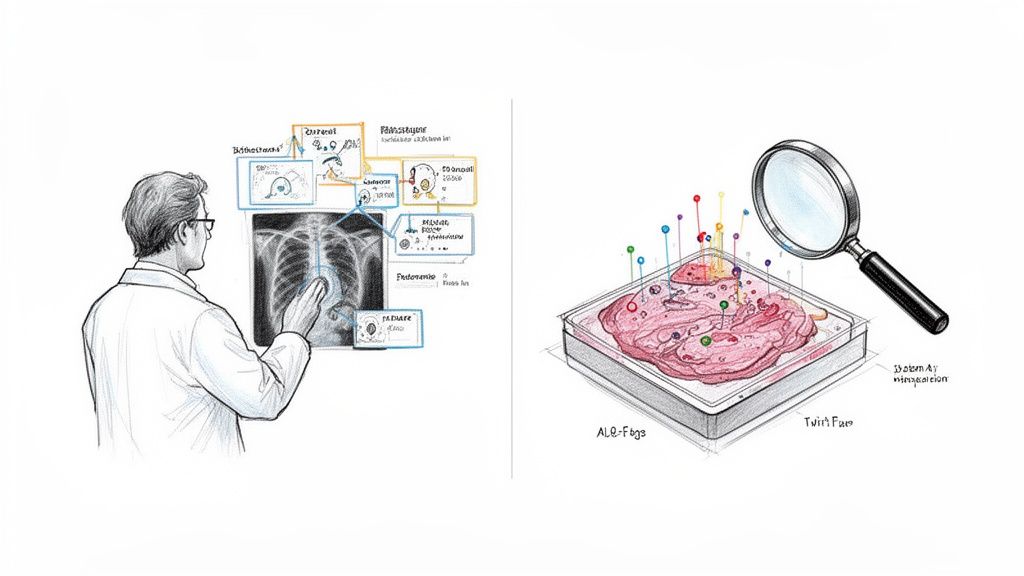
Radiologists spend their days sifting through countless images, hunting for tiny abnormalities that could signal a serious problem. It's a high-stakes, high-volume job where fatigue is a real factor, and a small oversight can have big consequences. This is where AI algorithms, especially deep learning models, truly shine.
Think about mammograms. An AI can scan an image and pinpoint microscopic calcifications or faint tissue distortions—often the earliest signs of cancer. The AI doesn’t get tired. It gives the last scan of the day the same sharp focus as the first. This provides an incredible safety net, catching things that might have been missed and helping find cancers when they're smaller and more treatable. The same logic holds true for finding lung nodules on CT scans or spotting tumors on an MRI.
AI essentially becomes a diagnostic co-pilot. It meticulously flags areas of concern that need a radiologist’s expert eye, which lets the human expert focus their attention where it matters most. It’s a partnership that builds both confidence and accuracy.
This collaboration is a perfect example of how thoughtfully designed internal tooling can be woven into a clinic's workflow to improve patient outcomes. By handling the initial, often repetitive review, AI not only sharpens precision but also dramatically speeds up how quickly patients get their results.
Pathology has traditionally been a very manual craft, with pathologists peering through microscopes to examine tissue samples on glass slides. AI is now digitizing this process, bringing a whole new standard of consistency and detail to the analysis.
Once a tissue sample is scanned into a high-resolution digital image, an AI can get to work. It can identify and count cancerous cells with a level of consistency that’s incredibly difficult for a person to maintain all day long.
This depth of analysis is a huge leap forward. It provides clinicians with richer diagnostic information, paving the way for more personalized and effective medicine through custom healthcare software development.
It's not just about images anymore. Large language models (LLMs) are also starting to show real potential in diagnostics. New studies are finding that when you feed an LLM structured clinical data, like a patient’s lab results, it can significantly improve the process of differential diagnosis.
Research from Florida State University recently showed that GPT-4 had a top-10 accuracy of 60% based on lab data alone, with some cases hitting nearly 80% accuracy. You can read more about how AI is improving differential diagnosis. This really drives home how important clean, structured data is for getting the most out of these powerful models.
It's one thing to install a powerful AI solution, but it's another thing entirely to prove it’s actually making a difference. How do you know your investment is truly improving diagnostic accuracy and delivering tangible value? To get clinicians on board and justify further spending, you have to move beyond feel-good stories and start tracking cold, hard numbers.
This is where a solid measurement framework comes in. By defining specific Key Performance Indicators (KPIs), you can build a powerful, data-backed case that shows exactly how AI is raising the bar for patient care and streamlining your operations.
First and foremost, the most important metrics are all about patient outcomes. These clinical KPIs get straight to the point: is the AI making diagnoses more accurate and reliable? The two cornerstones for measuring this are sensitivity and specificity. Think of them as two sides of the same coin, working together to give you a full picture of diagnostic precision.
Sensitivity (True Positive Rate): This tells you how good the AI is at catching what it's supposed to catch. It answers the question: "Of all the patients who actually have the disease, what percentage did the system correctly identify?" High sensitivity is absolutely critical for minimizing false negatives—you don't want to miss a real case.
Specificity (True Negative Rate): This measures how well the system avoids raising false alarms. It answers: "Of all the healthy patients, what percentage did the system correctly clear?" High specificity is just as important for preventing the stress, cost, and risk of unnecessary follow-up tests prompted by false positives.
You can't have one without the other. A system that’s super sensitive but has poor specificity will just create noise and over-diagnosis. On the flip side, a highly specific tool that isn’t sensitive enough will miss sick patients. The goal is to find that sweet spot where both are optimized.
Beyond just getting the diagnosis right, AI should also make the entire process run smoother. Operational KPIs help you quantify how the technology is making your team faster and more efficient, which frees up your experts to focus on complex cases. These metrics are often much easier to track and can show a return on your investment almost immediately.
A few key operational wins to track include:
Keeping a close eye on these numbers is essential when scaling your AI Automation as a Service efforts. They provide undeniable proof that your department can handle more, and do it more efficiently.
To really drive home the value AI brings to the table, nothing works better than a direct, side-by-side comparison. Looking at your KPIs before and after implementation paints a clear and compelling picture of the improvements.
This table shows what that contrast often looks like:
| Key Performance Indicator (KPI) | Traditional Diagnostic Process | AI-Augmented Diagnostic Process |
|---|---|---|
| Sensitivity | Baseline performance of human clinicians (e.g., 85%) | Improved performance with AI support (e.g., 92%) |
| Specificity | Baseline performance of human clinicians (e.g., 90%) | Maintained or improved performance (e.g., 94%) |
| Time to Diagnosis | Average of 48-72 hours | Reduced to an average of 24-36 hours |
| Clinician Time Saved Per Case | 0 minutes (manual review) | Average of 5-10 minutes saved per case |
When you lay out the data like this, the benefits are no longer theoretical. You’ve transformed the conversation from what AI could do to what it is doing, providing measurable proof of its impact on both clinical quality and your operational bottom line. This is exactly the kind of data-driven story we help our clients build.
Bringing AI into your diagnostic process isn't just a tech upgrade; it's a fundamental shift in clinical practice. To get it right, you need more than just a powerful algorithm. You need a deliberate, phased plan that weaves the technology into your existing workflows, making sure it's not only technically sound but also clinically valuable and—most importantly—trusted by your staff.
The journey starts by pinpointing the exact diagnostic bottlenecks where AI can make the biggest difference for your organization. From there, you build a clear roadmap that covers everything from data governance to clinician training. This kind of structured approach, as we explored in our AI adoption guide, is what separates a successful AI initiative from a costly experiment.
The first phase is all about planning. Before a single line of code is deployed, you have to get a handle on your organization's specific needs and current capabilities. This means taking a hard look at your data infrastructure, identifying a few high-value use cases, and setting clear goals for what you actually want to achieve.
Think of it like this: where is the most friction in your diagnostic process right now? Is it the turnaround times in pathology? Or catching those subtle, early-stage nodules in radiology? Answering these questions helps you focus your efforts where they'll count the most.
This is also the time to assemble your team. You absolutely need clinicians, IT specialists, and administrative leaders at the table from day one. Without this shared vision, even the most impressive technology will struggle to gain traction.
Once your strategy is locked in, the real work begins. The most successful rollouts follow a logical, step-by-step progression, moving from small, controlled pilots to a full-scale deployment.
This methodical process ensures you're building a sustainable capability, not just plugging in a new piece of tech. You can learn more about how we guide organizations through this journey with our AI Product Development Workflow.
The image below shows the key metrics to watch throughout this journey, focusing on sensitivity, specificity, and time to diagnosis.
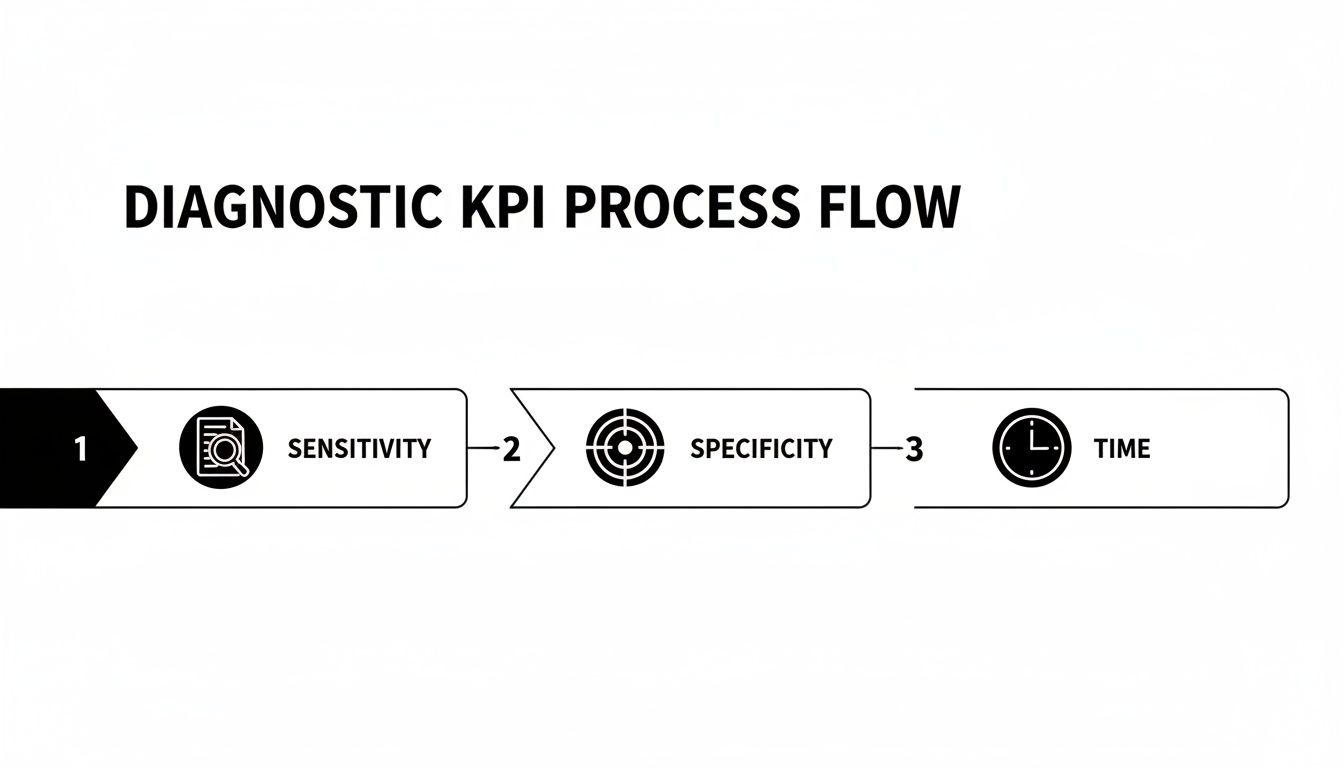
By keeping a close eye on these KPIs at each stage, you can objectively measure the real-world impact of your AI tools and make smarter decisions about where to go next.
And clinicians are taking notice. Roughly two-thirds of U.S. physicians now report using some form of health AI—a stunning 78% jump from just two years ago.
In the end, a successful AI integration is less about the technology itself and more about the people and processes you build around it. By taking a thoughtful, phased approach, healthcare leaders can ensure their AI initiatives deliver lasting improvements to diagnostic accuracy and patient care.
Even simpler tools can make a big difference. For instance, technologies like AI voice recognition in healthcare can dramatically improve data capture, making sure the information feeding more complex diagnostic algorithms is accurate from the very start.
Bringing AI into diagnostics is a massive step forward, but it’s not just a technology problem. It's a journey through a dense thicket of ethical questions and regulatory hurdles. The potential is enormous, of course, but realizing it means moving forward carefully to protect patients and maintain the trust we’ve worked so hard to build. This isn't just about plugging in new software; it's about a fundamental commitment to fairness, privacy, and being completely open about how these tools work.
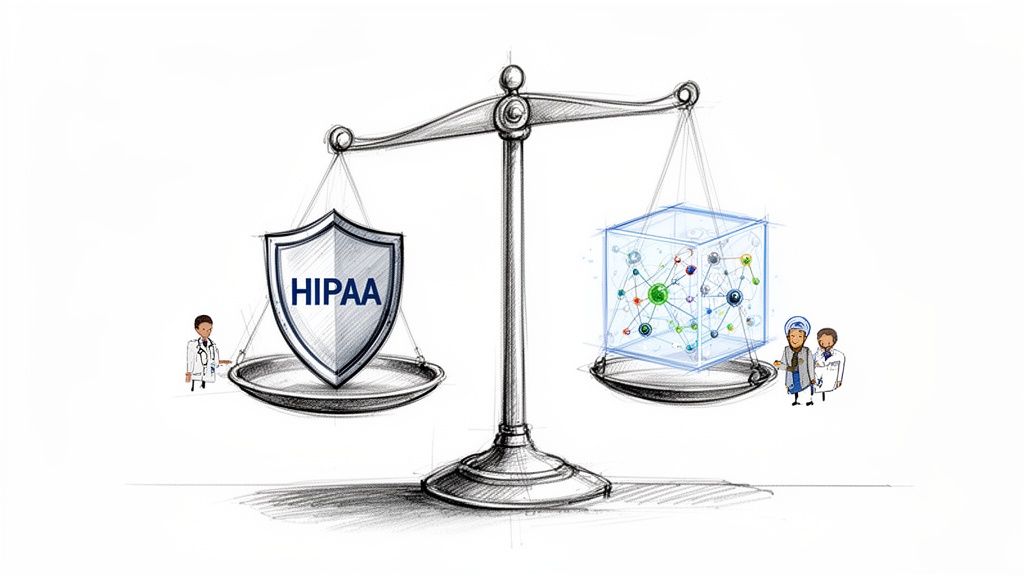
To get this right, you have to face these challenges directly. Working with an expert team that gets both the tech and the regulatory side of things is the only way to build an AI program that's both effective and responsible.
Patient data is the fuel for any diagnostic AI, but it's also incredibly sensitive information protected by tough regulations like HIPAA. Compliance isn't optional. From the moment you collect data to the second a model makes a recommendation, every single step needs rock-solid security to prevent breaches and keep patient information confidential.
But it goes beyond just checking boxes for compliance. We have an ethical duty to be transparent with patients about how their data is being used. Trust is built on clear communication and showing them you’re committed to protecting their most private information.
One of the biggest ethical minefields is algorithmic bias. Think about it: if an AI is trained on data that mostly comes from one patient group, it can easily learn to be less accurate for everyone else. This doesn't just lead to bad diagnostics; it can actually worsen existing health disparities.
The solution is to consciously build diverse datasets and constantly check the model’s performance across all demographic groups. This is a core idea behind fairness-focused tools like Alethic AI.
Then there’s the “black box” problem. A deep learning model can give you an answer, but good luck figuring out how it got there. That’s why Explainable AI (XAI) is so important. Clinicians won't—and shouldn't—trust a recommendation they can't understand. They need to see the logic before they act on it.
When you're dealing with AI in diagnostics, you have to get familiar with the demanding FDA approval process for medical devices. Many of these AI tools are classified as medical devices, which means they must pass a battery of tests to prove they're safe and effective.
These standards are always changing, so staying on top of them is critical for any organization wanting to use AI responsibly. This is exactly where the guidance of our expert team becomes so important.
No, the goal of AI in healthcare is augmentation, not replacement. AI serves as a powerful tool to assist clinicians by analyzing vast datasets and flagging potential issues, but it lacks the empathy, critical reasoning, and holistic patient understanding that human doctors provide. The most effective approach combines AI's analytical precision with a clinician's expert judgment.
High-quality, diverse, and well-labeled data is essential. For image-based diagnostics, this means thousands of annotated images (like X-rays or MRIs). For predictive analytics, it requires large, structured datasets from electronic health records. Crucially, all data must be anonymized and handled in compliance with privacy regulations like HIPAA.
Ensuring safety and fairness is an ongoing process involving several key steps:
The best starting point is strategy, not technology. Begin with an AI strategy consulting engagement to identify the specific clinical bottlenecks where AI can deliver the most value for your organization. This initial phase helps assess data readiness, build a solid business case, and select a manageable pilot project to prove the concept and build momentum for a wider rollout.
Ready to build a data-driven diagnostic strategy? Ekipa AI provides the expertise and tools to help you identify the right use cases, ensure data readiness, and implement AI solutions that deliver measurable improvements in diagnostic accuracy. Our process is guided by our expert team, ensuring a responsible and effective integration. Get your Custom AI Strategy report today.
How to build HIPAA-compliant AI: when LLM providers need a BAA, data minimization, de-identification, audit controls and a reference architecture.
Practical data migration planning guide for healthcare teams. Scope, mapping, compliance, validation, cutover and rollback decisions explained end to end.
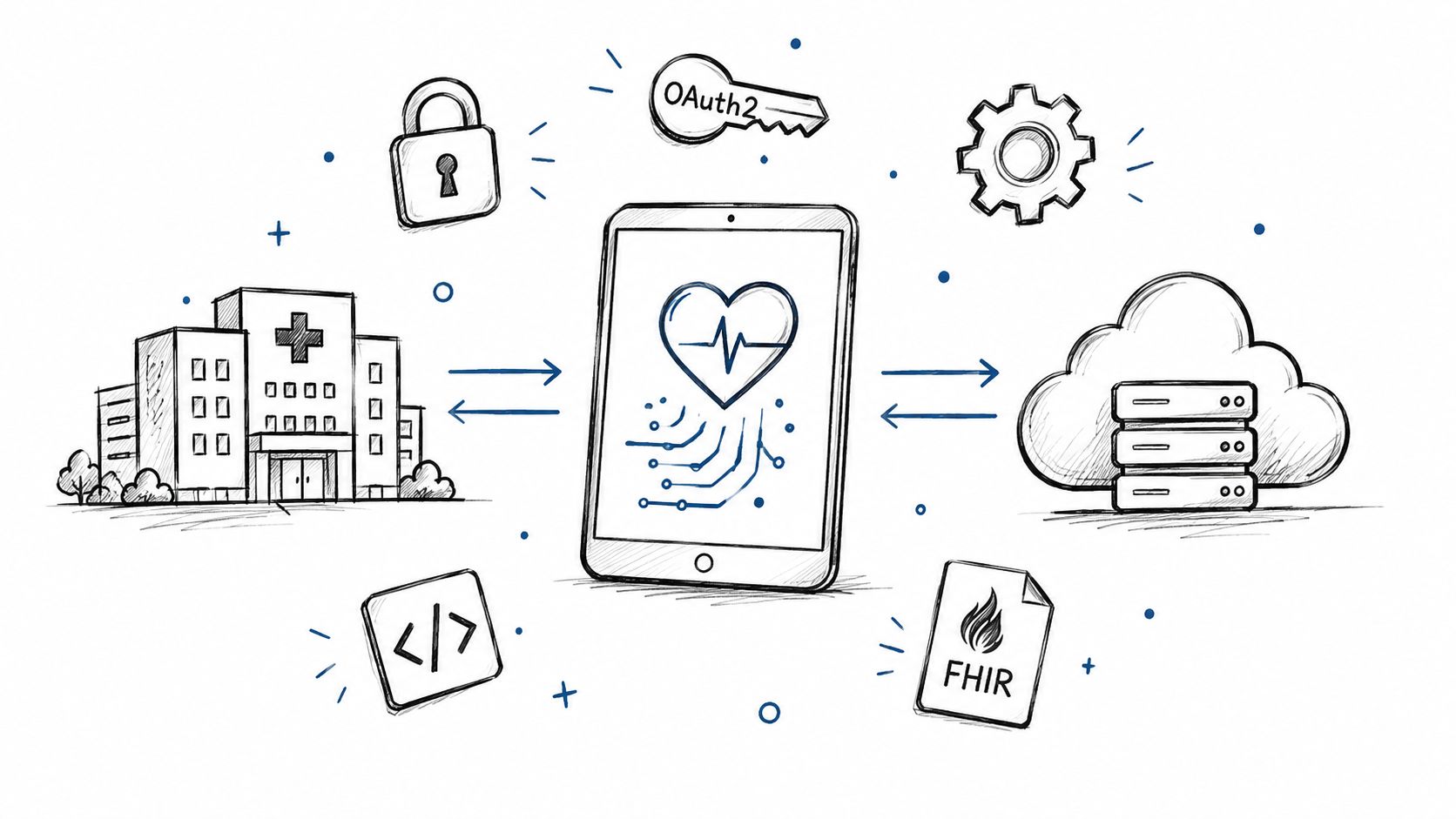
Smart on FHIR guide for healthtech engineers. Learn the OAuth 2.0 launch model, scope syntax, backend services, and US regulatory requirements.
Connect with our team to explore how AI expertise can transform your business.