AI in Healthcare
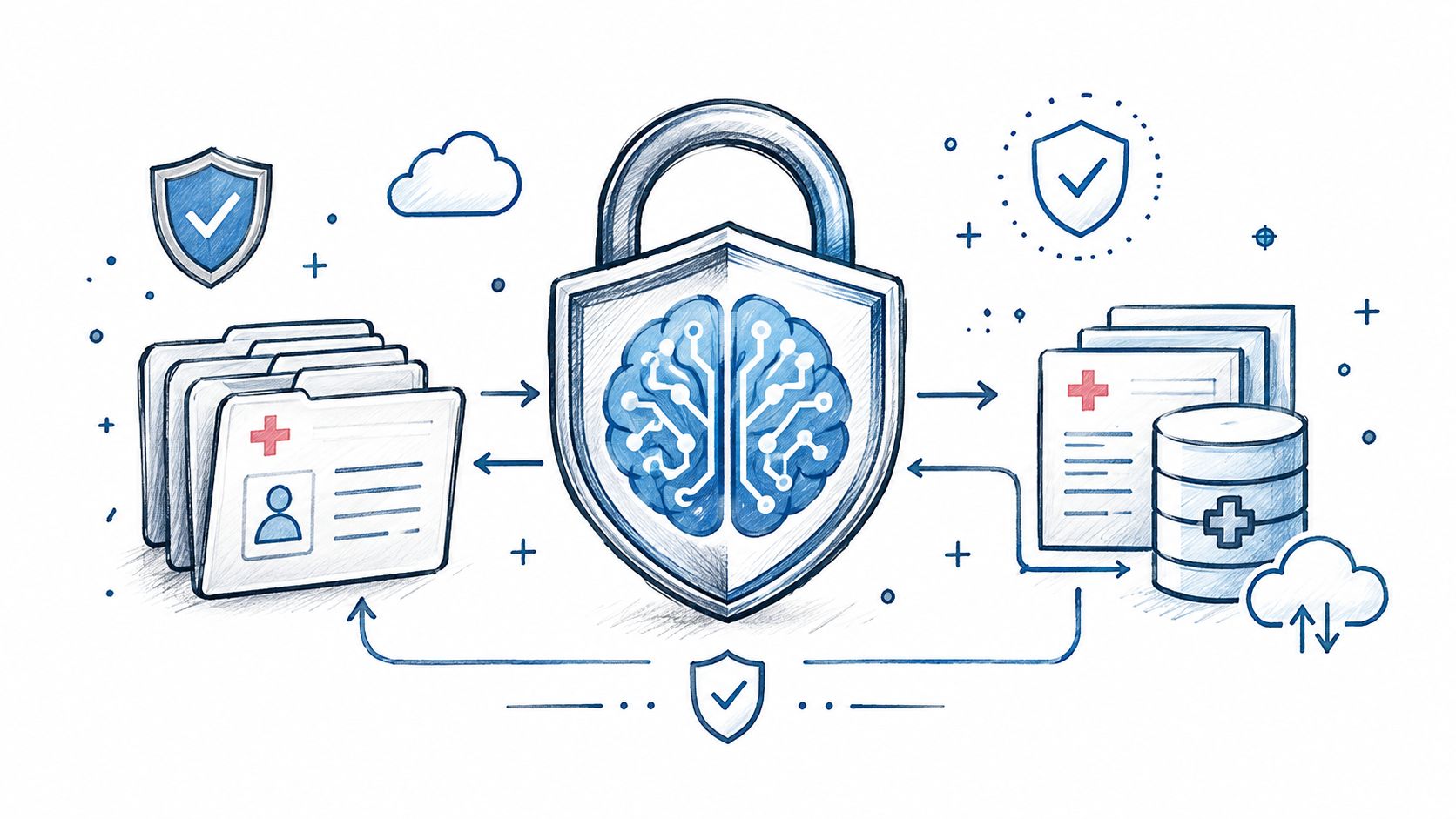
HIPAA-Compliant AI: How to Use LLMs With PHI Safely
How to build HIPAA-compliant AI: when LLM providers need a BAA, data minimization, de-identification, audit controls and a reference architecture.
October 16, 2026Read more
Master healthcare AI change management for 2026. Navigate stakeholder engagement, build governance, and scale AI adoption successfully.

Let's be honest—bringing AI into a healthcare setting isn't just about the tech. It's a deeply human challenge. While the algorithms get more impressive by the day, many organizations are finding it incredibly difficult to bridge the gap between adopting AI and actually succeeding with it. This guide is built from real-world experience to help you navigate those human hurdles and master healthcare AI change management.
Rolling out an artificial intelligence tool in a clinical setting is so much more than an IT project. It’s a fundamental shift in how people work, think, and collaborate. You can have the most advanced algorithm on the planet, but it's worthless if clinicians don't trust its recommendations, nurses can't fit it into their packed schedules, or patients are left confused.
This is exactly where most AI initiatives stumble—not because the code is bad, but because the human element was an afterthought. The real obstacles are rarely technical; they're rooted in organizational habits and human psychology.
Even though 86% of health systems are now using AI in some capacity, progress often stalls because of people-related challenges. In fact, a sobering statistic reveals that only 22% of organizations manage to successfully roll out specialized, domain-specific AI tools.
What’s holding them back? It usually comes down to three things: staff resistance, a fuzzy strategy from leadership, and a significant trust gap between the clinicians and the technology. You can find more data on these AI implementation roadblocks at censinet.com.
The success of any healthcare AI project is determined less by the sophistication of the technology and more by the strength of its change management strategy. Focusing on people, process, and culture is non-negotiable.

This reality means we need a deliberate, people-first approach. Before you even think about deploying a new tool, it’s critical to assess how ready your organization is for the change. A good HR guide to project success can give you a solid framework for evaluating these human factors from the start.
To provide a clear roadmap, we've organized the core components of a successful change strategy into a few key pillars. These are the areas where leadership must focus their energy to turn potential resistance into enthusiastic adoption.
| Pillar | Key Objective | Critical Success Factor |
|---|---|---|
| Trust and Transparency | Build clinical confidence in AI tools. | Provide clear explanations of how AI models work and evidence of their positive impact on patient safety and outcomes. |
| Workflow Integration | Ensure AI fits seamlessly into daily routines. | The AI solution must reduce, not increase, clicks and administrative burden. It should feel like a natural extension of the workflow. |
| Clear Communication | Align everyone on the "why" behind the change. | Leadership must consistently communicate a compelling vision that addresses fears, highlights benefits, and creates a sense of shared purpose. |
This table provides a high-level overview, but the real work is in the details. Getting these pillars right is what separates a frustrating, failed project from one that truly enhances patient care.
To build a solid foundation, leadership must tackle these areas head-on:
Building Trust: Clinicians need to see AI as a reliable co-pilot, not a mysterious black box or a threat to their autonomy. This starts with being transparent about how the models work and demonstrating, with data, that they improve care rather than complicate it.
Aligning Workflows: Any new tool has to slot into existing clinical processes without causing friction. If an AI solution adds extra steps, creates confusion, or breaks a well-established routine, your team will find a way to work around it—or abandon it altogether.
Communicating Vision: Your staff, from the front desk to the surgical suite, needs to understand the purpose behind this change. A clear, consistent message from leadership that acknowledges their concerns and emphasizes the benefits is absolutely essential for getting everyone invested.
By proactively addressing these human-centric challenges, you can bridge the gap between AI's potential and its practical application, ensuring the technology serves its ultimate goal: improving outcomes for every patient.
A successful foray into healthcare AI doesn't start with the flashiest new tool or a mountain of code. It begins much earlier, with a deliberate and rock-solid strategic foundation. I’ve seen organizations jump straight to the technology, and the results are often messy—wasted resources, frustrated teams, and projects that go nowhere.
The key is to anchor any AI initiative directly to your organization's core mission and operational goals. Forget vague ambitions like "improving efficiency." Get granular. What does success actually look like for your clinicians and patients? This is where AI strategy consulting becomes invaluable.
Maybe it’s cutting down the time your physicians spend on documentation by 20%, freeing them up for more patient interaction. Or perhaps it's boosting diagnostic accuracy for a specific cancer by 10%. These aren't just numbers; they are concrete, measurable objectives that give your teams a clear target and provide the benchmarks you'll use to measure success later on.
Strong governance isn't red tape; it's the guardrails that keep an AI project safe, effective, and compliant. From day one, this needs to be a joint effort between your clinical and IT domains.
One of the first and most critical moves is to assemble a cross-functional steering committee. This group shouldn't be siloed. It needs to include your clinical leaders, IT experts, administrators, and even representatives from legal and compliance. Everyone gets a seat at the table.
This committee needs a champion—a dedicated AI lead who serves as the single point of accountability. This person is essential for driving the vision, mediating between departments, and ensuring a direct line to executive leadership. Without this structure, decisions get made in a vacuum. A core part of their role will be to define an effective MLOps and AI deployment strategy that truly serves the enterprise and delivers real-world value.
A well-defined AI strategy is your organization's compass. It ensures every initiative, from a small pilot to a full-scale deployment, is pointed toward true north—improving patient outcomes and strengthening your operational backbone.
Let's be clear: executive buy-in is so much more than a signature on a budget request. It's active, visible sponsorship from the very top. Your leaders must not only approve the AI strategy but also become its most vocal champions, consistently communicating its importance and how it fits into the organization's long-term vision.
This alignment is absolutely crucial for securing a realistic budget. AI is not a one-time purchase. It demands sustained investment in technology, data infrastructure, continuous training, and ongoing maintenance. You need a detailed financial plan that maps out not just the initial setup costs, but the total cost of ownership over several years. A Custom AI Strategy report can help articulate this plan to stakeholders.
The numbers speak for themselves. The adoption of generative AI for clinical productivity has already hit 54% among care organizations. While the potential to unlock up to $360 billion in annual savings in the U.S. healthcare system is enormous, those gains are only possible with a thoughtful strategy. As reported by sources like Dialog Health, realizing these benefits requires a comprehensive plan with a long-term vision, specific projects, and clear ways to measure performance.
Ultimately, building this foundation is about being deliberate. By setting clear goals, creating strong governance, and securing true leadership support, you're building a stable launchpad for a successful AI transformation. For a deeper look at this process, you can explore our comprehensive Healthcare AI Services to see how we can support your strategic planning.
Let's get one thing straight. Rolling out a new AI tool is 10% technology and 90% people. Far too many healthcare AI initiatives fail not because the algorithm is flawed, but because they are treated as simple IT rollouts. They're not. This is a fundamental change to the way your people work, think, and care for patients.
Success, then, depends entirely on getting your people on board. That means everyone—from the most skeptical senior surgeon to the administrative staff who keep the lights on. You need a game plan for cutting through the noise, addressing the very real anxieties people have about AI, and building genuine enthusiasm for what's possible. It all starts by finding your allies.
Your first job is to map out everyone who will touch, or be touched by, this new technology. It’s easy to focus on the obvious users, but the ripples of an AI tool spread much wider. Miss a group, and you’re creating a blind spot that can derail the entire project.
Think expansively about these key players:
Once you know who the players are, you need to find your champions. These aren't necessarily managers or people with fancy titles. They are the influential, respected, and often tech-curious people who others naturally turn to for advice. They’re the social proof you need to drive adoption from the ground up.
When a respected peer says, "This new AI tool actually saved me an hour today," it carries more weight than any corporate announcement ever could.
Think about the nurse who everyone goes to with a tough IV or a question about the EHR. Or the resident who’s always tinkering with a new productivity app. These are your people. Find them, bring them into the inner circle early, and give them a real voice in the process. Empower them to test the tool, provide brutally honest feedback, and help you co-design the rollout.
Whatever you do, don't ignore the critics. Your most vocal skeptics are often your most passionate employees. Their concerns don't come from a place of negativity; they come from a deep-seated commitment to patient safety and stable workflows.
Their critical perspective is a gift. It will expose your blind spots and help you identify potential points of failure before they become full-blown disasters.
So, instead of trying to silence them, bring them in closer.
When you actively engage your critics, you can often turn them into your most constructive allies. There is nothing more powerful than when a former skeptic becomes a vocal advocate for the change.
As you start to bring these diverse voices together, you’ll find that a structured session is often the best way to get everyone aligned. You can explore how to build and run these crucial meetings by learning more about our strategic workshops for AI implementation.
The path from a polished AI strategy to genuine clinical impact starts with one successful first step. That step is your pilot program, and how you design it is critical. You're not aiming for a massive, complicated rollout; the goal here is a quick, tangible win that proves AI's value and gets people talking for all the right reasons. This is how you build the momentum you need for successful healthcare AI change management.
Let's be clear: starting small is the smartest way to handle risk. As we explored in our AI adoption guide, while healthcare AI adoption has been climbing, the reality is that most pilots fail. In fact, only about 30% ever make it into full production, often tripped up by unexpected integration costs or data that just wasn't ready. To beat those odds, you need a phased approach that delivers immediate value and builds trust before you even think about a full-scale deployment.
A pilot isn't just a technical test; it's a cultural one. Your goal is to prove that an AI tool can solve a real, painful problem for your clinicians in their actual workflow, building the social proof needed for wider adoption.
A deep-dive AI requirements analysis is where you start to define what a "win" even looks like. This is the process where broad strategic goals get whittled down into the specific, measurable outcomes for your pilot.
Before a single line of code is written or one user is trained, you need to draw firm boundaries around your pilot. A pilot that tries to fix everything will end up fixing nothing. My advice? Zero in on one, high-impact problem.
If you're looking for ideas on what a focused use case can look like, you can see our library of real-world use cases. Many of these started as highly targeted pilots for SaMD solutions or custom internal tooling.
Building a coalition of champions is key to making your pilot a success, and this process can help you get there.

By following a structured path like this, you methodically build the ground-level support that is absolutely essential for any pilot to thrive.
The people you bring into your pilot are just as important as the technology. You need a careful mix—not just the enthusiastic early adopters who will sing the tool's praises, but also a few of the pragmatic skeptics. They're the ones who will give you the brutally honest feedback you need to hear.
Once the pilot kicks off, collecting feedback can't be an afterthought. It has to be a continuous, structured part of the process. Our AI Product Development Workflow emphasizes this iterative loop.
Instead of a rigid checklist, think of it as a constant conversation. In the first week, I always recommend brief, daily check-ins—maybe 15-minute huddles to catch any immediate frustrations or workflow snags. From there, you can move to weekly surveys to track satisfaction and gather hard numbers on your metrics.
But the most valuable feedback often comes from just being there. Spend time on the floor, watching how people actually use the tool. This kind of "shadowing" will reveal workflow challenges that users might not even know how to articulate.
Ultimately, a pilot’s success isn’t just measured in KPIs. It’s measured by the buzz it creates. When a nurse from the pilot group pulls aside a colleague from another floor and says, "You won't believe how much time this new tool is saving me," you've found your quick win. That's the most powerful buy-in you could ever ask for.
Getting a pilot program off the ground is a huge accomplishment, but it's just the starting point. The real challenge—and where the true value lies—is in scaling that initial success across your entire organization. This is where your healthcare AI change management efforts truly kick into gear.
Now, the focus shifts from a controlled experiment to creating a sustainable ecosystem for your new AI tools. The goal isn't just to get people to use the technology; it's to weave it into the very fabric of your clinical and operational workflows until it's simply how work gets done. This means moving past one-off training and building a culture of continuous learning and refinement.
Of course, this is easier said than done. After the initial excitement of a pilot wears off, you'll inevitably run into organizational change fatigue. As detailed in Synopsix's change management insights, it takes a deliberate strategy to keep the momentum going.
The intensive, hands-on training that worked for your small pilot group won't work for hundreds or thousands of staff members across different departments. A one-size-fits-all approach is doomed to fail. You need to think bigger and more flexibly.
The key is to create role-specific learning journeys that meet people where they are. Here’s what that looks like in practice:
The best training doesn't just show people which buttons to click. It constantly reminds them why this new tool matters and reveals how they can get the most out of it in their day-to-day work.
As more people start using the AI tool, the volume of questions, issues, and great ideas will grow exponentially. A responsive support system is non-negotiable if you want to maintain user trust and avoid frustration. This is about creating a two-way conversation, not just a help desk.
Your support structure needs multiple channels. A centralized ticketing system is a must-have for tracking technical bugs, but don't stop there. You need avenues for softer, qualitative feedback, like regular user surveys, dedicated forums, or even office hours with the project team.
This constant flow of information is invaluable. First, it helps you spot and fix problems before they become widespread headaches. Second, and more importantly, it gives you the raw material to drive meaningful improvements to the AI tool itself. This is the core principle behind models like AI Automation as a Service, where user feedback is the engine that drives the technology’s evolution.
To keep the momentum going and justify future investment, you have to prove that your AI initiative is actually delivering value. This means moving past anecdotes and getting serious about tracking key metrics.
Keep a close eye on a focused dashboard of performance indicators:
This data tells a powerful story. It shows you which departments might need extra support and, crucially, gives you concrete evidence of your success.
Never underestimate the power of a well-timed success story backed by hard numbers. Announcing that the new AI tool helped slash diagnostic report turnaround times by 18% or gave nurses back 5 hours per week does more than just report a statistic. It reinforces the purpose of the change and builds the business case for the next phase of your AI journey. These tangible wins are what turn a project into a lasting transformation.
Getting an AI tool successfully piloted and scaled across your organization feels like crossing the finish line, but it’s really just the start of a new race. Your focus now has to shift to long-term governance and compliance—a continuous effort, not a one-and-done task. The rules for AI in healthcare are always in flux, which makes a proactive, sustainable oversight strategy absolutely essential.
This is often where bringing in a dedicated regulatory compliance partner can be a game-changer. They live and breathe this stuff. Trying to navigate the nuances of HIPAA and other standards on your own, especially as your AI models learn and evolve, requires a very specific kind of expertise. Your governance framework must be built on a foundation of strong ethical guardrails, ironclad data privacy, and a crystal-clear process for validating any model updates to prove they're still safe and effective.

Good AI governance isn't a static checklist you tick off once. It's a living, breathing process that has to adapt. When new technology pops up, you need a structured way to assess new AI tools for business, watch for model drift, and adjust your clinical workflows. This mindset is what separates a one-time implementation from a true, long-term capability.
Here’s what that looks like in practice:
As AI models demonstrate reliability, human users may naturally trust their outputs more and apply less scrutiny. Long-term governance must account for this evolving human-AI interaction to maintain safety over the device lifecycle.
This constant cycle of strategizing, implementing, and evaluating is what makes AI adoption stick. It ensures your organization doesn't just buy new technology but actually masters it for years to come. Our AI Strategy consulting is designed to support this lifecycle approach.
Let's be honest: navigating this complex journey alone is a huge undertaking. The most forward-thinking healthcare organizations I've worked with all understand the power of strategic partnerships. A trusted healthtech engineering partner can bring the technical firepower and strategic insight you need to build and maintain these sophisticated systems.
Whether you need help developing SaMD solutions, creating custom healthcare software development, or getting ongoing Healthcare AI Services, having the right expertise on your side is critical. Lasting success with AI in healthcare is built on three pillars: strong governance, a commitment to continuous improvement, and collaboration with experts who truly get the unique challenges of this industry. To learn more about the people who can guide you, meet our expert team.
When you're spearheading a major AI initiative, you’re bound to have questions. Let's tackle some of the most common ones we hear from healthcare leaders navigating this complex but rewarding path.
It’s almost never the technology. In our experience, the biggest hurdle is the human side of the equation.
Projects stumble when there's a breakdown in change management. This often looks like a lack of clinician buy-in from the start, confusing communication about the project's goals, or an AI tool that’s a nightmare to fit into existing clinical workflows. True success hinges on putting people first, right from day one.
Thinking about ROI purely in financial terms is a mistake. You need a more holistic view—what we call a balanced scorecard.
Of course, you'll track financial wins like cost savings from streamlined processes. But you also need to measure what truly matters in healthcare: improvements in clinical outcomes, rises in patient satisfaction scores, and critical adoption metrics. Are people actually using the tool? Is staff burnout decreasing because their administrative load is lighter? That's your real ROI.
You can't just push a new tool on them and expect a warm welcome. The key is to make them partners in the process.
Bring them into the conversation early, especially during the vendor selection and design phases. Find those respected, forward-thinking clinicians to act as clinical champions who can advocate for the new technology among their peers.
Above all, start with a pilot project that solves a real, nagging problem they face every single day. Show them how the AI is a smart assistant designed to augment their expertise and give them time back, not a machine trying to replace them.
Always, always start small. A well-designed, focused pilot program is the way to go.
This approach dramatically lowers your risk. It gives you the chance to prove the tool’s value on a smaller scale, work out the kinks, and build the trust and momentum you'll need for a broader rollout. A quick, tangible win is the most powerful tool you have for securing the buy-in needed for bigger, more ambitious projects down the line.
Navigating healthcare AI requires deep expertise in both technology and clinical realities. The Ekipa AI expert team has decades of experience helping organizations like yours succeed.
How to build HIPAA-compliant AI: when LLM providers need a BAA, data minimization, de-identification, audit controls and a reference architecture.

Practical data migration planning guide for healthcare teams. Scope, mapping, compliance, validation, cutover and rollback decisions explained end to end.

Smart on FHIR guide for healthtech engineers. Learn the OAuth 2.0 launch model, scope syntax, backend services, and US regulatory requirements.
Connect with our team to explore how AI expertise can transform your business.