AI Integration
Healthcare AI Consulting: What Good Support Looks Like
Healthcare AI consulting explained: when to get outside help, what a good engagement covers, how to compare partners and the red flags to watch for.
October 16, 2026Read more
Discover 10 powerful operational excellence strategies to boost efficiency and drive growth. Learn how to implement Lean, BPM, and AI for lasting results.
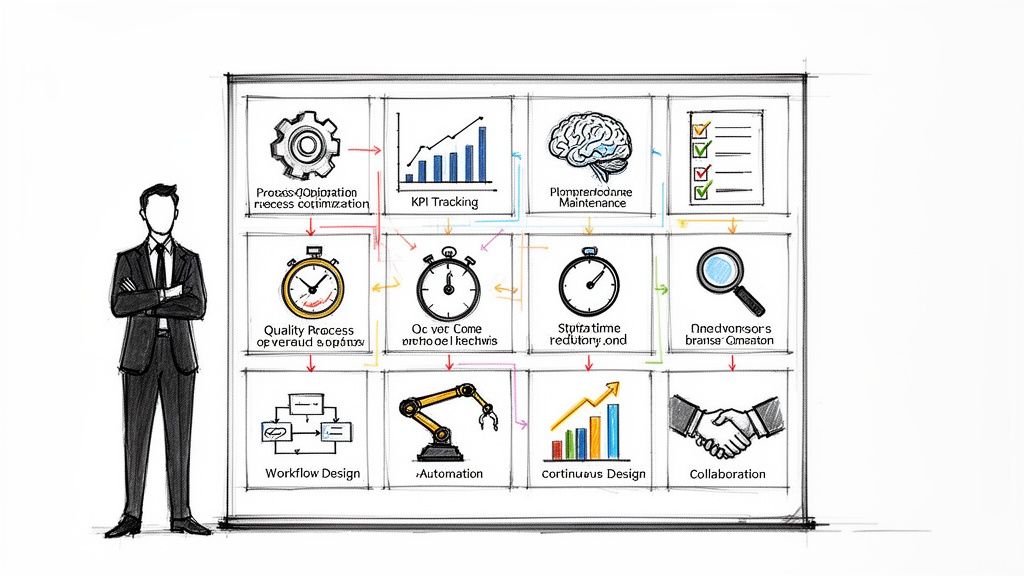
Operational excellence is more than a corporate buzzword; it's a strategic imperative for sustainable growth and a powerful competitive advantage. It represents a fundamental shift in organizational culture, moving from simply completing tasks to systematically improving how those tasks are performed. The goal is to achieve superior performance by embedding principles of efficiency, quality, and customer value into every facet of the business. At the core of transforming operations from good to great is a steadfast commitment to continuous process improvement, ensuring that refinement is an ongoing journey, not a one-time project.
Achieving this state requires more than just good intentions. It demands a structured approach, a clear vision, and the right toolkit. Thriving organizations don't stumble into efficiency; they architect it using proven methodologies. This is where a deep understanding of effective operational excellence strategies becomes critical for business leaders, operations managers, and AI strategists alike. These frameworks provide the blueprint for identifying waste, streamlining workflows, and creating a culture that actively seeks out and eliminates friction. The result is a more agile, resilient, and profitable enterprise.
This comprehensive guide moves beyond theory to provide a practical roundup of the top 10 operational excellence strategies you can implement today. For each strategy, we will break down:
This article is designed to be your go-to resource for transforming your operational capabilities, driving significant improvements in performance, and building a foundation for long-term success.
Lean Six Sigma is a powerhouse methodology that fuses two distinct but complementary operational excellence strategies: Lean's focus on waste elimination and Six Sigma's focus on defect reduction. Lean targets the "Eight Wastes" (defects, overproduction, waiting, non-utilized talent, transportation, inventory, motion, and extra-processing), while Six Sigma uses a data-driven, statistical approach to systematically remove defects and minimize process variability. Together, they create a robust framework for optimizing efficiency, quality, and customer value.
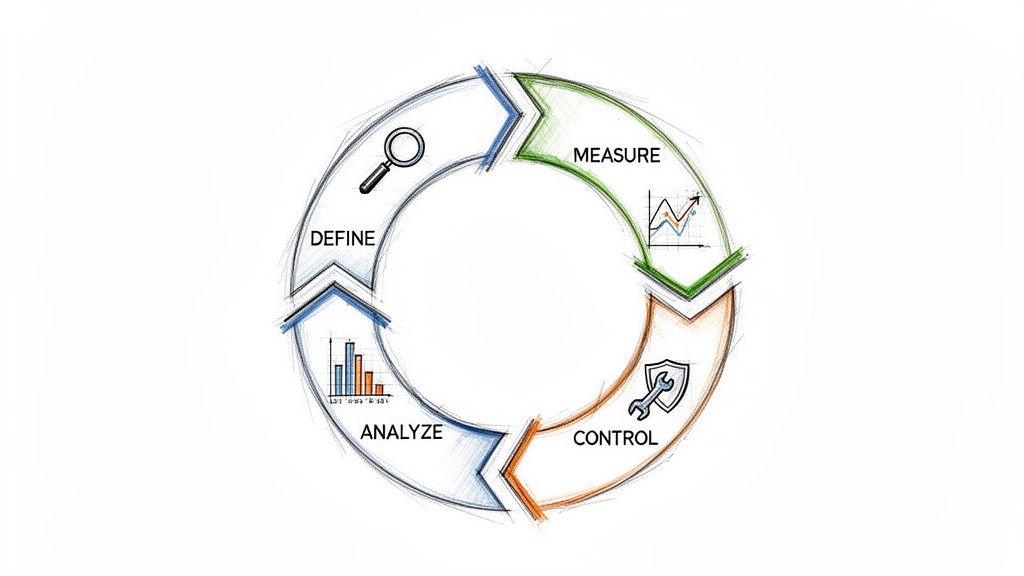
This methodology is particularly potent when paired with an AI strategy. Before deploying expensive AI solutions, Lean Six Sigma helps organizations rigorously identify and quantify inefficiencies in existing workflows. It answers the critical question: "Where will AI deliver the most significant, measurable impact?" By defining problems and measuring performance first, you ensure AI is applied to high-value opportunities rather than automating already flawed processes. This data-first approach de-risks AI investments and guarantees that solutions like AI Automation as a Service are targeted effectively.
A classic real-world example is GE, which, under Jack Welch, used Six Sigma to save an estimated $12 billion over five years by systematically improving processes across its vast portfolio. This illustrates the massive financial upside of embedding statistical discipline into your operations.
Business Process Management (BPM) is a systematic approach to making an organization's workflows more effective, efficient, and capable of adapting to an ever-changing environment. It’s not a one-time task but a continuous cycle of modeling, analyzing, measuring, improving, and optimizing end-to-end business processes. BPM provides a clear blueprint of how work actually flows, moving beyond organizational charts to reveal the cross-functional handoffs, bottlenecks, and redundancies that hinder performance. This visibility is the foundation for meaningful operational excellence strategies.
BPM is a critical precursor to successful AI integration. It acts as a diagnostic tool, mapping out the "as-is" reality of your operations so you can strategically design a future "to-be" state enhanced by AI. Without this clarity, companies risk automating chaos or applying AI to low-impact areas. By thoroughly understanding a process, you can pinpoint the exact steps where AI can drive the most value, whether it’s through intelligent data capture, predictive decision-making, or fully autonomous execution. It ensures that investments in technology like workflow automation are precise and yield maximum ROI.
A prime example is a major bank that used BPM to map its loan origination process. By identifying data entry and verification as key bottlenecks, it introduced AI-powered document processing, reducing the approval cycle from several days to just a few hours.
Kaizen is a Japanese management philosophy that translates to "change for the good," focusing on small, incremental, and continuous improvements involving every employee. Rather than pursuing massive, disruptive projects, Kaizen embeds a culture where everyone, from the CEO to the front-line worker, is empowered to constantly identify and implement small enhancements in their daily work. This approach compounds over time, leading to significant gains in efficiency, quality, and morale.
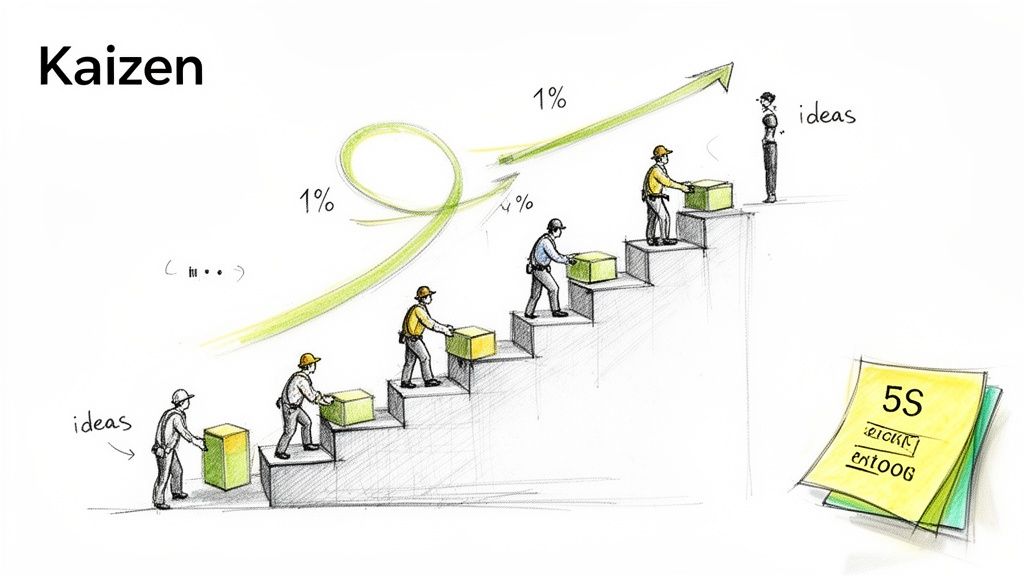
A Kaizen culture is the perfect foundation for a successful AI transformation. AI thrives on data and iterative refinement, which aligns perfectly with Kaizen's principles. This culture creates a grassroots engine for identifying high-value automation opportunities that leadership might otherwise miss. Instead of a top-down AI mandate, employees actively suggest where AI can eliminate tedious tasks, improve data accuracy, or streamline workflows, ensuring solutions like AI Automation as a Service solve real, everyday problems and secure organization-wide buy-in.
Toyota is the quintessential example, using Kaizen to become a global leader in manufacturing. Its production system empowers every worker to stop the assembly line to fix a problem, embodying the principle that continuous, small-scale quality control is everyone's responsibility and a core driver of operational excellence strategies.
Total Quality Management (TQM) is a comprehensive management philosophy where quality and continuous improvement are embedded into every single aspect of an organization's culture and processes. Pioneered by figures like W. Edwards Deming, it shifts the responsibility for quality from a specific department to every employee. TQM is built on core principles of customer focus, total employee involvement, process-centered thinking, and strategic, data-driven decision-making. The ultimate goal is to exceed customer expectations by preventing defects and constantly refining operations.
In an AI-driven environment, TQM acts as the essential quality assurance framework. It ensures that AI solutions are not just technically functional but also genuinely enhance customer value and align with business objectives. Deploying AI without a TQM mindset risks creating sophisticated systems that solve the wrong problems or deliver a poor user experience. This approach guarantees that quality standards are defined and met throughout the AI lifecycle, from data sourcing and model training to deployment and customer feedback, ensuring that AI enhances, rather than detracts from, operational excellence.
A powerful example is Xerox, which faced intense competition in the 1980s. By adopting TQM principles, the company dramatically improved product quality, reduced manufacturing costs, and increased customer satisfaction, a turnaround that ultimately saved it from bankruptcy. This highlights how an organization-wide focus on quality is a potent operational excellence strategy.
Value Stream Mapping (VSM) is a cornerstone Lean technique that creates a detailed visual representation of every step in a process. More than just a flowchart, a VSM documents the flow of both materials and information required to deliver a product or service from start to finish. This powerful visualization tool makes it easy to see where true value is created and, more importantly, where waste and delays are hiding in plain sight.
For any business pursuing AI, VSM is the essential first step to building a strategic roadmap. Before you can automate, you must understand the current state in granular detail. VSM provides this clarity, moving beyond assumptions to create a data-backed blueprint of your operations. It pinpoints specific bottlenecks, manual handoffs, and information gaps that are prime candidates for high-impact automation. This prevents the common pitfall of investing in AI tools for business that target low-value or misunderstood parts of the workflow, ensuring a higher return on your technology investment.
A powerful real-world example is Nike, which used VSM to analyze and streamline its global supply chain. By mapping the entire process from manufacturing to retail, Nike identified major delays and inefficiencies, allowing it to significantly reduce lead times and improve product availability.
The Theory of Constraints (TOC) is a powerful management philosophy that views any complex system as being limited in achieving more of its goals by a very small number of constraints. It asserts that every process has a single bottleneck, and focusing improvement efforts on that one constraint is the fastest path to elevating overall system performance. Instead of diluting resources by trying to optimize everything at once, TOC provides a laser-focused method to increase throughput.
TOC is a crucial framework for any AI strategy because it directly answers the question: "Which single part of our operation, if automated, would unlock the most value for the entire system?" Many organizations mistakenly apply AI to non-critical areas, but TOC forces a prioritization that maximizes ROI. By identifying the primary bottleneck, often a manual, knowledge-intensive, or slow decision-making process, you can deploy AI precisely where it will break the constraint and have a cascading positive effect on the entire value chain.
Boeing famously used TOC to slash manufacturing times for its aircraft by identifying and managing bottlenecks in its assembly line, demonstrating how this focused approach drives dramatic results in complex environments.
Robotic Process Automation (RPA) is a technology that uses software "bots" to automate repetitive, high-volume, and rule-based business processes that humans typically perform. When enhanced with Artificial Intelligence, this evolves into Intelligent Automation, where bots can handle unstructured data, learn from past actions, and manage exceptions. For operational excellence strategies, integrating AI with RPA is transformative; it eradicates tedious manual work, slashes error rates, accelerates processes, and most importantly, liberates human talent for high-value strategic initiatives.
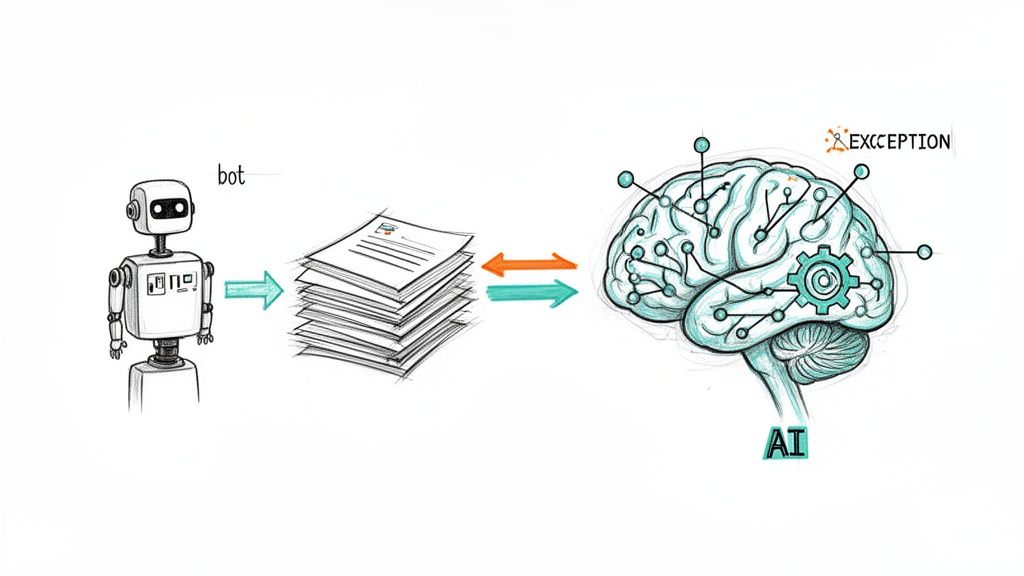
Intelligent Automation is a foundational pillar of digital transformation and a direct path to measurable operational gains. Instead of just mimicking keystrokes, AI-powered RPA can interpret invoices, understand customer emails, and make context-aware decisions, turning automation into a dynamic and intelligent workforce. This approach ensures that your AI Automation as a Service investment delivers a direct, quantifiable return by tackling complex workflows that standard RPA cannot. It bridges the gap between simple task execution and genuine process intelligence, making operations more resilient and scalable.
A powerful example is in financial services, where banks use RPA with AI for transaction processing, often reducing processing times by over 80% while achieving near-perfect accuracy. This demonstrates how Intelligent Automation directly boosts efficiency and compliance.
DevOps represents a fundamental cultural and technical shift, uniting software development (Dev) and IT operations (Ops) to shorten the development lifecycle and provide continuous delivery with high quality. It emphasizes collaboration, automation, and rapid feedback loops. Agile Operations extends this philosophy, applying agile principles like iterative development and continuous improvement directly to operational tasks, creating a highly responsive and adaptive infrastructure.
This combination is the engine for deploying and managing AI solutions at scale. AI models are not static; they require constant monitoring, retraining, and redeployment based on performance and new data. A DevOps and Agile Operations framework provides the essential CI/CD (Continuous Integration/Continuous Deployment) pipeline to automate this entire lifecycle. This ensures that new AI models and updates can be pushed to production quickly and reliably, allowing the business to iterate and improve AI-driven processes with unprecedented speed, a core tenet of our AI Product Development Workflow.
Netflix is a prime example, using its advanced DevOps culture to deploy thousands of changes to its platform daily. This agility allows them to constantly test new features, optimize algorithms, and maintain an exceptional level of service and innovation.
Data-Driven Decision Making (DDDM) is an organizational philosophy that prioritizes decisions based on empirical evidence and data analysis rather than intuition or tradition. It involves building a culture where data is systematically collected, analyzed, and leveraged to guide strategic and tactical choices. This analytics-first approach creates faster learning cycles and a significant competitive advantage, as seen with pioneers like Amazon and Netflix who use data to relentlessly optimize customer experiences.
An analytics-first culture is the bedrock of a successful AI strategy. AI models are only as good as the data they are trained on, and without a solid data foundation, AI investments are likely to fail. This approach ensures that your organization is already collecting and valuing the right information before attempting to build complex AI systems. It establishes the data literacy required to identify high-value AI use cases, accurately measure their impact, and trust the outputs of AI-powered tools. It shifts the focus from "what can AI do?" to "what critical business problem can our data help AI solve?".
A prime example is the Oakland A's "Moneyball" strategy, which used statistical analysis to identify undervalued players, completely transforming baseball scouting. This showcases how an analytics-first mindset, one of the most fundamental operational excellence strategies, can disrupt an entire industry by uncovering insights hidden in the data.
This strategy leverages AI and machine learning to forecast equipment failures before they happen, shifting operations from reactive to proactive. Predictive Maintenance uses historical and real-time sensor data to anticipate breakdowns, while Anomaly Detection identifies unusual patterns in operational data that signal potential issues. Together, they form a powerful defense against unplanned downtime, enabling organizations to schedule maintenance precisely when needed, extend asset lifespan, and improve safety.
Predictive Maintenance is a cornerstone of modern industrial AI, transforming maintenance from a costly, reactive necessity into a strategic, value-driving function. For any business with critical physical assets, this approach directly impacts the bottom line by minimizing expensive downtime and optimizing maintenance spend. It allows you to move beyond fixed schedules and "run-to-failure" models, using data to make intelligent decisions that boost Overall Equipment Effectiveness (OEE) and protect revenue streams. This proactive stance is fundamental to achieving true operational excellence.
A powerful real-world example is GE, which uses its Predix platform to monitor jet engines and power turbines. By analyzing vast streams of sensor data, GE can predict component failures with high accuracy, saving airlines and utility companies millions in avoided downtime and emergency repairs. This illustrates how AI-enabled maintenance can become a core competitive advantage.
| Approach | Implementation complexity | Resource requirements | Expected outcomes | Ideal use cases | Key advantages |
|---|---|---|---|---|---|
| Lean Six Sigma | High — structured methodology and certification | Trained belts, statistical tools, cross-functional teams, time | Reduced variation, measurable cost savings, process efficiency | Complex processes with measurable defects (manufacturing, logistics) | DMAIC rigor, quantifiable ROI |
| Business Process Management (BPM) | Medium–High — process mapping and tool integration | BPM tools/platforms, process analysts, stakeholder engagement | End-to-end visibility, faster automation, improved compliance | Enterprise workflows, regulated processes, digital transformation | Comprehensive process governance and automation readiness |
| Kaizen (Continuous Improvement) | Low–Medium — cultural change and ongoing practice | Employee participation, small investments, facilitation | Incremental gains, higher engagement, continuous improvement | Frontline operations, teams seeking sustained small improvements | Low cost, high employee ownership |
| Total Quality Management (TQM) | High — organization-wide quality systems | Quality frameworks, audits, training, metrics systems | Improved customer satisfaction, consistent quality, reduced defects | Customer-centric businesses, product/service quality focus | Holistic quality focus and standards compliance |
| Value Stream Mapping (VSM) | Low–Medium — visual workshops and analysis | Facilitators, frontline input, simple mapping tools | Clear waste identification, prioritized improvement roadmap | Mapping product/service flows with manual steps | Visual prioritization of high-ROI improvements |
| Theory of Constraints (TOC) | Medium — focused analysis and ongoing attention | Constraint analysis, focused resources, coordination | Rapid throughput gains by addressing bottlenecks | Systems limited by single bottlenecks (manufacturing, services) | High-leverage improvement focus |
| RPA with AI Integration | Medium — bot development plus AI enhancement | RPA platform licenses, developers, governance, AI models | Fast automation of repetitive tasks, reduced errors, quick ROI | High-volume rule-based work with exceptions (finance, insurance) | Rapid deployment, minimal system disruption |
| DevOps & Agile Operations | High — cultural and technical transformation | CI/CD tooling, cloud infra, SRE/DevOps expertise | Faster releases, reliable production, rapid model iteration | AI model deployment, fast-feedback product teams | Continuous delivery and operational resilience |
| Data-Driven Decision Making | High — infrastructure and cultural shift | Data warehouses/lakes, analytics tools, data talent | Better decisions, faster learning cycles, measurable KPIs | Organizations scaling analytics and AI initiatives | Evidence-based decisions and accountability |
| AI Predictive Maintenance & Anomaly Detection | High — sensors, data pipelines, ML models | IoT sensors, data engineers, ML models, maintenance integration | Reduced unplanned downtime, longer asset life, optimized inventory | Asset-intensive industries (manufacturing, utilities, mining) | Proactive failure prevention and fast ROI |
You’ve explored a comprehensive arsenal of ten powerful operational excellence strategies, from the structured rigor of Lean Six Sigma and Business Process Management to the cultural power of Kaizen and the technological leverage of AI-driven automation. We've navigated through the systematic flow analysis of Value Stream Mapping, the bottleneck focus of the Theory of Constraints, and the quality-centric principles of Total Quality Management. The journey continued into the modern era with Agile, DevOps, data-driven cultures, and the predictive power of AI in maintenance and anomaly detection.
The central thread connecting these diverse methodologies is a relentless commitment to creating value and eliminating waste. Operational excellence is not a one-time project or a single initiative; it is an ongoing, dynamic pursuit. It's the cultural heartbeat of an organization that constantly asks, "How can we do this better?" The strategies detailed in this article are not mutually exclusive. In fact, the most successful organizations often weave them together, creating a customized framework that fits their unique context, industry, and goals. For instance, a manufacturing firm might use Lean Six Sigma for process refinement while implementing AI-enabled predictive maintenance to prevent costly downtime.
As you move from understanding these concepts to implementing them, keep these core principles at the forefront:
Embarking on this path requires clear, deliberate action. Don't let this knowledge remain theoretical. Here is your immediate plan:
Mastering these operational excellence strategies transforms your organization from a reactive entity into a proactive, resilient, and continuously improving powerhouse. It’s the definitive path to not only surviving market disruptions but leading through them, ensuring sustainable growth and a lasting competitive advantage in an increasingly complex world.
The core principles of operational excellence revolve around continuous improvement, respect for people, and creating customer value. Key tenets include eliminating waste (Lean thinking), reducing process variation (Six Sigma), empowering employees to drive improvements (Kaizen), and focusing all efforts on delivering what the customer values most.
AI acts as a powerful accelerator for traditional operational excellence strategies. It enhances data-driven decision-making by analyzing vast datasets to uncover insights, automates complex and repetitive tasks through Intelligent Automation (RPA + AI), predicts equipment failures before they happen (Predictive Maintenance), and optimizes entire value streams by identifying bottlenecks that are invisible to human analysis.
Continuous improvement (like Kaizen) is a core component of operational excellence, but it is not the entire picture. Operational excellence is a broader strategic state where the entire organization, its culture, and its systems are aligned to consistently deliver superior value to customers. Continuous improvement is the ongoing activity that enables and sustains this state of excellence.
The best starting point depends on your organization's specific challenges. If you have clear quality issues or defects, Lean Six Sigma is a strong choice. If your workflows are poorly understood and inefficient, start with Business Process Management (BPM) or Value Stream Mapping (VSM). If you need quick wins by freeing up employee time, RPA with AI Integration for high-volume tasks is often a great first step.
Success should be measured with clear, quantifiable Key Performance Indicators (KPIs) tied to business goals. Examples include:
Ready to move from strategy to execution? The journey to operational excellence is complex, but Ekipa AI provides the clarity and tools to accelerate your success. Our platform helps you diagnose operational inefficiencies, identify the most impactful AI and automation opportunities, and build a clear roadmap for implementation. Stop guessing and start building a more efficient, intelligent, and resilient organization today with Ekipa AI. For a deeper dive into our expertise, meet our expert team.
Healthcare AI consulting explained: when to get outside help, what a good engagement covers, how to compare partners and the red flags to watch for.
AI adoption strategies for healthcare organizations: readiness, use-case selection, data and privacy, governance, workflow design and measuring results.

Smart on FHIR guide for healthtech engineers. Learn the OAuth 2.0 launch model, scope syntax, backend services, and US regulatory requirements.
Connect with our team to explore how AI expertise can transform your business.