The Universal Commerce Protocol: An Architectural Guide for CTOs & Product Leaders
January 14, 202617 min read
Discover the Universal Commerce Protocol, an AI-driven standard for seamless commerce. Learn how it reduces complexity and enables interoperable ecosystems.
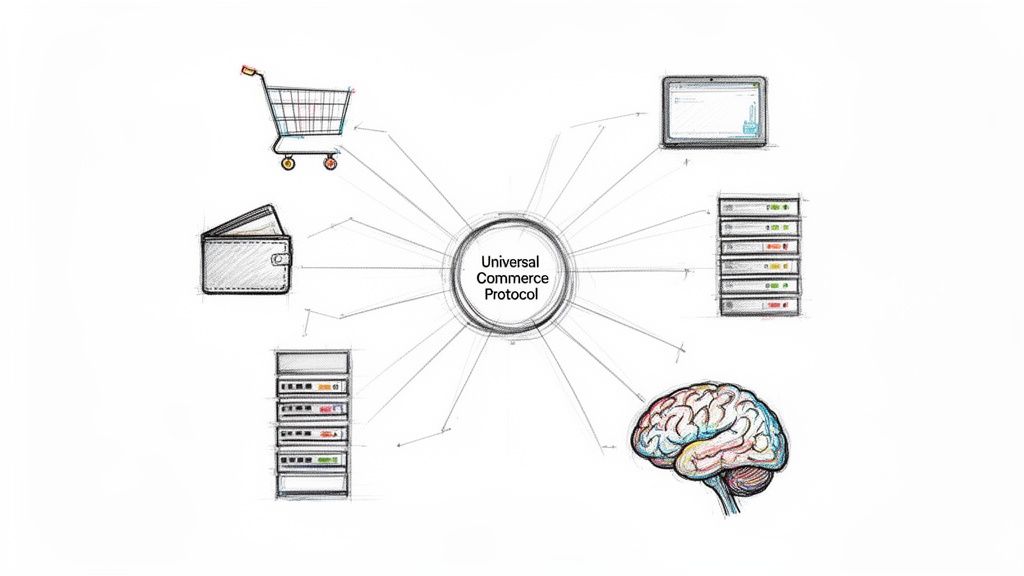
What is the Universal Commerce Protocol (UCP)? For technology leaders, it’s best understood as a universal translator for digital commerce—an open standard creating a common language that allows disparate platforms, services, and AI agents to orchestrate transactions seamlessly.
In architectural terms, UCP acts as a master adapter. Instead of building endless, fragile, and expensive custom integrations for every service—from payment processors to inventory systems—it provides a single, standardized communication layer. This isn't just another API; it's a foundational shift in how digital ecosystems are built and scaled.
Confronting the Commerce Integration Crisis
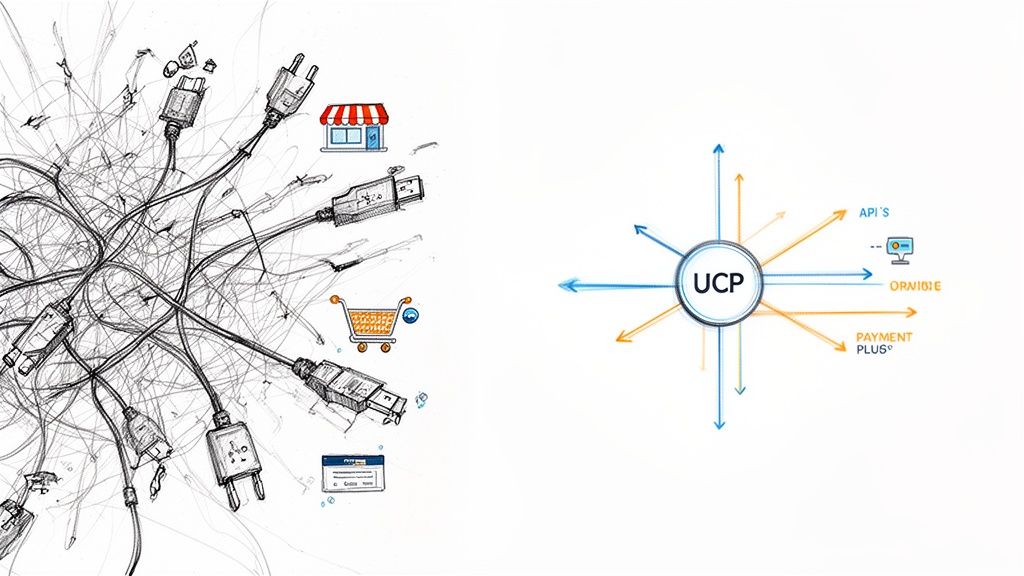
As a CTO or product leader, you're intimately familiar with the nightmare of digital commerce integration. The typical landscape is a tangled mess of brittle, point-to-point connections. Each new partner, payment gateway, or sales channel demands its own custom-built API, creating an expensive web of dependencies that stifles innovation and accumulates architectural debt.
This technical debt makes scaling a painful ordeal and reacting to market shifts impossibly slow. The common struggles involved in Payment Provider Integration exemplify this widespread crisis—a crisis that a universal protocol is designed to solve.
This fragmented model is unsustainable in an era of AI-driven commerce. We are moving toward a future where autonomous AI agents will manage complex, multi-step transactions on behalf of users, from product discovery to returns processing. Legacy, siloed architectures simply cannot support this dynamic reality.
A New Foundation for AI-Driven Commerce
The Universal Commerce Protocol is the strategic architectural answer to this complexity. It is not another piece of technology to manage but a foundational communication layer, analogous to HTTP for the web or SWIFT for banking. It establishes a standardized ecosystem where platforms and services can interact without requiring custom engineering for every connection.
This architectural paradigm shift offers significant benefits:
Drastically reduce integration complexity and the associated engineering overhead.
Accelerate time-to-market for new services and partnerships.
Enhance scalability by building on a resilient, predictable foundation.
Future-proof your platform for a world where AI-orchestrated transactions are the norm.
The real power of the Universal Commerce Protocol lies in its ability to transform a collection of isolated digital islands into a fully interconnected, interoperable continent. It unlocks the potential for frictionless, AI-led transactions that were previously architecturally unfeasible.
For organizations ready to capitalize on this opportunity, applying these principles is key. Our specialized ecommerce AI solutions are designed to help companies leverage standards like UCP to build next-generation intelligent commerce experiences. This isn't merely a technical upgrade; it’s a strategic imperative for any leader building a modern digital platform.
What Is The Universal Commerce Protocol?
The Universal Commerce Protocol (UCP) is an open standard designed to solve the chronic problem of system interoperability in digital commerce. Rather than another platform to manage, think of it as a universal translator—a shared language similar to SWIFT for global banking or HTTP for the web. UCP provides a common communication layer for an increasingly fragmented ecosystem of commerce systems, AI agents, and third-party services.
This means you can stop building and maintaining an expensive and fragile web of custom integrations for every new partner, payment gateway, or sales channel. Instead, you integrate once with the protocol, enabling your platform to communicate with any other service that also speaks UCP.
Solving The Core Problems Of Modern Commerce
UCP was engineered to address the persistent architectural challenges that stifle innovation, inflate budgets, and hinder agility.
The protocol was specifically designed to solve three primary problems:
Integration Complexity: It replaces the brittle "spaghetti architecture" of custom APIs with a single, robust standard. This dramatically slashes engineering overhead and reduces the time required to onboard new services and partners.
Siloed Data and Services: By establishing a common language, UCP dismantles the walls between systems. Critical information on inventory, orders, and payments can flow seamlessly across your entire ecosystem, from ERP to storefront.
Fractured User Journeys: It enables a consistent, unified experience for customers, regardless of where a transaction begins or ends. An AI agent can initiate a purchase on one platform and complete it through a retailer's backend, creating a frictionless flow that reduces cart abandonment.
This standardization is essential for the next wave of AI-driven commerce. As we explored in our AI adoption guide, autonomous agents require structured, predictable data to execute tasks reliably. UCP provides that foundational framework, enabling truly intelligent, automated transactions.
The protocol gained significant momentum in early 2026 after its unveiling by Google at the National Retail Federation's Big Show. Co-developed with industry leaders like Shopify, Walmart, and Target, UCP has garnered support from over 20 global companies, including payment giants Visa, Mastercard, and Stripe. More details on this industry-wide collaboration can be found on Fintool.
UCP transforms the digital marketplace from a collection of isolated islands into an interconnected ecosystem. It's the architectural key to unlocking frictionless, AI-orchestrated transactions at scale, enabling platforms to innovate together rather than integrate in isolation.
The table below summarizes the core capabilities UCP provides, standardizing key functions to create a more connected and intelligent commerce ecosystem.
Universal Commerce Protocol Core Capabilities
Capability
Functionality
Strategic Benefit for CTOs
Identity & Authentication
Standardizes how users and systems are identified and verified across platforms.
Simplifies security management and enables single sign-on experiences, reducing both risk and user friction.
Discovery & Cataloging
Defines a common format for product data, inventory, and pricing information.
Eliminates data transformation headaches and ensures product information is consistent everywhere.
Order Management
Provides a universal schema for creating, updating, and tracking orders across channels.
Radically simplifies omnichannel fulfillment and reduces errors from manual data reconciliation.
Payments & Invoicing
Creates a unified API for initiating payments, handling refunds, and generating invoices.
Allows for plug-and-play integration with any compliant payment provider, increasing flexibility.
Fulfillment & Logistics
Standardizes communication for shipping, tracking, and delivery updates.
Improves supply chain visibility and automates communication between merchants and logistics partners.
Each of these capabilities directly addresses a major source of technical debt and operational drag. Adopting this standard is not just about adding a new tool; it's about fundamentally re-architecting your platform for future growth.
The journey begins with a clear assessment of your current architecture. A thorough AI gap analysis can pinpoint where your systems stand and what steps are needed to prepare. Speaking with our expert team can provide the clarity and strategic roadmap required to navigate this transition effectively.
A Look Under the Hood: The UCP Architectural Blueprint
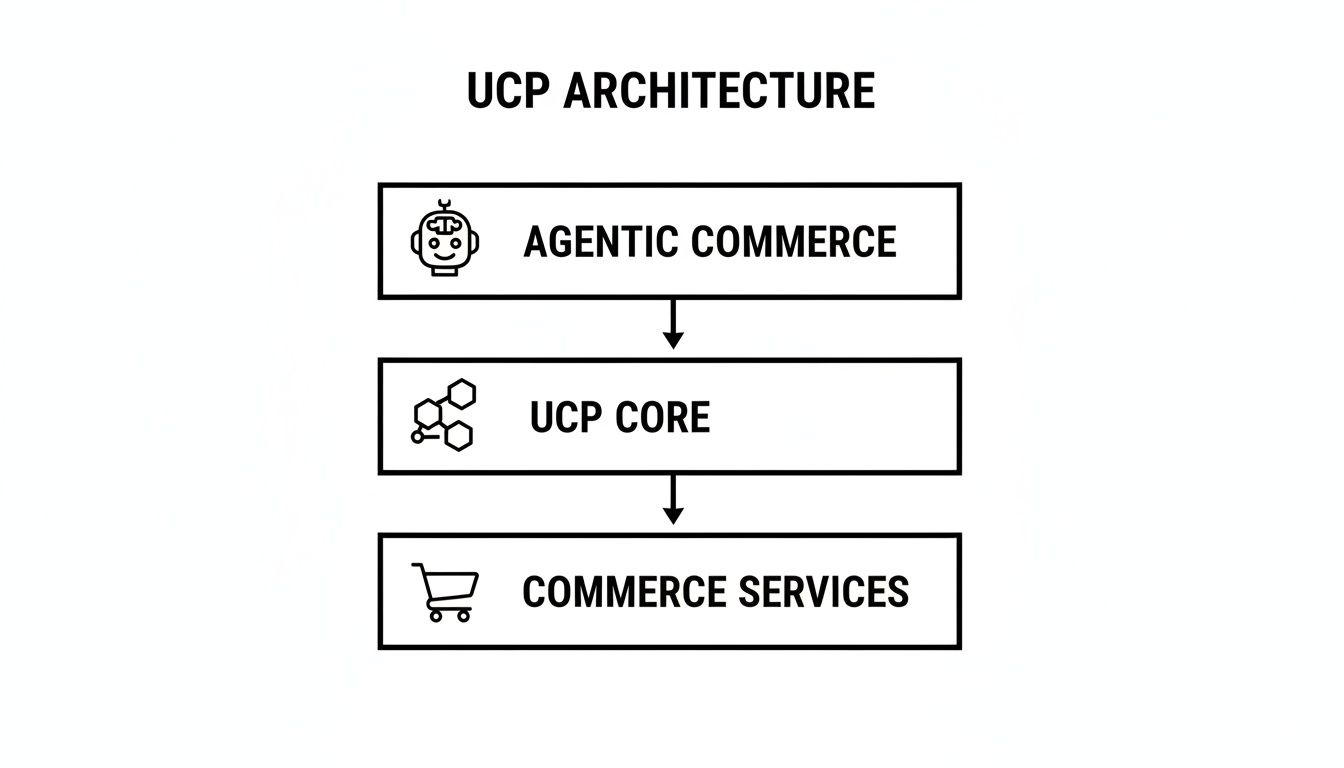
For a CTO, the value of any protocol is revealed in its architecture. The Universal Commerce Protocol (UCP) is built on a clean, layered foundation designed for security, extensibility, and reduced complexity. It organizes the fundamental components of commerce into a coherent framework, moving away from the tangled web of one-off integrations.
Architecturally, UCP functions as a universal adapter. Instead of your systems making dozens of unique API calls for payments, inventory, and shipping, they connect to one standardized protocol. This shifts the integration paradigm from a chaotic, many-to-many problem to a clean, many-to-one model, dramatically reducing engineering effort and long-term maintenance overhead.
Crucially, this design also ensures that businesses remain the Merchant of Record. You retain full control over customer relationships and data while participating in a larger, interconnected commerce network.
How It Works: Core Components and Standards
The UCP architecture is built on modern, secure, and proven standards. It establishes a common language for the entire commerce lifecycle, enabling disparate systems to communicate without friction.
Here’s a breakdown of its core components:
Product Catalogs & Inventory: UCP defines a common format for product data, pricing, and stock levels, eliminating the need for constant data mapping and translation between systems.
Order Processing: It establishes a universal schema for creating, updating, and tracking orders, simplifying everything from initial sale to returns management and creating a single source of truth.
Payments: By utilizing open wallets and standardized payment handlers, UCP allows for plug-and-play integration with various payment providers, granting architectural freedom and avoiding vendor lock-in.
Authentication & Security: The protocol leverages battle-tested standards like OAuth 2.0 for secure, token-based authentication, ensuring every transaction is authorized and all communication is encrypted.
These standardized components form the bedrock of a more agile and scalable commerce ecosystem, removing the friction that stalls partnerships and new channel launches.
Powering Agentic Commerce Transactions
The key strategic payoff of the UCP architecture is its role in enabling agentic commerce—a future where AI agents execute complex, multi-step commercial tasks for users. Imagine an AI agent discovering a product on one platform, verifying inventory on another, applying a loyalty discount from a third, and processing payment through a fourth—all in a single, fluid transaction.
UCP provides the structured communication layer that makes this possible. It is the "grammar" that allows an AI to confidently orchestrate a complex transaction, from discovery to fulfillment, across systems that were never designed to interoperate.
Without this common protocol, AI agents would be unable to reliably navigate the thousands of proprietary APIs that define today's commerce landscape. UCP creates the predictable and secure environment they need to function effectively.
Exploring real-world use cases can illuminate how this technology translates into tangible business value. Preparing for this shift begins with a clear understanding of your current state, which is precisely what a thorough AI gap analysis delivers. For expert guidance on this journey, connecting with our expert team is a valuable first step.
How UCP Translates Into Real-World Business Value
While the technical architecture of the Universal Commerce Protocol is compelling, for founders and product leaders, the critical question is its impact on the business. UCP is not merely an engineering project; it is a strategic decision that directly influences revenue, operational agility, and competitive positioning.
For years, digital commerce has been constrained by expensive, time-consuming custom integrations. UCP breaks this cycle. By establishing a common language, it enables businesses to launch new services and partnerships with unprecedented speed. Projects that once required months of custom development can now be executed in a fraction of the time, freeing your team to focus on core product innovation rather than plumbing.
Drive More Revenue by Cutting Out Friction
One of the most immediate benefits of UCP adoption is its direct impact on cart abandonment. By enabling a unified checkout experience, the protocol provides customers with a smooth, predictable path to purchase, regardless of where their journey begins—on social media, in a chatbot, or via a personal AI assistant.
The Universal Commerce Protocol was designed to combat abandoned carts by standardizing how AI agents handle critical steps like Checkout, Identity Linking, and Order Management. This creates secure, interoperable transactions that eliminate the friction causing customer drop-off. For a deeper dive into its core principles, the official documentation at ucp.dev is an excellent resource.
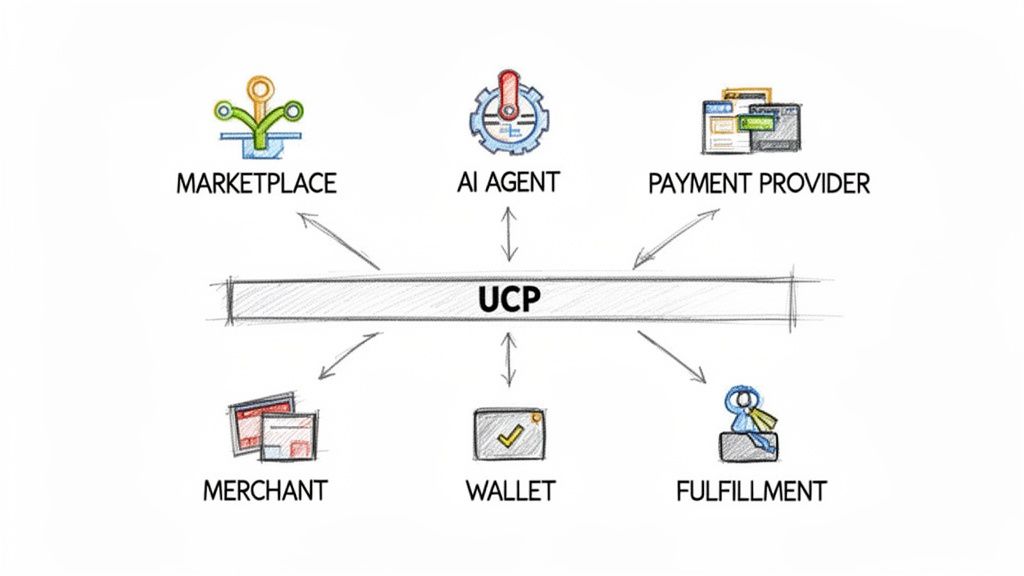
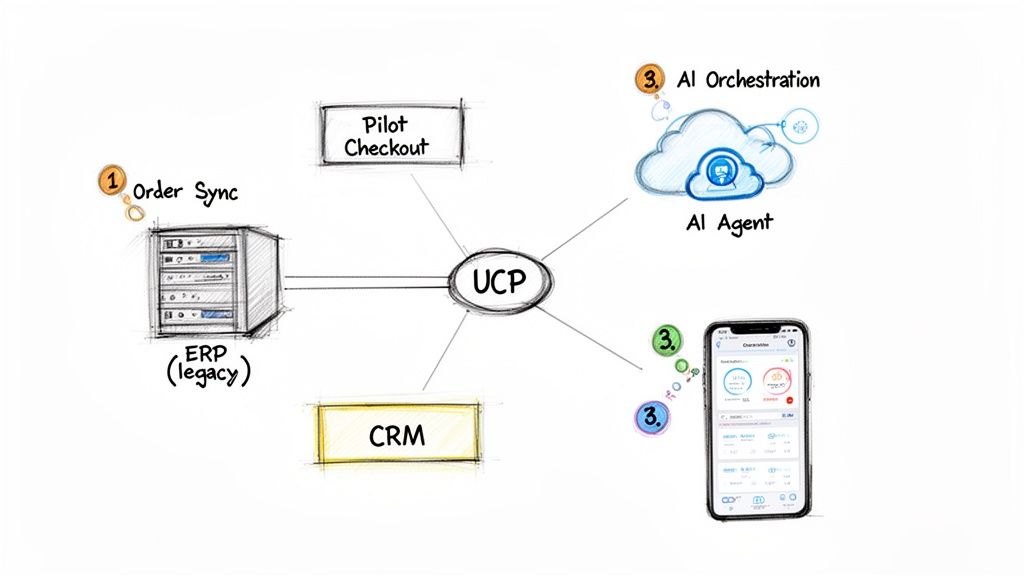
This diagram illustrates UCP's role as the central nervous system for agentic commerce. It connects AI agents to a diverse array of backend services, enabling them to coordinate complex transactions seamlessly.
Unlock Powerful Network Effects
Beyond initial cost savings and conversion improvements, the true long-term advantage of UCP lies in its network effects. The more platforms, payment gateways, and merchants that adopt the protocol, the more valuable it becomes for every participant.
Adopting the Universal Commerce Protocol is like joining a global commerce grid. Instead of building isolated power plants for each new partnership, you simply plug into a network where every connection amplifies the value of the whole.
This creates a self-reinforcing cycle of growth:
Expanded Reach: Your products and services become instantly accessible to any AI agent or platform that speaks UCP.
New Revenue Streams: Partnerships previously deemed too complex or costly become viable opportunities.
A Future-Ready Foundation: Your platform is inherently prepared for the next wave of AI-driven commerce, mitigating the risk of being left behind.
For any leadership team, adopting UCP is a clear investment in agility and scale. It transitions your business from a walled garden to a connected, influential node in a rapidly expanding digital ecosystem.
Our specialized ecommerce AI solutions help companies leverage protocols like UCP to build these next-generation experiences. The journey often begins with a thorough AI gap analysis, providing a clear roadmap to align your technology with these strategic goals. A conversation with our expert team can provide the direction needed to get started.
Integrating UCP With AI and Legacy Systems
Adopting the Universal Commerce Protocol does not require a risky, multi-million dollar overhaul of your core ERP and CRM systems. A strategic, phased integration is the prudent path, where UCP serves as a common language rather than a replacement for your foundational technology.
An AI strategy platform can act as the conductor of this integration orchestra, using UCP as its communication backbone to interact with your diverse systems. This effectively creates a translation layer between modern, AI-powered services and the legacy platforms that run your business. You can introduce new capabilities without disrupting core operations.
Phased Adoption Strategies
A "big bang" implementation is a recipe for failure. A phased rollout that targets high-impact areas first is a far more grounded approach that delivers value at each stage and builds momentum.
A unified checkout experience is an ideal starting point. It is a self-contained project that can immediately reduce cart abandonment rates and improve customer satisfaction with minimal disruption to backend systems.
Once a pilot is successful, you can expand UCP's footprint incrementally:
Next, integrate order management: Connect UCP to your fulfillment and shipping workflows to streamline omnichannel operations.
Then, unify product catalogs: Standardize how product information is shared across all channels, partners, and marketplaces.
Finally, connect inventory and logistics: Use the protocol to provide all sales channels with a real-time, accurate view of stock levels.
This iterative method minimizes risk while delivering tangible improvements at each step.
Bridging Legacy and Modern Systems
The key to integrating UCP with legacy systems is to build an abstraction layer. This layer serves as a middleware translator, mapping proprietary data formats to the standardized UCP schema. Effective data mapping is crucial, defining how a "customer record" in your legacy CRM translates to a UCP "buyer profile" or how an "invoice" from your ERP becomes a UCP "order confirmation."
Think of this abstraction layer as a diplomatic translator. It allows your legacy systems, which speak their own unique dialects, to communicate fluently with the modern, standardized world of UCP without having to learn a new language themselves.
This approach isolates your core systems, allowing them to continue performing their essential functions while participating in a modern, interconnected commerce ecosystem.
For companies seeking expert guidance, our AI Automation as a Service provides the specialized skills to manage these integrations. We help you build the necessary abstraction layers to connect your foundational technology to the UCP standard, accelerating your journey to a more agile, AI-ready architecture. This enables innovation without requiring a complete technological teardown.
Building Your Strategic Roadmap To UCP Readiness
Adopting the Universal Commerce Protocol is a fundamental business decision that requires a clear, strategic plan. It is not just another IT project but a shift in platform strategy that begins not with code, but with an honest assessment of your current architecture and operational readiness.
The first critical step is a capability gap analysis. This involves a rigorous review of your current commerce stack to identify integration bottlenecks, data silos, and sources of customer friction. A thorough gap analysis provides a data-backed understanding of your starting point and highlights where UCP can deliver the greatest immediate impact. This work forms the foundation of a comprehensive modernization strategy.
From Assessment To Action
Once your current state is clear, the next step is to develop a phased roadmap. Expert guidance can help your leadership team assess readiness, build a compelling business case, and design pilot projects with measurable outcomes. A smart roadmap always prioritizes high-value, low-risk initiatives first.
Consider these initial steps:
Define a Pilot Project: Select a manageable yet meaningful area, such as creating a unified checkout experience for a key sales channel. This contains risk while demonstrating tangible value early on.
Establish Success Metrics: Define what a "win" looks like before you begin. Are you targeting a reduction in cart abandonment, faster partner onboarding, or lower integration costs? Clear KPIs are essential.
Build the Business Case: Use data from a successful pilot to make a powerful case for a broader UCP rollout across the organization.
UCP readiness is not about achieving a perfect architecture on day one. It's about executing a clear, strategic plan that connects technology initiatives to business outcomes, transforming a daunting transition into a series of manageable wins.
Your Partner in AI-Orchestrated Commerce
Transitioning from a patchwork of disparate systems to a connected, AI-driven ecosystem requires both vision and expert guidance. The goal is to create a practical, actionable plan that aligns your technology with your core business objectives.
At Ekipa AI, we serve as a strategic partner to guide you through this transformation. We combine deep technical expertise with sound business strategy to ensure your UCP adoption is successful. If you are ready to explore how this protocol can future-proof your business, our implementation support team is here to help you get started.
Frequently Asked Questions (FAQ) for Technology Leaders
When a new standard like the Universal Commerce Protocol emerges, it naturally raises strategic questions for CTOs, founders, and product leaders. Here are answers to some of the most common inquiries.
How is UCP different from traditional API integrations?
Traditional API integration results in a brittle, point-to-point web of custom connections often referred to as "spaghetti architecture." Each new service requires another bespoke integration, creating significant maintenance overhead.
The Universal Commerce Protocol (UCP) offers a fundamentally different architectural model. It functions as a universal language for commerce. Instead of building dozens of unique connections, you build one connection to the protocol's standard. Any UCP-compliant service can then interoperate with your platform without a custom-built translator. This shifts the paradigm from managing a portfolio of fragile APIs to building on a resilient, scalable foundation, drastically reducing long-term costs and accelerating time-to-market.
What happens to my customer data? Will I remain the Merchant of Record?
Yes. UCP was designed to keep merchants in full control. You remain the Merchant of Record, and the direct relationship with your customer—along with all associated data—stays with you. The protocol standardizes the transaction flow, not data ownership.
UCP leverages secure, proven standards like OAuth 2.0 to manage permissions. Customer data is not pooled or centralized; it is exchanged on a per-transaction basis with proper authentication. You gain the benefits of a connected network without ceding control over your most valuable asset: your customer relationships.
What are the first steps to get ready for UCP?
A strategic approach will ensure a smoother transition and faster realization of benefits.
Architectural Audit: Begin with an honest assessment of your current commerce architecture. Identify integration bottlenecks and key pain points. A thorough AI gap analysis is the best way to accelerate this discovery process.
Team Alignment: Socialize the shift toward a standardized, API-first model with your engineering and product teams. Frame it as a strategic move toward building flexible, modular services.
Define a Pilot Project: Select a high-impact, low-risk project to start, such as standardizing the checkout flow with a key partner. A small win builds momentum and provides a powerful business case for wider adoption.
Partnering with an AI strategy consulting firm can help transform these steps into a detailed readiness report and a practical implementation roadmap.
Is UCP only for large enterprises?
No. While industry giants are leading adoption, UCP is designed for businesses of all sizes. For startups and mid-market companies, the protocol can be a great equalizer. It eliminates the need for large engineering teams to build and maintain custom integrations with every major payment or logistics partner. By plugging into the UCP standard, smaller companies can offer the kind of seamless, intelligent experiences that were once the exclusive domain of tech giants, democratizing access to powerful commerce capabilities.
At Ekipa AI, we help leaders build the strategic bridge from their current architecture to a future of AI-orchestrated commerce. If you're ready to assess your readiness and define a clear path forward, start by getting your Custom AI Strategy report to map out your next steps with the guidance of our expert team.
Measuring AI success goes beyond productivity metrics. Learn how organizations can evaluate AI ROI by tracking real business impact, including cost savings, revenue growth, and improved decision-making.
AI is transforming manufacturing with smart factories that optimize efficiency, reduce costs, and pave the way for the next era of intelligent production.