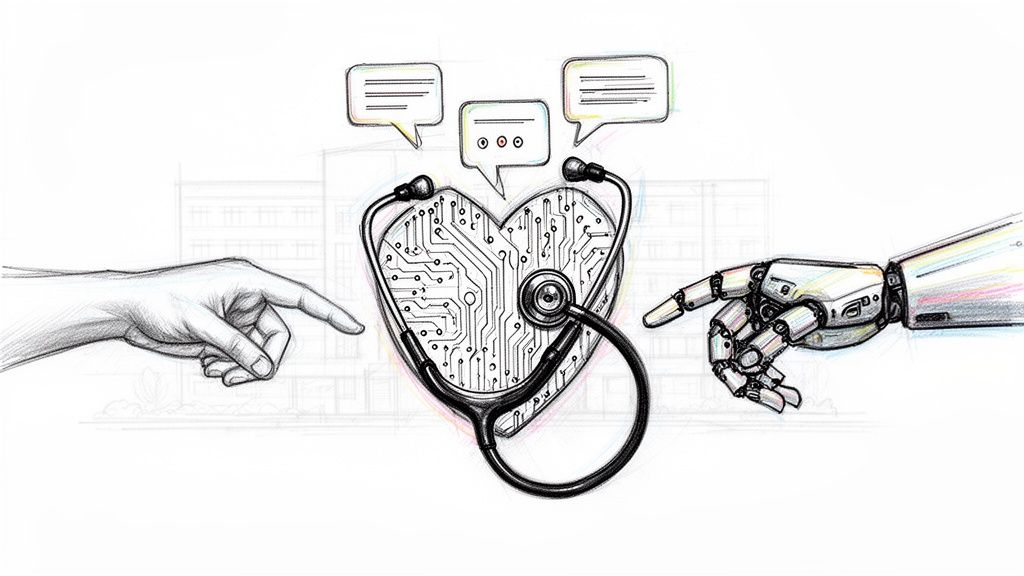
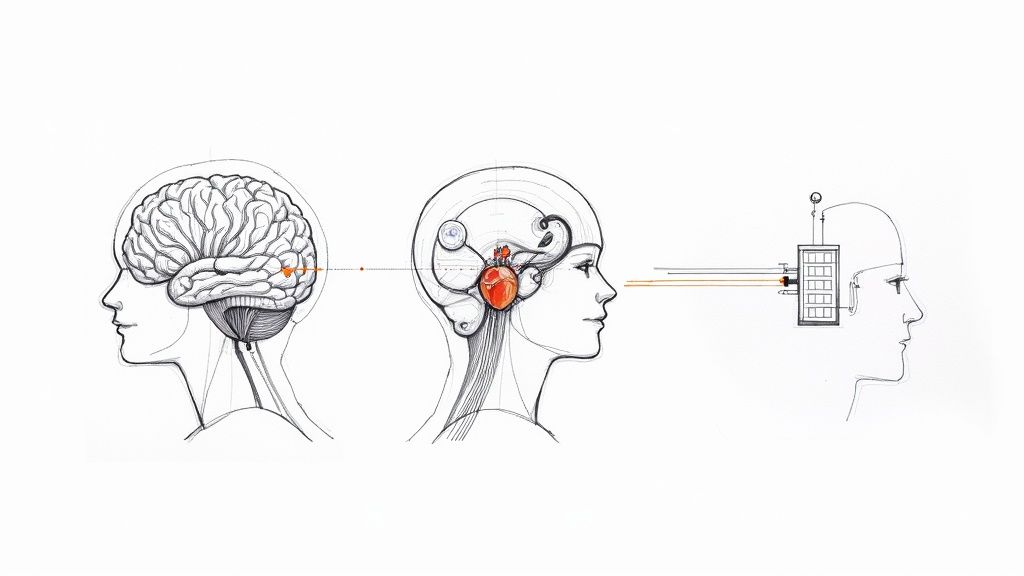
Think about a front desk that’s always on, never has a bad day, and can field thousands of patient questions at once. That’s not science fiction; it’s the reality being created by AI chatbots for healthcare support. These smart assistants are completely changing how patients connect with their doctors and clinics, often serving as the very first touchpoint for everything from scheduling a visit to getting answers after a procedure.
The New Digital Front Door in Patient Care

We live in an on-demand world, and patients now expect the same instant, easy access from their healthcare providers. The old way of doing things—endless phone trees and long waits at the front desk—just doesn't cut it anymore. It leads to overwhelmed staff and frustrated patients. AI chatbots are designed to fix this problem, acting as a tireless digital front door that’s always open for business.
These aren't your basic, pre-programmed responders. They are sophisticated tools built to understand and handle patient needs with real efficiency. By taking over routine administrative work and providing instant answers to common questions, they give clinical staff their time back to focus on what they do best: providing high-quality care. The availability of tools like a free AI assistant is a perfect example of how this technology is becoming the first, crucial step in a modern patient's healthcare interaction.
A Strategic Imperative for Modern Healthcare
For any healthcare organization looking to stay relevant, adopting AI chatbots isn't just a "nice-to-have" feature—it's a strategic must. This technology is a cornerstone of the digital shift happening across the industry, born from the need to work smarter, keep patients engaged, and ultimately improve outcomes. A chatbot that offers a smooth, responsive first impression sets a positive tone for the entire patient journey. You can explore more about this trend in our insights on the healthcare industry's digital evolution.
A well-designed chatbot does more than just spit out information. It builds trust and loyalty by being there with reliable support right when a patient needs it, day or night. That constant availability can directly boost patient satisfaction and even help them stick to their treatment plans.
The business argument for bringing AI chatbots into the fold is crystal clear. Organizations that get on board are better equipped to:
- Reduce administrative workload: By automating tasks like appointment scheduling and answering billing questions, the pressure on front-office staff drops significantly.
- Enhance patient access: Offering 24/7 support means patients aren't limited by office hours, making care far more accessible and convenient.
- Boost operational efficiency: Chatbots can manage a huge volume of simple interactions, which lets human teams work more effectively on complex issues.
In the end, integrating AI chatbots for healthcare support is about redesigning the patient experience to meet modern expectations. It’s about making healthcare more responsive, personal, and efficient for everyone involved.
How AI Chatbots Understand Clinical Needs
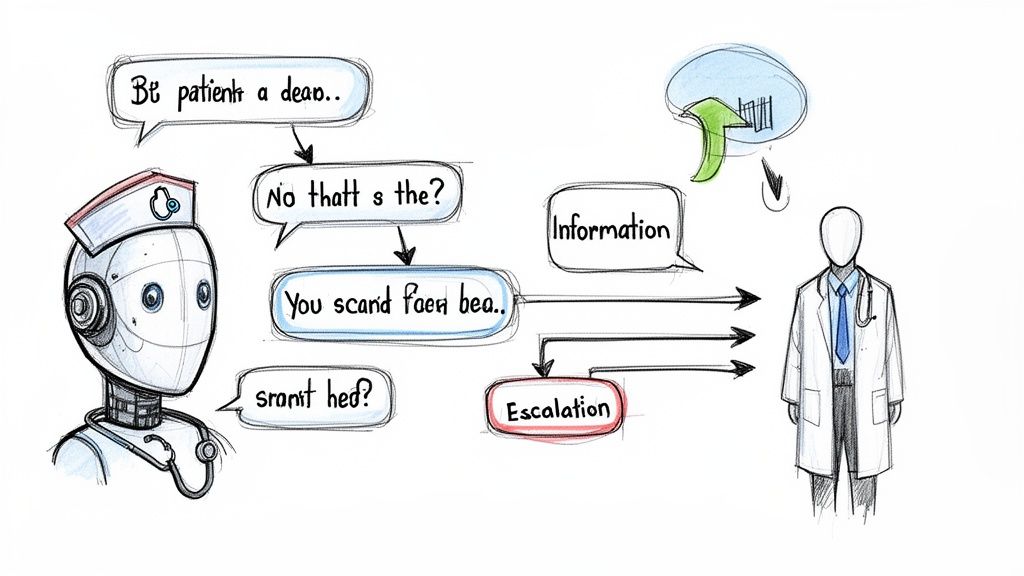
So, what separates a genuinely helpful healthcare chatbot from a glorified FAQ page? It’s the ability to grasp what a patient is really saying, much like an experienced triage nurse hears the concern behind the words. This is where simple, rule-based bots fall short and advanced conversational AI shines.
A rule-based chatbot operates like a frustrating phone tree. It follows a rigid script, and the moment a patient asks something in a slightly different way, the system grinds to a halt. In stark contrast, modern AI solutions are built to interpret intent, understand context, and even pick up on sentiment.
The engine behind this capability is Natural Language Processing (NLP). You can think of NLP as the chatbot's "brain." It's what allows the technology to read, decipher, and make sense of human language in a way that is both meaningful and clinically aware. NLP is the magic that moves a bot from just matching keywords to actual comprehension.
The Power of Conversational AI
Conversational AI takes it a step further. It’s not just about understanding a single question; it's about sustaining a real dialogue. This is what allows a chatbot to ask smart follow-up questions and remember what was said earlier in the chat—absolutely crucial for something like a symptom assessment where context is everything.
The business impact is impossible to ignore. By early 2025, 85% of healthcare organizations were already seeing significant ROI from generative AI tools like chatbots. This isn't just a trend; it's a fundamental shift, with healthcare adopting enterprise AI at 2.2 times the rate of the general economy. You can discover more insights on these AI adoption statistics.
A critical feature of any responsibly designed chatbot is knowing when to stop. The best systems are programmed to recognize keywords or scenarios that signal a potential emergency, immediately escalating the conversation to a human.
This "human-in-the-loop" approach is a cornerstone of safe and effective AI. It’s also a central focus of our AI strategy consulting. You get the scale and efficiency of automation, but you never lose the irreplaceable judgment of a clinical professional.
Blending AI Efficiency with Human Oversight
This hybrid model is the key to success. It frees up your teams to focus on complex cases by letting the AI handle the high volume of routine inquiries. The result is a system that feels both incredibly efficient and deeply empathetic.
Getting this right requires a deliberate strategy built on a few core technologies working in concert:
- Natural Language Processing (NLP): Deciphers what patients are asking, even with slang, typos, or unique phrasing.
- Machine Learning (ML): Allows the bot to learn from every single interaction, constantly getting smarter and more accurate over time.
- Escalation Protocols: A set of clear, pre-defined rules that ensure conversations involving urgent symptoms or sensitive topics are seamlessly handed off to a live person.
Building this kind of sophisticated logic isn’t about just plugging in generic AI tools for business. It demands a deep understanding of clinical workflows and patient safety. That’s why a thorough AI requirements analysis is the essential first step—it ensures the final solution truly serves your clinicians and patients.
How AI Chatbots Boost Both Efficiency and Patient Care
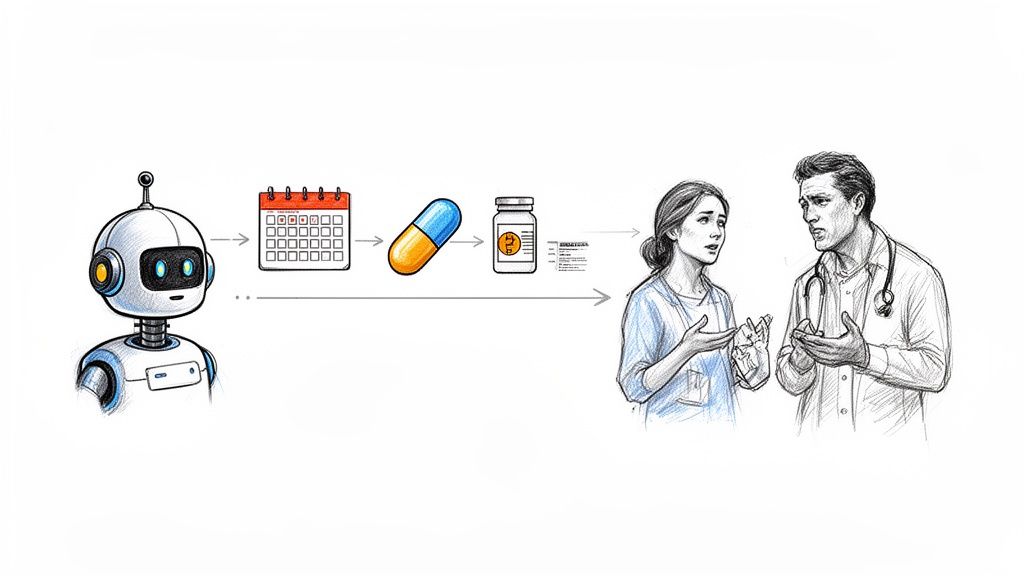
AI chatbots in healthcare are doing something quite remarkable: they’re improving both the patient journey and the behind-the-scenes workflows at the same time. Think of them as tireless digital assistants, expertly handling the constant juggling act between operational smoothness and genuine patient satisfaction. This dual impact is precisely what makes them so valuable for any modern health provider.
On the operational side, these bots take over a massive amount of the administrative grind that ties up your skilled staff. This immediately frees people to focus their expertise on complex patient needs, rather than getting stuck in a cycle of repetitive tasks.
For patients, these tools offer constant, reliable support. Getting instant answers helps them feel more confident, stick to their care plans, and ultimately, achieve better health outcomes.
The value here splits neatly into two key areas: making the clinic run better and making the patient feel better. Let's look at how they differ.
The table below breaks down the two primary categories where AI chatbots are making a real difference in healthcare today.
Clinical vs Operational Use Cases for Healthcare Chatbots
| Use Case Category |
Specific Application |
Primary Benefit |
| Clinical Support |
Personalized medication and appointment reminders. |
Improved patient adherence and reduced no-shows. |
| Operational Efficiency |
24/7 automated appointment booking and rescheduling. |
Reduced administrative workload and optimized clinic schedules. |
| Clinical Support |
Answering common, non-urgent health questions with vetted info. |
Immediate patient reassurance and fewer unnecessary calls. |
| Operational Efficiency |
Handling routine billing and insurance coverage queries. |
Lowered call volume to billing staff and faster query resolution. |
| Clinical Support |
Automated post-discharge follow-up and symptom tracking. |
Proactive patient monitoring and early issue detection. |
| Operational Efficiency |
Processing standard prescription refill requests. |
A faster, more streamlined workflow for both patients and staff. |
As you can see, the applications target distinct—but equally important—goals. One side is all about direct patient interaction and support, while the other is focused on unburdening your staff so they can do their best work.
Making Clinic Operations Run Smoother
An AI chatbot can be a genuine force multiplier for your administrative team. By taking on routine inquiries and processes, it creates a ripple effect of efficiency across the entire organization.
Here are a few of the most common ways they help out:
- Appointment Management: Patients can book, change, or cancel appointments anytime, day or night. This simple change reduces no-shows and helps keep the schedule full without anyone having to pick up the phone.
- Billing and Insurance Questions: The chatbot can instantly answer the most frequent questions about invoices, payment methods, and insurance coverage. This dramatically cuts the number of calls flooding your billing department.
- Prescription Refill Requests: It can handle routine refill requests by verifying patient details and sending the request directly to the pharmacy, taking a multi-step process off your team’s plate.
The growth in this space has been explosive. Having already surpassed $1 billion, the global healthcare chatbot market is on track to exceed $10 billion in the next decade. This isn't just hype; it's a direct response from tech-savvy patients who expect instant answers and from clinics struggling to keep up with administrative demands.
Creating a Better Patient Journey
While a smoother-running clinic is a huge win, the impact on the patient experience is just as powerful. When done right, a chatbot becomes a trusted, go-to resource that builds a stronger, more continuous connection between the patient and your practice.
A chatbot’s ability to provide instant, personalized information at any hour makes patients feel seen and supported. It removes the friction of waiting for office hours, empowering them to take a more active role in their own care.
Here’s where chatbots really shine from the patient’s perspective:
- Personalized Reminders: They can send timely nudges for medications, upcoming appointments, or pre-op instructions, which is incredibly helpful for keeping patients on track.
- 24/7 Health Information: By answering common, non-urgent health questions with clinically approved information, they offer immediate peace of mind and cut down on anxious phone calls.
- Post-Discharge Follow-Up: Chatbots can automatically check in with patients after a procedure, ask how they’re recovering, and gather feedback—all without requiring manual effort from your team.
For more specialized practices, tools like our Clinic AI Assistant can be set up to manage these interactions with a high degree of personalization. It can handle everything from getting a new patient onboarded to sending follow-up care reminders, ensuring a consistent and supportive experience that builds real loyalty.
Navigating HIPAA Compliance and Data Privacy
When you bring new technology into healthcare, security and patient trust have to lead the way. Innovation is exciting, but it can never come at the expense of privacy. For any healthcare leader looking at AI chatbots for healthcare support, the first and most important question is always about compliance.
The Health Insurance Portability and Accountability Act (HIPAA) isn’t just a best practice; it's the law. It sets strict, non-negotiable rules for how patient data is protected, and an AI system is held to the same high standard as any other part of your IT infrastructure.
If a chatbot is going to handle Protected Health Information (PHI), every single component of that system must be designed for security from the very beginning. This isn't a feature you can bolt on later; it must be embedded in the core architecture. A detailed AI requirements analysis is the essential first step to ensure your solution is built on a compliant foundation.
The Pillars of a HIPAA-Compliant Chatbot
So, what does it actually take to make an AI chatbot HIPAA-compliant? It comes down to a specific set of technical and procedural safeguards that protect sensitive patient data at every turn. Think of it as building a digital fortress around each patient conversation.
A genuinely compliant chatbot isn't built on a single feature but on several layers of security working in concert:
- End-to-End Encryption: All data must be scrambled and unreadable, whether it's sitting in a database ("at rest") or moving between the user and your servers ("in transit").
- Strict Access Controls: Not everyone in your organization should have access to PHI. Role-based access ensures that only specific, authorized individuals can view patient data, and even then, only the minimum necessary to do their jobs.
- Secure Data Storage: PHI has to be stored in a certified HIPAA-compliant environment. This could be a secure on-premise server or a cloud provider that will sign a Business Associate Agreement (BAA).
- Comprehensive Audit Trails: Every action involving PHI must be logged. The system needs to create a permanent record of who accessed what data, when they did it, and what they did with it. This is absolutely critical for accountability and incident investigation.
Choosing a Security-Focused Technology Partner
Your chatbot vendor isn't just selling you software. They become a business associate and a steward of your patients' most sensitive information. This means choosing a partner who deeply understands and prioritizes these security demands is non-negotiable. Whether you're evaluating vendors for internal tooling or for a patient-facing system, you have to ask for hard evidence of their security measures.
In healthcare, a data breach isn't just a technical problem. It's a fundamental violation of patient trust with devastating legal and reputational fallout. The cost of a breach is always far greater than the cost of building security in from the start.
This is where looking beyond HIPAA itself can give you a clearer picture of a vendor's commitment. For a good overview of what robust data protection looks like, this SOC 2 Compliance Guide is a great resource. Certifications like SOC 2 prove a company has implemented and maintains strong controls over its information systems.
Ultimately, a successful AI program in healthcare rests on a foundation of trust. It’s about showing patients, clinicians, and regulators that you're using powerful AI solutions not just effectively, but also responsibly. That’s why security must be a central pillar of your AI strategy consulting from day one.
Your Strategic Roadmap for Chatbot Implementation
Let's be honest: moving from a great idea for a chatbot to a fully deployed, valuable tool is a journey. If you just jump in without a map, you risk wasting time and money on a project that doesn't deliver. This is about being strategic. Think of it as a step-by-step blueprint for successfully launching an AI chatbot for healthcare support.
The first, and most important, part of this journey has nothing to do with technology. It’s all about strategy. Before a single line of code is written, you need to be crystal clear on what a “win” looks like. That means setting specific goals and identifying the key performance indicators (KPIs) you’ll use to track your chatbot’s real-world impact on everything from operational load to patient satisfaction. Getting this part right ensures your investment solves actual problems in your organization.
Define Your Objectives and Select the Right Use Case
First things first: what specific problem are you trying to solve? Are your front-desk staff drowning in administrative tasks? Do you need a better way to help patients stick to their medication plans? Or is the goal to offer immediate support for patients after they’ve been discharged?
Once you’ve nailed down the core objective, you can pick a high-impact use case to get started. Some of the smartest places to begin are:
- Automated Appointment Scheduling: This is a huge win. It frees up your team from the phone and lets patients book an appointment whenever it's convenient for them, even at 2 AM.
- Prescription Refill Management: Takes a common, often repetitive, task off the plates of both your patients and clinical staff.
- Answering FAQs: Your chatbot can become the go-to source for routine questions about clinic hours, parking, or insurance, handling a massive volume of inquiries instantly.
Starting with a focused pilot project is almost always the right move. A successful pilot demonstrates the value of the technology fast, which helps build momentum and support internally. You also learn invaluable lessons before committing to a larger, more complicated rollout. This is the exact philosophy behind our AI Product Development Workflow—we believe in iterative progress fueled by real data.
Choose Your Vendor and Plan for Integration
With a clear use case in hand, it's time to find the right technology partner. This decision is about much more than just a list of features or the price tag. You need a vendor who genuinely gets healthcare and understands that security and compliance are non-negotiable. Your partner must be absolutely committed to protecting patient data.
Integration is the other big piece of this puzzle. A chatbot that exists in its own little world is of limited use. To be truly effective, it has to connect seamlessly with your core systems, especially your Electronic Health Record (EHR) and patient portal. This is what allows the chatbot to do meaningful work, like booking an appointment directly into a doctor's calendar or checking a patient's prescription history.
This infographic breaks down the essential pillars of a compliant AI system—things you absolutely must consider when planning your tech and choosing a partner.
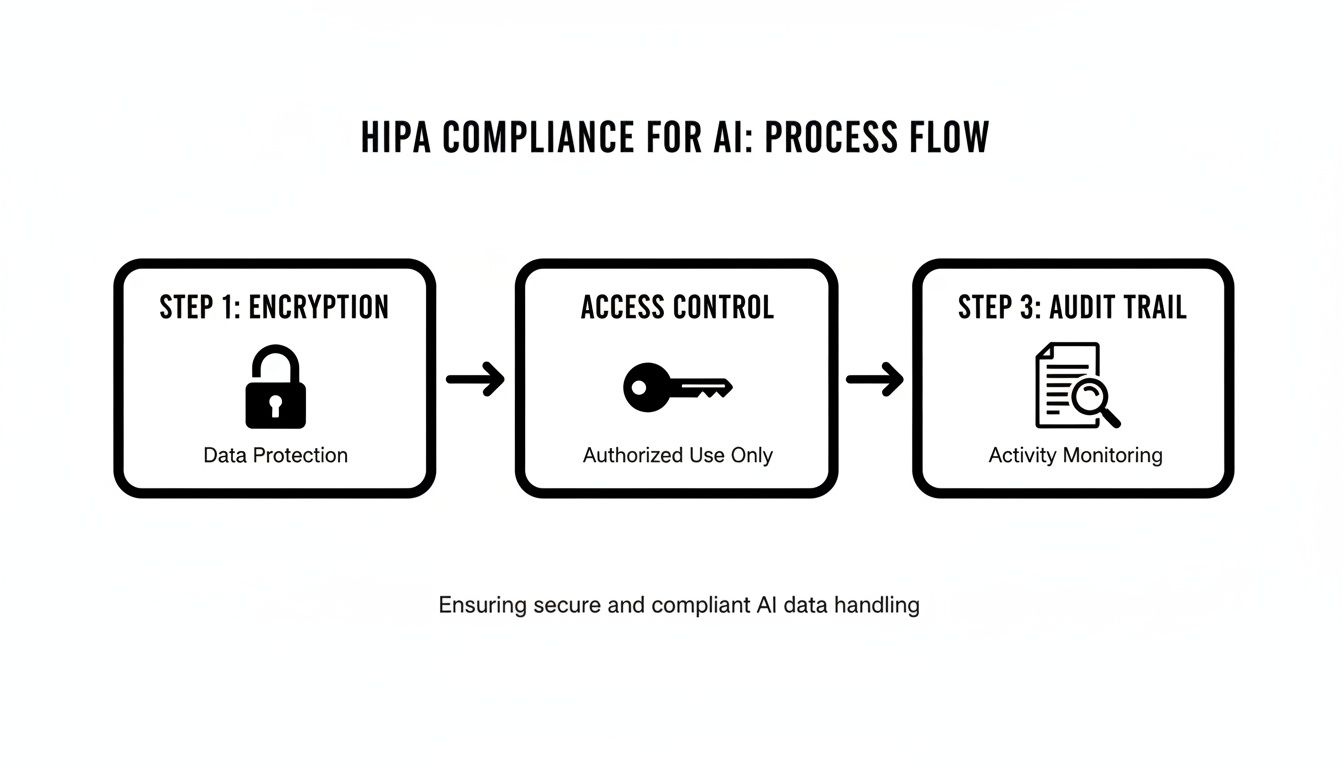
As you can see, critical security layers like encryption, access controls, and detailed audit trails aren't optional extras; they have to be baked into any AI solution that touches patient data from day one.
Pilot, Launch, and Scale
Once you have your plan, your use case, and your partner, you're ready to start the pilot. This is where you test-drive the chatbot with a small, controlled group of users. Their feedback is gold. It will help you find bugs, smooth out the user experience, and make sure the final product is genuinely helpful for both patients and staff.
The goal of a pilot isn't perfection; it's learning. Use this phase to understand how real users interact with the chatbot and make necessary adjustments before a full-scale launch.
After a solid pilot, you can move forward with a wider launch. But the job isn't done. You have to keep a close eye on your KPIs to prove the chatbot's value and spot opportunities to make it even better. As you collect more data and demonstrate a clear ROI, you can start scaling the solution to other departments and tackling new use cases. This phased, strategic approach is what turns a chatbot project into a lasting, successful asset for your organization.
Measuring Success and Calculating ROI
So, how do you prove your new AI chatbot is more than just a shiny new toy and is actually pulling its weight? To make the case for investing in AI chatbots for healthcare support, you need a solid framework for measuring what "success" really looks like. It all comes down to tracking the right numbers to calculate a real-world return on investment (ROI).
Measuring a chatbot's impact isn’t about a single magic number. It's about painting a full picture of how it's improving things across your entire organization. A well-executed chatbot should deliver clear wins in three key areas: how your operations run, how patients interact with you, and even in the care they receive. This big-picture view is what builds a business case that gets everyone on board.
Key Performance Indicators for Success
To measure success, you have to track specific Key Performance Indicators (KPIs) that connect directly back to the goals you set in the first place. When you group these metrics by category, it becomes much clearer where the chatbot is making the biggest splash. The idea is to swap out vague claims for hard data.
Here’s what you should be keeping an eye on:
- Operational Efficiency: These KPIs show how the chatbot is saving precious time and resources. Think reduced call volume to your front desk, less staff time spent on repetitive questions, and a lower overall cost for each patient interaction.
- Patient Engagement: This is all about how patients are actually using and reacting to the chatbot. You’ll want to track the number of active users, patient satisfaction scores (CSAT), and how often they successfully complete a task, like booking an appointment without human help.
- Clinical Outcomes: This can be trickier to measure, but you can track metrics that point to better health outcomes. For instance, you can look for improved medication adherence rates thanks to automated reminders or a drop in no-shows for follow-up appointments.
The most powerful argument combines these metrics into one cohesive story. Imagine being able to say: "Our chatbot cut front-desk calls by 30%, saving the team 20 hours a week, all while earning a 92% patient satisfaction score." That’s a win-win-win.
Measuring performance isn't a one-and-done task; it's an ongoing process to understand and optimize the value your AI chatbot delivers. The table below outlines the core metrics that will help you build a comprehensive view of its impact.
Key Performance Indicators for Healthcare Chatbot Success
A summary of the essential metrics to track across operational, patient engagement, and clinical categories to effectively measure the impact and ROI of an AI chatbot.
| KPI Category |
Metric Example |
What It Measures |
| Operational |
Reduced Call Volume |
The decrease in incoming calls to administrative or clinical staff handled by the chatbot. |
| Operational |
Cost Per Interaction |
The total cost of the chatbot divided by the number of interactions, compared to human agent costs. |
| Operational |
Staff Time Saved |
The number of hours administrative staff save by automating routine tasks like appointment booking. |
| Patient Engagement |
Active User Count |
The number of unique patients interacting with the chatbot over a specific period (e.g., daily, monthly). |
| Patient Engagement |
Task Completion Rate |
The percentage of users who successfully complete a goal (e.g., booking an appointment, refilling a prescription). |
| Patient Engagement |
Patient Satisfaction (CSAT) |
Patient-reported satisfaction scores collected through post-interaction surveys. |
| Clinical |
Appointment No-Show Rate |
The reduction in missed appointments due to automated reminders and easy rescheduling. |
| Clinical |
Medication Adherence |
The percentage of patients who confirm taking medication after receiving a reminder from the chatbot. |
Tracking these KPIs provides the raw data you need to tell a compelling story about your chatbot's value and justify continued investment.
Calculating a Tangible Return on Investment
Once you have this data in hand, you can start calculating a concrete ROI. The first step is to put a dollar amount on the operational savings. A simple way to start is by calculating the total hours your staff saved and multiplying that by their average hourly wage. That’s your direct cost savings right there.
Next, you need to assign a value to better patient engagement. This is a bit less direct, but you can connect it to things like a lower patient churn rate or the revenue from a filled appointment slot that would have otherwise been a costly no-show.
Add these financial benefits together, then subtract what the chatbot cost you—including the initial setup, software, and any ongoing maintenance. This is how you move from performance metrics to a real success story. It’s a discipline we build into every Custom AI Strategy report we create, making sure our clients can clearly show the value they’re getting from their investment in advanced AI solutions.
Your Questions, Answered
Let's tackle some of the common questions that come up when leaders start thinking about AI chatbots for healthcare support. We'll cut straight to the point on patient adoption, technical headaches, and what these bots can really do, so you have the clarity to make your next move.
How Do We Get Patients to Actually Use a Chatbot?
Trust is everything. The first step is to be completely upfront—always introduce the chatbot as an AI assistant and make it incredibly easy to reach a human with a single click. Start by having the chatbot handle simple, high-value tasks that patients already understand, like scheduling an appointment or requesting a prescription refill.
When patients have a good first experience, their confidence grows. The secret is consistency. A chatbot that delivers accurate, helpful information every time, drawing from a solid clinical knowledge base, will earn that trust. We build this careful design into every project, and you can get more details from our expert team.
What's the Toughest Part of Connecting a Chatbot to Our EHR?
Getting it to talk to your EHR system securely and smoothly is the biggest hurdle. EHRs often run on older, complicated systems, which makes pulling and pushing data in real-time a real challenge. The solution is to build a secure "translator" layer—often called middleware—that uses standard healthcare data protocols like HL7 and FHIR.
This ensures the chatbot can perform actions like booking an appointment directly into the EHR without messing up the data or breaking HIPAA rules. It’s a specialized job that demands serious expertise in both AI and healthcare IT, which is why working with a seasoned team on custom healthcare software development is non-negotiable.
Can These Chatbots Give a Medical Diagnosis?
No, and they absolutely shouldn't. It's crucial to design AI chatbots for healthcare support to steer clear of offering any medical diagnosis or treatment advice. Their job is to manage administrative work, share pre-approved educational content, and route questions to the right human expert.
A smart chatbot is programmed to instantly recognize red-flag words like "chest pain" and immediately guide the user to call emergency services or connect with a live person. Its goal is to free up your clinical team by handling the routine stuff, not to step in for their medical expertise.
How Long Until We Deploy a Chatbot and See a Return?
You can get a pilot program up and running for a specific task, like appointment booking, in about 8-12 weeks. A full-scale rollout that’s deeply integrated with your EHR is more likely to take 6-9 months.
You'll start seeing early wins, like fewer administrative phone calls, within the first 6 months. The bigger payoff—things like higher staff morale and better patient outcomes—usually starts to become obvious around the 12-18 month mark. As we explored in our AI adoption guide, the quickest path to ROI is starting with a focused strategy and a high-impact use case.
Ready to see how AI can reshape your patient experience and streamline operations? Ekipa AI provides the strategy and hands-on support to make it happen. Let's find out how our AI solutions can create real value for your organization. Contact our expert team to get started.
Explore Our AI Solutions