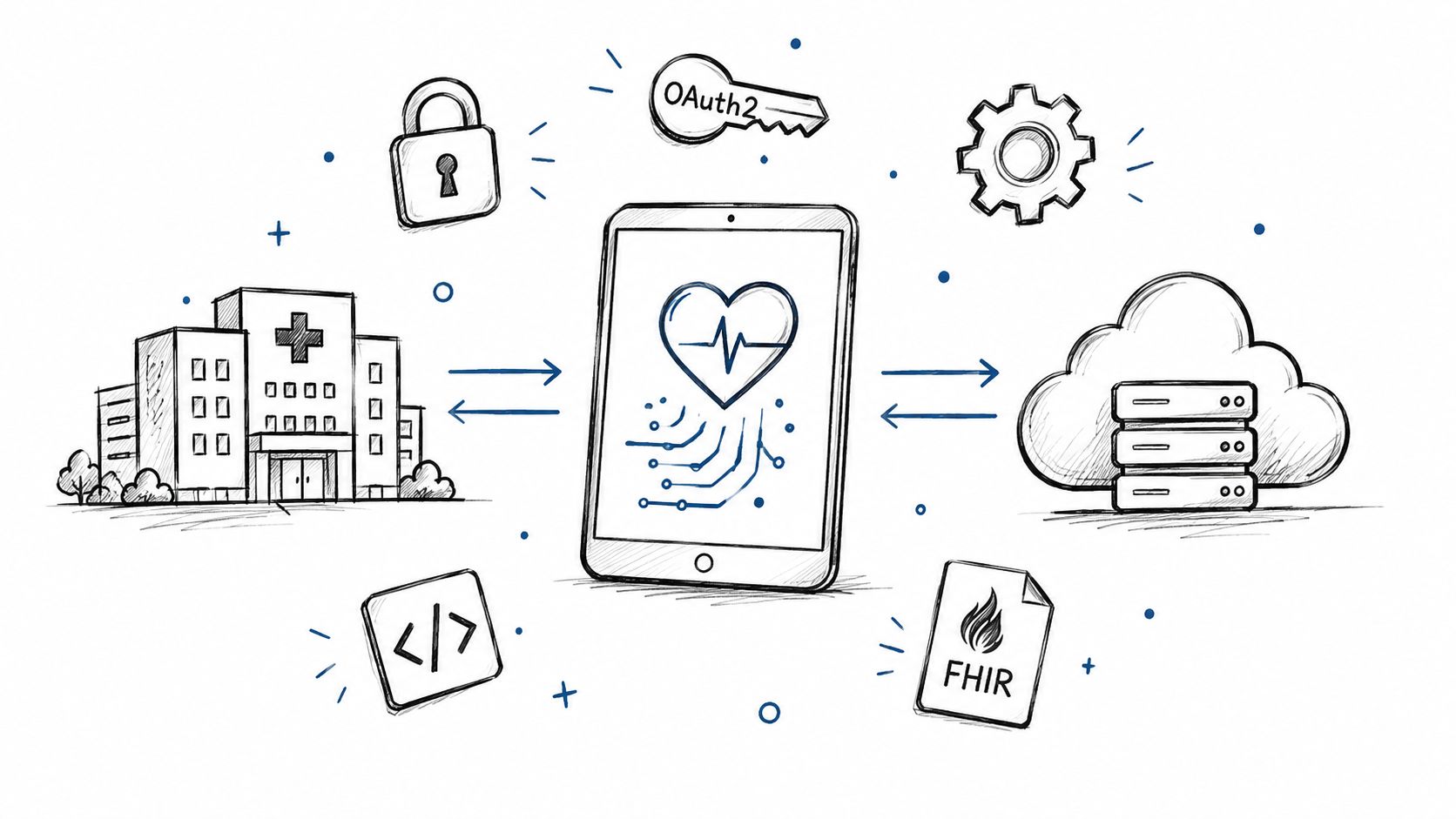
AI in Healthcare
Smart on FHIR: What It Is and How It Works in Practice
Smart on FHIR guide for healthtech engineers. Learn the OAuth 2.0 launch model, scope syntax, backend services, and US regulatory requirements.
October 14, 2026Read more
Discover how AI-driven healthtech workflow management transforms clinical efficiency. Our guide covers strategy, ROI, implementation, and scaling.

AI-powered workflow management is changing the game in healthtech. It's about using intelligent automation to handle the endless administrative and clinical tasks that bog down healthcare systems. We're not talking about replacing human experts, but rather giving them a strategic co-pilot to fight clinician burnout and operational gridlock. The goal is to offload the repetitive work, from the moment a patient checks in to the final bill being paid.
Let's be honest, healthcare is stretched to its breaking point. The pressures are immense. Administrative tasks are piling up, clinicians are burning out at an alarming rate, and patient loads just keep growing. The old way of doing things—relying on legacy software and manual processes—simply can't keep up anymore. This is why AI-driven workflow management has shifted from a "nice-to-have" novelty to an absolute necessity.
The forces driving this change are impossible to ignore. Doctors and nurses are drowning in paperwork and EHR data entry, often spending more time on a keyboard than with their patients. At the same time, staffing shortages are hitting every corner of the industry, forcing organizations to figure out how to get more done with fewer people.
Automation is the only realistic way forward. And to be clear, this isn't about replacing your skilled professionals; it's about empowering them. Think of AI as a co-pilot that helps navigate everything from tedious patient scheduling to the complexities of revenue cycle management. To really grasp this shift, it's helpful to see how an AI BI transformation in healthcare analytics makes operations more intelligent.
By integrating directly into EHRs and other core systems, AI is completely changing how clinical documentation works. It can listen to, transcribe, and structure clinical notes in real-time, letting physicians give their full attention to the person in front of them. You can learn more about our dedicated work in our Healthcare AI Services.
The real magic of AI here is its ability to take on the mind-numbing, repetitive tasks that eat up a clinician's day. This frees up their mental energy for what they were actually trained to do: think critically, show empathy, and make complex medical decisions.
This isn't just a feeling; the numbers tell the same story. The global market for AI in clinical workflows was valued at $2.08 billion in 2024 and is set to hit $2.78 billion in 2025. Even more impressively, projections show it soaring to $11.08 billion by 2030, which is a compound annual growth rate of 31.9%. This kind of growth doesn't happen unless there's a massive, industry-wide need being met.
That explosive growth highlights a simple fact: for any forward-thinking healthcare leader, AI workflow automation is now a critical investment. The organizations jumping on this aren't just chasing efficiency. They're building stronger, more responsive, and more financially sound operations that can actually handle the demands of modern healthcare. The question has moved past if you should adopt AI—it's now about how quickly you can get it working for your teams and your patients.
Jumping into AI-driven healthtech workflow management without a solid plan is a fast track to frustration, wasted budgets, and tools nobody uses. I’ve seen it happen. To make a real difference, you need a clear roadmap that takes you from a promising idea to a solution that genuinely improves care and efficiency.
The best place to start? Go for the quick wins. Look for those high-impact, low-complexity use cases—the "low-hanging fruit." Think about automating the soul-crushing process of prior authorization submissions or using AI to generate the first draft of a clinical note. These early victories do more than just improve a single workflow; they build momentum and create internal champions who see the value and advocate for broader adoption. Our guide on real-world use cases can help you identify these opportunities.
With a few promising use cases in hand, it’s time to dig into the details. This is where you map out your data needs, figure out how a new tool will talk to your existing EHR and patient portals, and—most importantly—navigate the maze of healthcare compliance. You can't afford to treat security and privacy as an afterthought.
A tailored strategy from the get-go is invaluable. You're not just buying a piece of software; you're fundamentally changing how people work. Getting a clear, prioritized list of opportunities upfront with a Custom AI Strategy report can shave months off your decision-making process and focus your efforts where they'll matter most.
This is where you can start to visualize AI as a co-pilot, not a replacement. It's an assistant that augments human expertise at every step.

As you can see, when AI is woven through the entire patient journey—from scheduling to billing—the benefits start to compound. An efficiency gain in one department creates a positive ripple effect in the next, leading to a much smoother system for both staff and patients.
Of course, all of this needs to be built on a foundation of compliant healthcare application development. Getting this right from day one is non-negotiable and saves you from massive headaches down the road.
Forget the "big bang" launch. In my experience, that approach is almost always a disaster. It’s too disruptive and the risks are too high. A phased execution, on the other hand, lets you learn and adjust as you go.
Start with small, controlled pilot projects focused on those initial use cases you identified. A pilot gives you a safe space to test your ideas, collect real feedback from users, and fine-tune the solution without breaking your core clinical operations.
A pilot's success isn't measured by its perfection, but by what you learn. It's your low-risk opportunity to see if your assumptions about workflow, data, and user adoption hold up in the real world.
To keep these iterative cycles on track, you need a disciplined process. Following a structured AI Product Development Workflow brings order to the chaos, helping you manage timelines, resources, and expectations from the first prototype to a full-scale deployment.
By proving value on a small scale and then scaling intelligently, you build a powerful AI-driven system that does more than just boost efficiency. It frees up your clinicians to do what they do best: provide outstanding care. A good roadmap gets you to your destination, but a great one helps you build a resilient, adaptable foundation for whatever comes next.
Let's be honest, every new initiative comes down to one question: what’s the return? It’s great to talk about efficiency, but you need to see that show up on the bottom line. So, let's move past the theory and talk about how to measure the real-world value of AI-driven healthtech workflow management.
The most direct impact you'll see is on your team's time—your most expensive and valuable resource. We're not talking about a few minutes saved here and there. Recent studies show automation can give back 13% to 21% of a nurse's time each year. I've also seen AI documentation tools cut a physician's paperwork burden by a solid 20%. These aren't just hypotheticals; you can dig into the financial returns of AI in healthcare on kissflow.com for more data.
When you start multiplying those time savings across an entire clinic or hospital system, the numbers get big, fast. Reclaiming thousands of staff hours every month isn't a pipe dream; it's a direct outcome of automating the right workflows.
But this isn't just about cutting costs. It’s about reinvesting that time where it truly counts.
This is exactly where a service like AI Automation as a Service can make a difference, helping you turn those theoretical time savings into measurable improvements on the floor.

The ROI of AI goes far beyond the clock. It has a massive impact on your organization's financial health by bringing a new level of accuracy to administrative processes. Think about medical billing and coding—a workflow infamous for human error that leads directly to claim denials, lost revenue, and endless rework.
By automating these tasks, AI doesn't just reduce errors; it practically eliminates them. The result is cleaner claims, faster reimbursement cycles, and a much healthier bottom line. In fact, one analysis of an AI-powered radiology platform found a staggering 451% return on investment over five years.
Numbers like that change the conversation entirely. It’s no longer a question of "can we afford to do this?" but rather, "can we afford not to?" These powerful AI tools for business are no longer a luxury; they’re becoming a necessity for staying competitive.
To get the green light from leadership, you need to tell a clear story backed by data. Don't try to boil the ocean. Pick one specific, high-pain area to start. For example, calculate the total cost of claim denials from the last fiscal year, or tally up the hours your team spends on manual prior authorizations each week.
Once you have that baseline, you can project the potential savings using established benchmarks for Healthcare AI Services. Frame your proposal not as an expenditure, but as a strategic investment in financial stability and operational excellence.
Key Metrics to Track for Your ROI Calculation:
By zeroing in on these concrete numbers, you can build an undeniable case for AI-driven workflows. The data speaks for itself: the organizations that thrive will be the ones that learn to measure and maximize their return on AI.
An incredible AI model is just a science project without the right data, solid integrations, and airtight compliance. When you're building AI-driven healthtech workflow management, these aren't just boxes to check—they are the entire foundation of your project. Get them right from day one, or you’ll be rebuilding from scratch later.
Let's be blunt: your AI is only as good as the data it eats. We're not just talking about having a lot of data; we need clean, high-quality, and contextually relevant information. Your models will only be as reliable as the datasets they’re trained on, which means getting serious about data preparation—cleaning it, structuring it, and labeling it correctly.
This isn’t glamorous work, but it’s critical. In fact, some studies show that up to 70% of software defects can be traced right back to poor data quality. It's often why bringing in a skilled HealthTech engineering partner early on can save you a world of pain, ensuring your data foundation is rock-solid before a single line of model code is written.

Once you have a clean, reliable data stream, the next question is: where does it flow? This is where integration becomes the make-or-break challenge. Your brilliant new AI tool can't operate in a vacuum. It has to talk to everything else you’re already using, especially those legacy Electronic Health Record (EHR) systems. This is where so many projects hit a wall.
Grappling with older, often clunky, internal tooling and connecting it to modern AI is a massive technical lift. It demands real expertise in APIs, data mapping, and workflow orchestration to get information moving securely between systems without bringing clinical operations to a screeching halt.
The real win with integration isn't just making two systems exchange data. It's about creating a single, unified workflow where the AI feels like a natural part of the tools your team already depends on.
This is particularly true for specialized SaMD solutions, which have to integrate flawlessly into the wider clinical ecosystem to be truly useful. If you need to pull structured information from disparate sources, our guide on the AI-powered data extraction engine is a great resource. This tough integration work is a core component of any successful custom healthcare software development initiative.
Finally, there’s compliance. This isn't a suggestion; it’s a rigid, high-stakes requirement. In healthcare, protecting patient data is the law. Regulations like the Health Insurance Portability and Accountability Act (HIPAA) come with staggering penalties for getting it wrong, making compliance an absolute, non-negotiable priority.
Every single touchpoint in your AI workflow—from data ingestion to the final output—has to be built with privacy and security in mind from the very beginning. This includes:
We call this a "privacy by design" approach. You can't just slap compliance on at the end; it has to be woven into the very fabric of your project from the first meeting. Navigating this regulatory maze takes specialized knowledge and is another strong argument for working with a partner who lives and breathes healthtech compliance.
Juggling data quality, system integration, and strict regulations is undoubtedly complex, but it's entirely achievable with the right strategy. It just takes careful planning, deep technical expertise, and a genuine understanding of the healthcare world. By tackling these three pillars head-on, you're not just building an AI tool—you're building a safe, secure, and sustainable asset for your organization. This kind of strategic groundwork is a key part of our AI strategy consulting, where we help teams build this robust framework for long-term success.
So, your AI pilot was a success. That's a huge win, but it's really just the first step. The true measure of your AI strategy isn't a single successful project; it’s whether you can scale those isolated wins into a new, enterprise-wide way of operating.
Making that leap from a promising experiment to a core part of your healthtech infrastructure is all about people. Real change isn't about rolling out more software—it's about fundamentally shifting how your organization works. This puts change management front and center. You can't just mandate adoption; you have to win over clinicians and staff by showing them, in no uncertain terms, how this new tool makes their day-to-day work better.
Moving beyond a pilot means changing your perspective. You're no longer just trying to prove a concept; you're building a foundational capability for the entire organization. Your initial project gave you some great data and, hopefully, a few passionate internal champions. Now, it's time to formalize that success and make it repeatable.
To do that, you need a solid framework that covers a few key areas:
As we’ve explored in our AI adoption guide, user-centric design is everything. If a tool isn’t intuitive and doesn't slot right into existing clinical workflows, it will be ignored, no matter how powerful the tech behind it is.
To scale effectively, you need more than just a nod from the C-suite. You need genuine enthusiasm from the people on the ground. Clinicians are, quite rightly, skeptical of any new technology that promises to make their lives easier but often just adds more administrative burden.
The secret to getting their buy-in is to focus entirely on the "What's In It For Me?" (WIIFM) factor. Show them the AI tool cuts their documentation time by three hours a week, and they'll listen. Show them it gets rid of after-hours charting, and you’ll have a new advocate for life.
The market is moving too fast to ignore this. The global healthcare AI market is set to explode from $32.34 billion in 2024 to an incredible $431 billion by 2032. This isn't just hype; it's a fundamental industry shift. In fact, 57% of healthcare organizations see automating administrative tasks as their biggest AI opportunity. You can find more on AI adoption trends at ventionteams.com to see just how urgent this is. Staying ahead requires ongoing AI strategy consulting to navigate this new terrain.
AI is never a "set it and forget it" tool. Models drift, performance needs constant monitoring, and workflows must be refined based on real-world feedback from your users. Scaling successfully means building a culture that not only accepts but embraces this cycle of iteration.
This is where having the right Key Performance Indicators (KPIs) becomes critical. You have to look beyond a simple ROI calculation and track metrics that show both operational and human value:
This feedback loop is your engine for growth. It tells you what’s working, what’s not, and where your next big optimization opportunity is hiding. It's what turns your organization from a passive user of AI into an active partner in its evolution.
Making this journey—from a single successful pilot to an AI-powered operating model across the entire organization—is no small feat. It demands a mix of deep technical skill, strategic vision, and a genuine understanding of clinical realities. This is exactly where a dedicated partner can be invaluable. Guiding this kind of transformation is the challenge our expert team is built to solve, ensuring your efforts to scale deliver a real, lasting impact.
AI-driven workflow management uses artificial intelligence to automate, streamline, and optimize administrative and clinical processes in healthcare. Instead of manual data entry, scheduling, and billing, AI systems handle these tasks intelligently. This reduces errors, frees up staff time, and allows healthcare professionals to focus on patient care. Common examples include automated clinical note generation, AI-assisted medical coding, and intelligent patient scheduling.
Start with a "low-hanging fruit" project: a high-impact, low-complexity workflow that is causing significant pain. Good candidates are often prior authorization submissions, appointment reminder systems, or summarizing patient intake forms. A successful pilot in a specific area builds momentum and proves the value of AI, making it easier to gain buy-in for larger projects. This initial discovery is a key part of our AI strategy consulting.
Adoption hinges on user-centric design and demonstrating clear value. Involve clinicians in the selection and implementation process from day one to ensure the tool fits their actual workflow. The AI should feel like a seamless "co-pilot," not another system to manage. Focus on the "What's In It For Me?" (WIIFM) factor by highlighting how the tool reduces administrative burden, eliminates after-hours charting, and gives them more time with patients.
The three biggest risks are data privacy, regulatory compliance (especially HIPAA), and model accuracy. To mitigate these, you must:
Measure ROI by tracking both quantitative and qualitative metrics.
Smart on FHIR guide for healthtech engineers. Learn the OAuth 2.0 launch model, scope syntax, backend services, and US regulatory requirements.
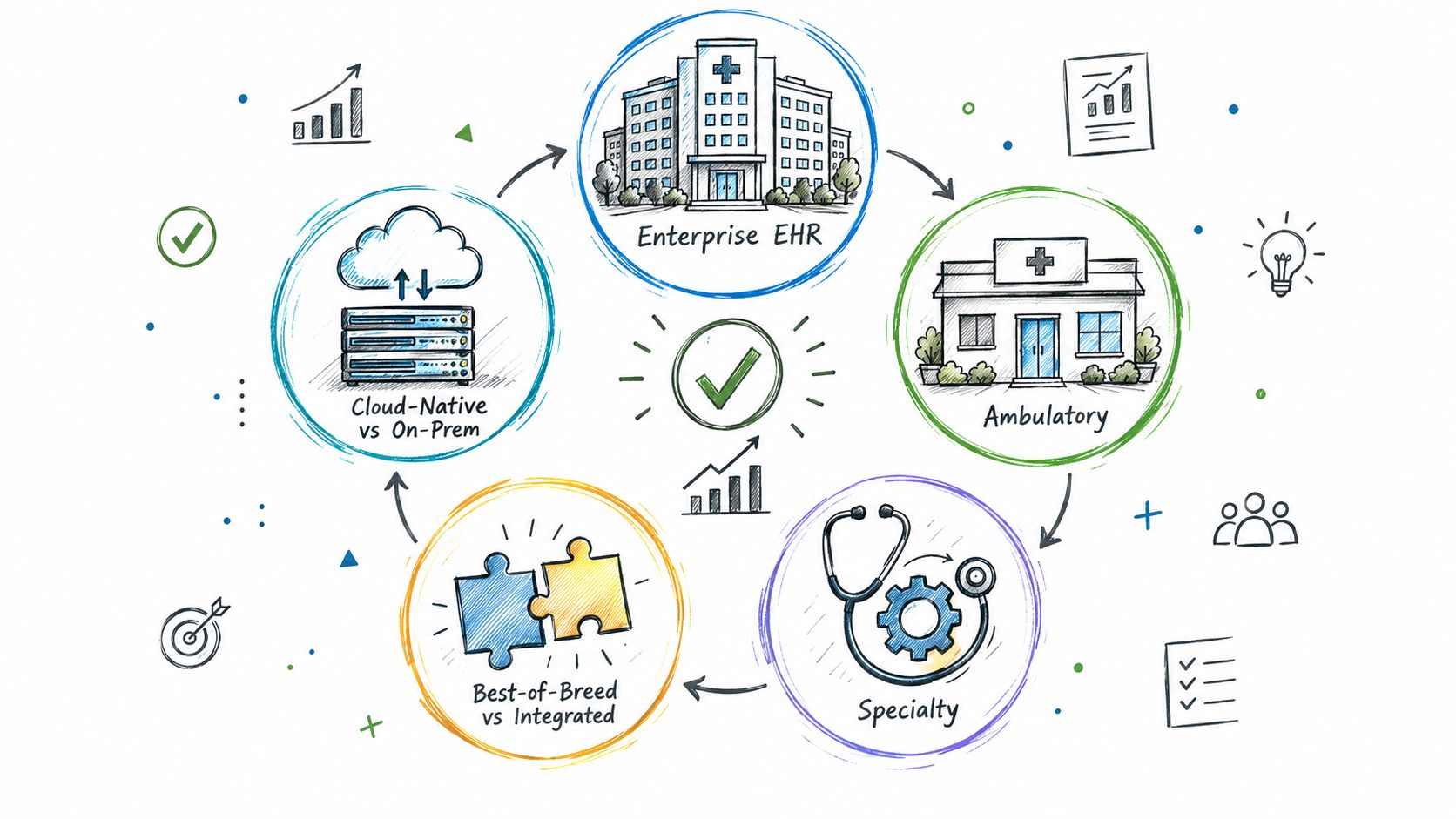
Explore the types of EHR systems by deployment model, care setting and scope. Compare integration options, trade-offs and selection tips for healthtech teams.
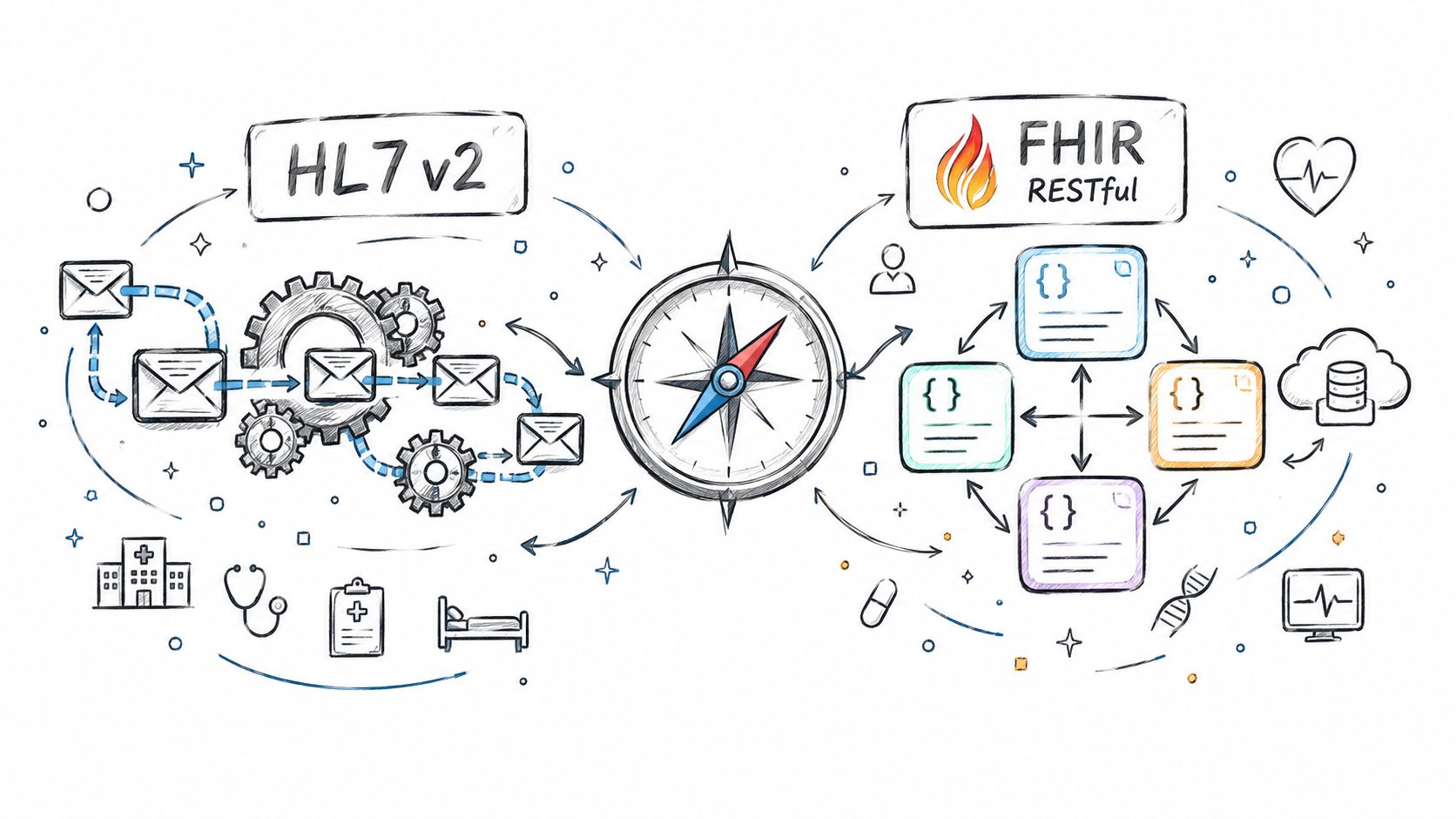
Compare Fhir vs. hl7 standards for healthtech integration. See how HL7 v2 and FHIR differ in use, mechanics, regulation, and real-world architecture.
Connect with our team to explore how AI expertise can transform your business.