AI in Healthcare
HIPAA-Compliant AI: How to Use LLMs With PHI Safely
How to build HIPAA-compliant AI: when LLM providers need a BAA, data minimization, de-identification, audit controls and a reference architecture.
October 16, 2026Read more
Explore AI driven transformation in healthcare enterprises with this guide on strategy, applications, and implementation for unlocking strategic value.
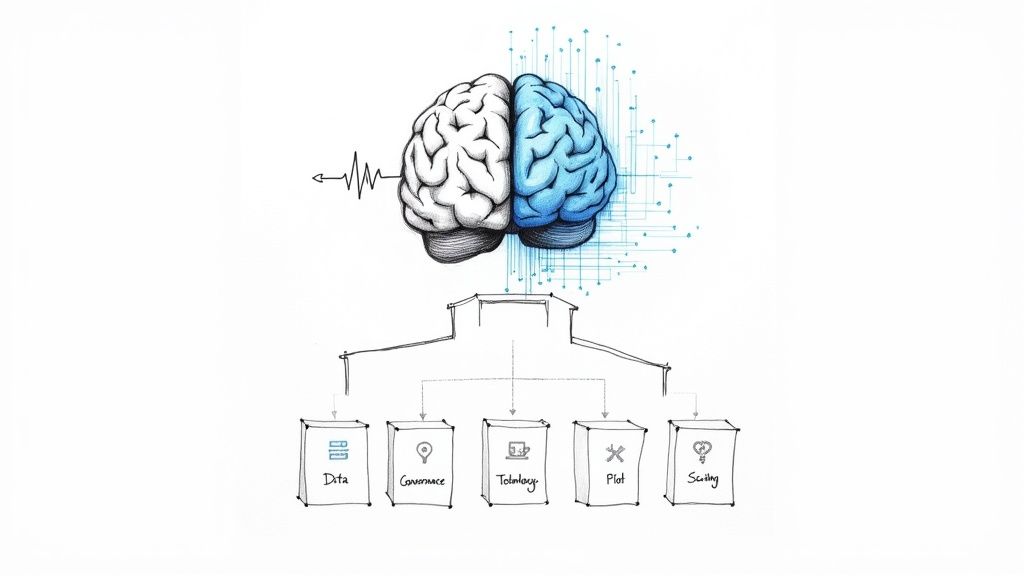
When you look at the future of healthcare, it’s impossible to ignore the massive changes already underway. AI-driven transformation in healthcare enterprises isn't just about adding new software; it's a deep, fundamental shift where artificial intelligence becomes woven into the very fabric of clinical and operational work. This guide cuts through the noise to show you what this really means for the industry.
For decades, healthcare has run on manual processes and disconnected data systems. Think of it like navigating a new city with a folded paper map. You'll probably get where you're going, but it's slow, you might make a wrong turn, and you have no idea what traffic looks like ahead.
An AI-driven transformation in healthcare enterprises is the equivalent of switching to a live, intelligent GPS. It doesn't just give you a static route; it analyzes real-time data to predict traffic jams, suggests better paths, and even points out interesting spots you didn’t know existed.
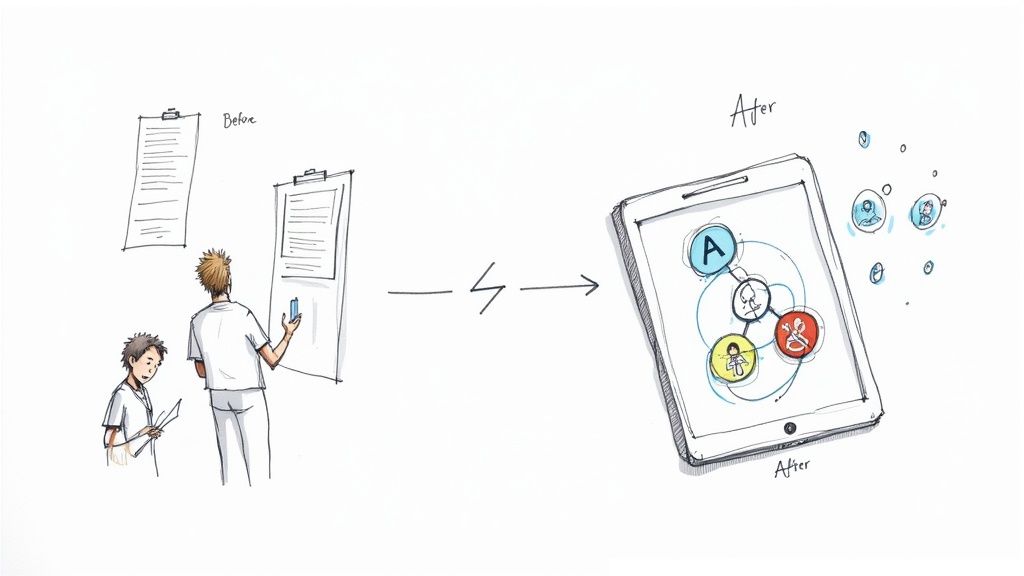
The point isn't to replace doctors or nurses. It's to give them superpowers. The idea is to build a system where technology takes on the repetitive, data-heavy lifting, which frees up skilled professionals to do what they do best: focus on nuanced patient care and critical thinking. The ultimate goal is a healthcare ecosystem that's more predictive, personal, and profoundly more effective.
At its heart, this shift touches every part of a healthcare organization. It’s a complete overhaul of operations and culture, all driven by data and smart algorithms. The key pillars of this new reality are:
For a deeper look at what's happening across the board, this Artificial Intelligence (AI) in Healthcare: A Practical Guide offers a great overview of the practical applications taking shape.
This is much more than a simple tech upgrade—it's a strategic necessity. The healthcare organizations that get this right will be able to provide better care more affordably, giving them a real edge. As we’ve seen in our work, applying AI in the healthcare industry is the key to unlocking better performance and happier patients.
Starting this journey requires a clear, focused vision. It’s not enough to run a few scattered pilot projects. Success demands a unified, enterprise-wide strategy. This guide will break down the strategies and real-world applications that are making this incredible change happen.
The current surge of AI in healthcare isn't an overnight phenomenon. It’s the result of several powerful forces finally coming together at the right time. For years, the industry has been busy digitizing records and gathering data. Now, that massive digital wellspring is ready to be used.
This shift is really being driven by three key factors. First, we have an explosion of health data from electronic medical records (EMRs), medical imaging, and even personal wearable devices. Second, the raw computing power available today is incredible, allowing us to process all that data at speeds we could only dream of a decade ago. Finally, the AI algorithms themselves have grown incredibly sophisticated, capable of finding subtle patterns in complex data that humans would easily miss.
This convergence of data, power, and algorithms is creating real-world value in three distinct areas, fundamentally reshaping how healthcare organizations operate. Grasping these pillars makes it clear why this isn't just hype—it's an urgent priority.
Clinical Value: This is all about better patient outcomes. AI can analyze medical scans with a level of accuracy that complements a radiologist's expertise, helping spot diseases earlier. Predictive models can flag patients at high risk for conditions like sepsis, giving clinical teams a crucial head start. It’s a fundamental move from reactive to proactive medicine.
Operational Value: Here’s where the efficiency gains really shine. By automating tedious administrative work like billing, coding, and scheduling, AI frees up your team's most valuable asset: their time. Our AI Automation as a Service is built to do exactly that—tackle operational bottlenecks, cut costs, and let your staff get back to focusing on patients.
Research Value: AI is turbocharging medical innovation. Instead of taking years, AI can analyze enormous datasets to speed up drug discovery, pinpoint the best candidates for clinical trials, and uncover new treatment pathways. It collapses research timelines from decades to months.
And this isn't just a future-looking trend; it's happening right now. A recent survey of over 600 healthcare professionals revealed that 63% are already using AI in their daily operations, with another 31% actively running pilots. This momentum, which is moving faster than in many other industries, is heavily focused on data analytics (58%), generative AI (54%), and large language models (53%). This tells us the industry is moving beyond simple automation and into sophisticated applications like diagnostics and drug discovery. You can explore more on these trends in the healthcare and life sciences insights on rsisecurity.com.
"The shift isn't just about adopting new tools. It's about building a more resilient, efficient, and patient-centric healthcare system from the ground up."
To truly understand what the AI-driven transformation in healthcare enterprises looks like on the ground, it helps to compare the old way of doing things with the new reality. The table below puts this into perspective, showing the practical impact of AI across key hospital functions. It’s a clear picture of the move from reactive problem-solving to proactive, data-informed strategy.
| Healthcare Function | Traditional Approach (Before AI) | AI-Driven Approach (After AI) |
|---|---|---|
| Medical Diagnostics | Relies solely on clinician interpretation of images and reports, which can be time-consuming and prone to human error. | AI algorithms analyze scans in seconds, highlighting potential anomalies for radiologists to review, improving speed and accuracy. |
| Hospital Operations | Manual staff scheduling, patient flow management, and resource allocation often lead to long wait times and inefficient bed usage. | Predictive analytics forecast patient admission rates and optimize staff schedules and bed assignments, reducing bottlenecks. |
| Patient Treatment | Standardized treatment protocols are applied broadly based on general patient populations. | Personalized treatment plans are developed using a patient's genetic data, lifestyle, and specific biomarkers for better outcomes. |
| Drug Discovery | Researchers manually analyze compounds and conduct lengthy trials, a process that can take over a decade and cost billions. | AI models analyze biological data to predict the efficacy of potential drugs, identifying promising candidates in months, not years. |
As you can see, these AI solutions aren't just making incremental improvements. They are fundamentally rewiring the core processes of healthcare delivery, leading to a system that is smarter, faster, and far more attuned to the needs of each patient.
You really start to see what AI-driven transformation in healthcare means when you look past the buzzwords and at the tools being used right now. We're not talking about far-off theories; we're talking about practical applications that are fundamentally changing a clinician's day-to-day work and a patient's treatment journey. These are the engines turning mountains of data into better health outcomes.
The most effective AI solutions don't try to replace human experts. Instead, they act as a force multiplier. Think of it as a second set of eyes for a radiologist, a tireless assistant for a busy doctor, or a data-savvy partner for a medical researcher.
Let's dive into the core applications making a real difference today.
Medical imaging—like X-rays, CT scans, and MRIs—produces a staggering amount of visual information. Analyzing these images demands intense focus and years of expertise. Today, AI, particularly computer vision, has become an indispensable ally in this field.
AI models trained on millions of medical scans can spot subtle patterns and tiny anomalies that might otherwise be missed. They can flag a potential tumor, highlight the faint, early signs of a neurological disorder, or pinpoint a hairline fracture with incredible speed. This doesn't take the final decision away from the clinician. What it does is brilliant: it prioritizes their workload, directing their attention to the most urgent cases. The result is earlier diagnoses and faster treatment. Much of this progress comes from expert custom healthcare software development that seamlessly integrates these smart algorithms into existing hospital systems.
One of the biggest shifts in modern medicine is the move from being reactive to proactive. Instead of just treating people after they get sick, we can now use predictive analytics to identify individuals at high risk for serious health events before they happen.
Here are a few powerful examples:
We've compiled a whole collection of these applications in our library of real-world use cases.
Physician burnout is a massive problem, and one of the biggest drivers is the crushing weight of administrative tasks. This is where Natural Language Processing (NLP), a branch of AI that understands human speech and text, is making a huge impact.
NLP tools can listen in on a doctor-patient conversation and automatically generate clinical notes, transcribe dictations, or fill out electronic health records (EHRs). This gives physicians back hours of their day once lost to tedious data entry, allowing them to focus completely on the person in front of them. The Clinic AI Assistant is a great example of a tool designed to slash this administrative load and restore valuable time to healthcare providers.
By automating documentation, AI not only improves a doctor's well-being but also boosts the quality of the clinical data itself, making it more structured, searchable, and useful for future research.
Generative AI is also pushing the boundaries of medical research. One of its most exciting applications is in creating synthetic data. To build powerful AI models, you need massive, diverse datasets. But patient privacy rules, for very good reason, make it difficult to access sensitive health information.
This is where generative AI comes in. It can create completely new, artificial patient data that has the same statistical properties as a real dataset but contains zero personally identifiable information. This gives researchers a safe and ethical way to develop and test new diagnostic tools and treatments, speeding up the pace of medical innovation while keeping patient privacy locked down. This capability is just one of many powerful AI tools for business that are changing what's possible.
Jumping into an AI-driven transformation in healthcare enterprises isn’t about buying the latest tech; it's about having a clear, structured plan. Without a solid blueprint, even the most promising AI projects can fizzle out. A strategic framework is that blueprint, guiding your organization from initial curiosity to full-scale, impactful deployment.
Think of it like building a new hospital wing. You wouldn't start pouring concrete without architectural plans, a solid foundation, and a deep understanding of how each department needs to function. AI implementation requires that same methodical approach, ensuring each step is built securely on the one before it.
The whole journey can be broken down into four distinct, manageable stages. This method takes the mystery out of the process, making it far more approachable for healthcare leaders ready to make a move. For a deeper dive into building out your plan, this practical guide on how to implement AI in business offers some excellent, actionable insights.
This first phase is all about nailing down your "why." What specific clinical or operational problems are you trying to solve? True success starts by tying AI initiatives directly to core business goals, whether that's shortening patient wait times, boosting diagnostic accuracy, or trimming administrative overhead.
A thorough AI requirements analysis is non-negotiable here. This means taking a hard look at your current capabilities, mapping out your data sources, and pinpointing where AI can deliver the most significant value. The key takeaway from this stage should be a well-defined strategy document that serves as the foundation for everything to come.
With your strategy locked in, the focus shifts to preparing the ground. This stage is less about fancy algorithms and more about the critical infrastructure AI needs to thrive. It really boils down to two key areas:
The process flow for most healthcare AI applications follows a logical path from analysis and prediction to automation.
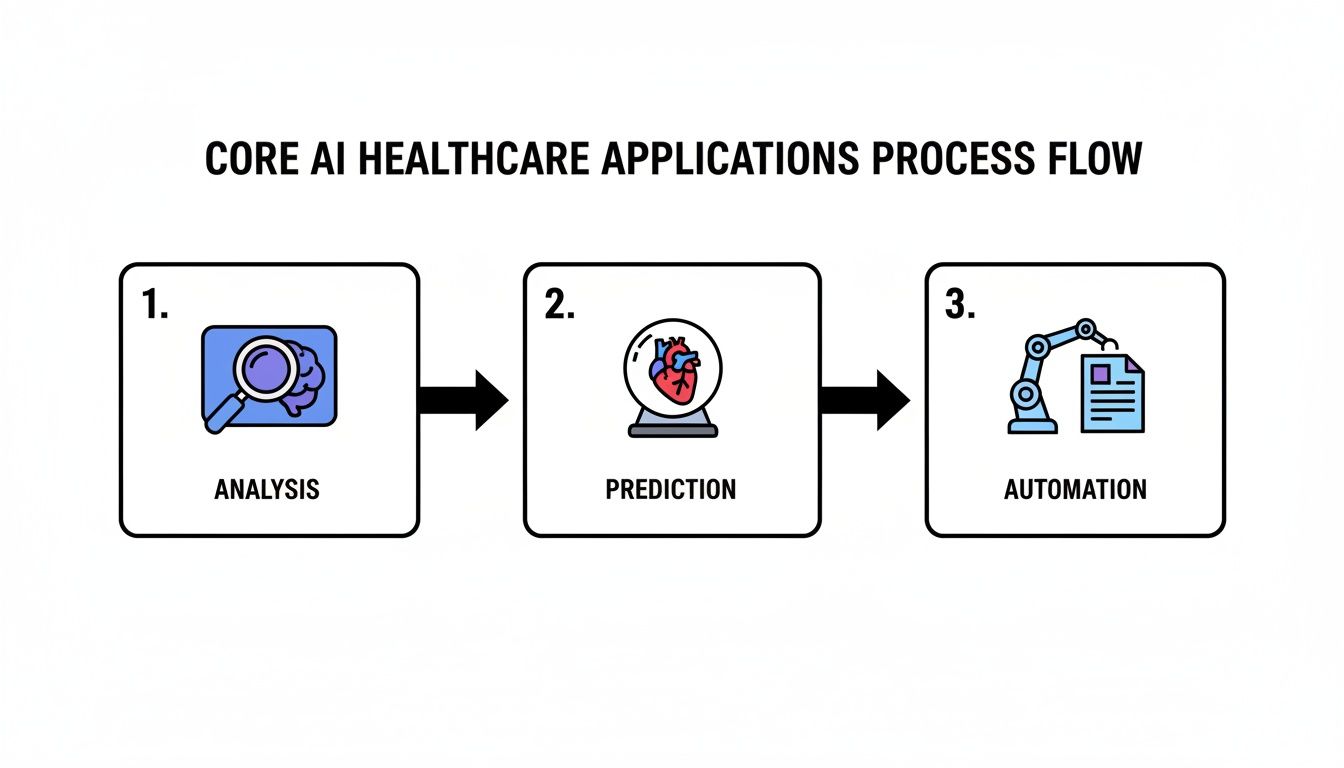
This cycle is powerful. AI first sifts through complex data to find patterns, then uses those patterns to predict outcomes, and finally, automates workflows based on those predictions, creating a loop of continuous improvement.
Once your foundation is solid, it's time to test the waters on a small, manageable scale. The goal here is simple: prove the value of your idea quickly and learn from a real-world test run without causing major disruption.
Pick one or two high-impact use cases you identified back in the discovery phase. A good pilot needs clear success metrics, a defined timeline, and the active participation of your clinical and operational staff. Our AI Product Development Workflow is designed to structure these pilots for success, ensuring they deliver tangible, measurable results.
After a pilot proves its worth, the final stage is to scale that solution across the wider organization. This means embedding the AI tool directly into core clinical workflows and internal systems. Change management is absolutely essential here—it requires clear communication, comprehensive training, and continuous support for your staff as they adapt.
This adoption is happening fast. In the massive $4.9 trillion healthcare industry, AI deployment has more than doubled compared to the rest of the economy. Between 2023 and 2025, the use of specialized AI tools in healthcare shot up tenfold, with 22% of organizations now on board. Health systems are leading the charge at a 27% adoption rate, underscoring just how critical AI is becoming for automating work and driving efficiency.
While the promise of AI-driven transformation in healthcare enterprises is enormous, the road to getting it right is filled with real-world challenges. Honestly, recognizing and tackling these hurdles head-on is what separates a stalled project from a true competitive advantage. Ignoring them is like setting sail without checking the weather—you’re bound to hit a storm you could have avoided.
A successful transformation means taking a clear-eyed look at the three main obstacles: the regulatory and ethical minefield, the technical debt and complexity, and the all-too-human challenge of organizational change.
Healthcare operates under a microscope, and for good reason. We're dealing with people's most sensitive information, so compliance isn't just a box to check—it's the foundation of trust.
At the end of the day, the guiding principle must be "do no harm." Every single AI application has to be rigorously vetted for fairness, transparency, and its absolute commitment to patient well-being.
Let’s be realistic: integrating advanced tech into the tangled, often aging IT environments found in most healthcare organizations is a serious technical lift. It's almost never a simple plug-and-play situation.
One of the biggest headaches is legacy system integration. Many hospitals and clinics still run on older electronic health record (EHR) systems that were never built to talk to modern AI platforms. You can't just connect them. Bridging that gap takes specialized skills to build clean data pipelines, and it often means developing custom internal tooling just to make things work.
Another major technical challenge is model explainability. For a doctor making a life-or-death decision, a "black box" AI that spits out an answer without showing its work is a non-starter. Clinicians have to understand why an algorithm is recommending a certain course of action to trust it. That makes explainable AI (XAI) a non-negotiable feature, not just a nice-to-have.
This might be the toughest hurdle of all, and it has almost nothing to do with code. Implementing AI fundamentally changes how people work. It requires a deep cultural shift toward making decisions based on data.
As we explored in our AI adoption guide, a core part of any good AI strategy consulting engagement is planning for these issues. When you manage them proactively, potential roadblocks become the stepping stones to a successful—and ethical—AI transformation.
The work we're seeing in AI-driven transformation in healthcare enterprises isn't the finish line; it's the starting block. The applications making waves today are just laying the groundwork for a future where healthcare is not only smarter but woven seamlessly into the very fabric of patient care.
The next wave is all about technologies that hum quietly in the background, making healthcare more predictive, deeply personalized, and truly participatory. The end game is an ecosystem that anticipates needs before they even surface, shifting the entire paradigm from reactive treatment to proactive wellness.

A couple of key trends are already starting to define this next chapter, moving AI from a visible tool to an invisible, supportive partner for clinicians.
Ambient Clinical Intelligence: Picture a doctor's visit where the physician focuses entirely on the patient, never once touching a keyboard. That's the promise of ambient intelligence. It uses sophisticated microphones and AI to listen in on the natural conversation, automatically generating accurate clinical notes, ordering prescriptions, and even scheduling follow-ups on the fly. This could be the technology that finally solves the burnout crisis fueled by endless administrative tasks.
Federated Learning: One of the biggest hurdles for healthcare AI is getting enough diverse data without ever compromising patient privacy. Federated learning is the elegant solution. It allows an AI model to learn from data across multiple hospitals or research centers—all without that sensitive data ever leaving the original secure server. Only the model's learnings are shared, not the data itself. This leads to smarter, more robust algorithms while keeping patient privacy ironclad.
These aren't just fascinating concepts; they are vital tools for tackling some of the world's biggest health challenges. Right now, about 4.5 billion people lack access to essential health services, and a projected shortfall of 11 million health workers by 2030 will only make things worse. AI-powered diagnostics and patient triage are seen as essential for bridging this gap. You can discover more insights about AI's role in global health on weforum.org.
The journey of AI transformation is continuous. It's a commitment to constant learning, adapting, and innovating to meet the evolving needs of patients and providers.
Kicking off this journey with a clear vision and an experienced guide is non-negotiable. The road ahead demands smart planning, from building out a solid AI strategy consulting plan to executing it with precision. To navigate this complex but rewarding path with confidence, the guidance of our expert team can make all the difference, ensuring every step you take is a confident one toward a better future for health.
Thinking about a major shift like bringing AI into a healthcare enterprise is bound to spark some questions. We get it. Here are some of the most common things we hear from leaders just like you, along with our straightforward answers.
This is the big one, isn't it? The single most important first step is to forget about the technology for a moment and focus on a specific, nagging business problem. Don't chase shiny objects; chase results.
Start with a deep-dive AI requirements analysis to get a clear picture of what you actually need and whether your data is ready for the job. An initial AI Strategy consulting tool can be invaluable here. It helps you build a practical roadmap, get your leadership team aligned, and pinpoint the pilot projects that will deliver the biggest bang for your buck, setting you up for a win right out of the gate.
Protecting patient data isn't just a line item; it's the foundation of everything. You need a defense-in-depth approach.
Start with rock-solid data governance policies. Simple techniques like data anonymization and de-identification are must-haves before any AI model training begins. You can also explore more advanced methods like federated learning, which allows models to be trained on decentralized data without ever pooling it in one place. Most importantly, only work with vendors whose AI tools for business were built from day one with HIPAA and security baked into their DNA.
A proactive security posture isn’t just about ticking regulatory boxes. It's about earning and keeping the trust of your patients, which is the absolute bedrock of a successful healthcare organization.
This is all about people, not just tech. True adoption comes from building trust and proving value.
You have to involve your clinical teams from the very beginning—in the selection, design, and testing phases. Position AI as a helpful assistant that frees them from tedious administrative work and sharpens their diagnostic insights, not as something trying to replace them.
Run small, controlled pilot programs so your staff can see the benefits for themselves. Offer great training and open up clear, honest channels for feedback. When your team sees AI as a tool that genuinely helps them provide better, more efficient care, the trust and adoption will naturally follow.
The journey from a promising idea to an enterprise-wide AI capability takes a clear vision and a partner who's been down this road before. To see how our expert team can guide you through every stage, take a look at our services and let's connect.
Ready to build your AI roadmap and kickstart your transformation? At Ekipa AI, we help healthcare organizations like yours get from discovery to execution faster and more effectively. Getting a Custom AI Strategy report can be a crucial first step.
How to build HIPAA-compliant AI: when LLM providers need a BAA, data minimization, de-identification, audit controls and a reference architecture.
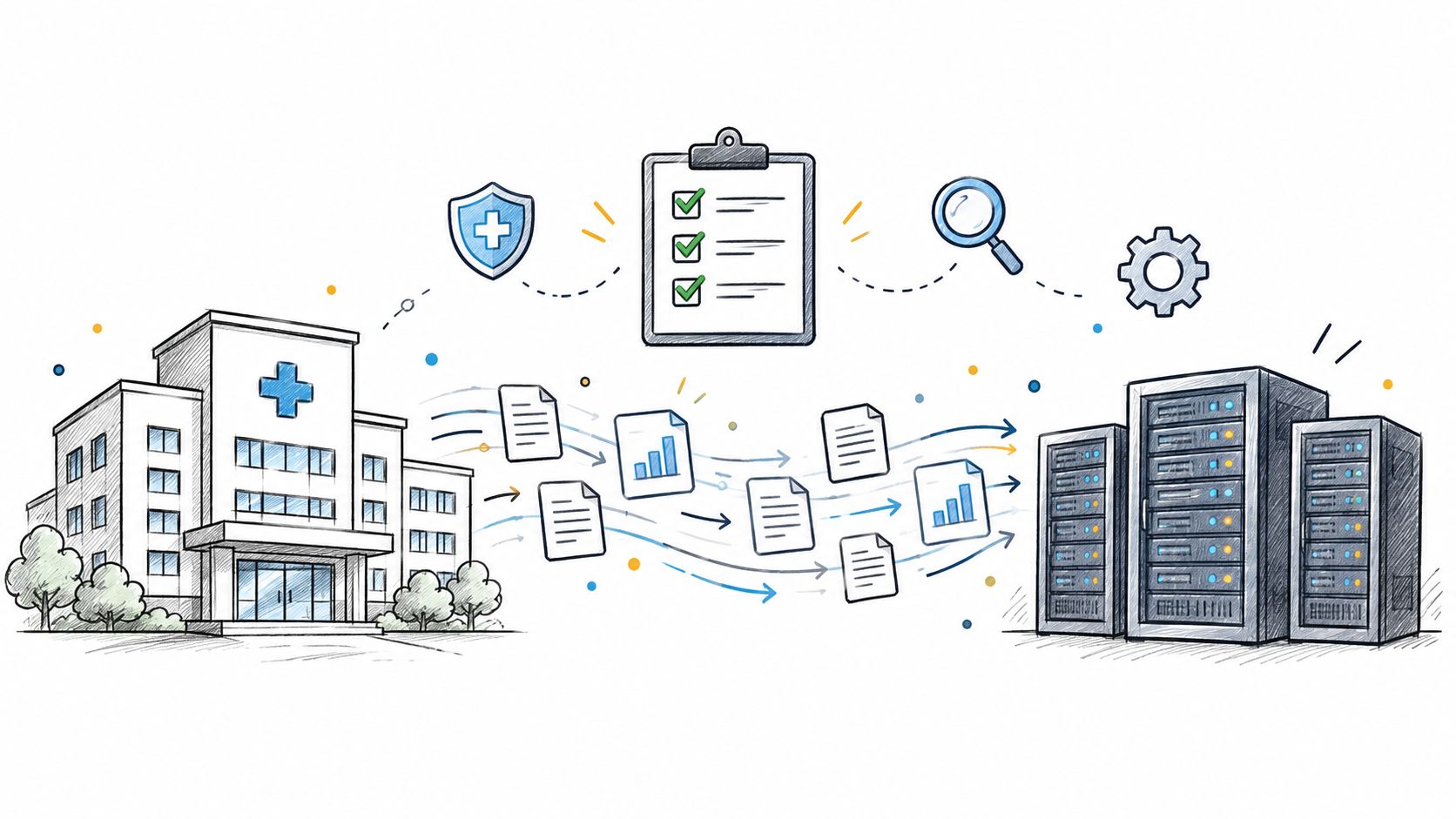
Practical data migration planning guide for healthcare teams. Scope, mapping, compliance, validation, cutover and rollback decisions explained end to end.
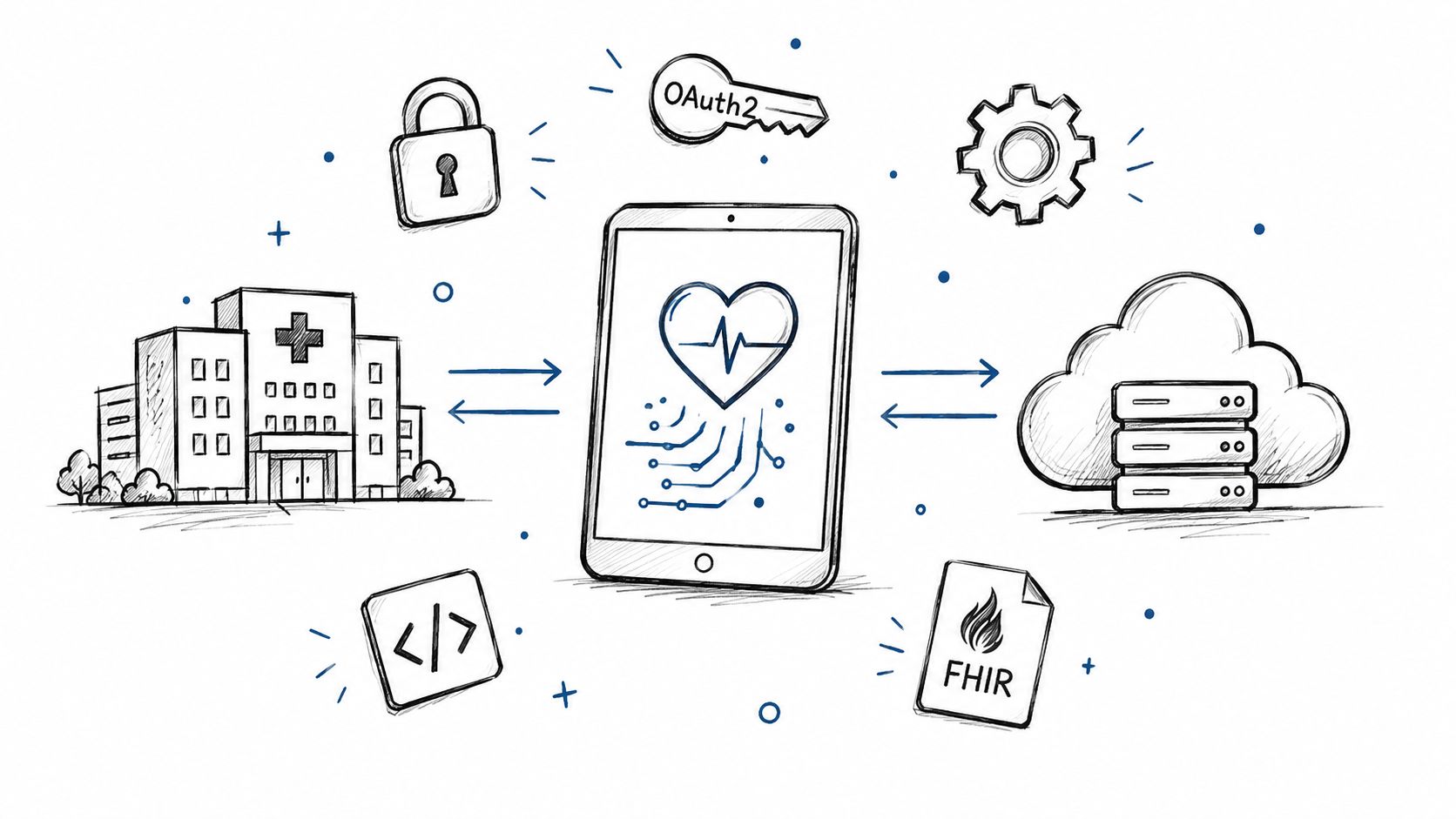
Smart on FHIR guide for healthtech engineers. Learn the OAuth 2.0 launch model, scope syntax, backend services, and US regulatory requirements.
Connect with our team to explore how AI expertise can transform your business.