AI in Healthcare
HIPAA-Compliant AI: How to Use LLMs With PHI Safely
How to build HIPAA-compliant AI: when LLM providers need a BAA, data minimization, de-identification, audit controls and a reference architecture.
October 16, 2026Read more
Discover how AI used in medical field is revolutionizing patient care. Explore real-world applications in diagnostics, treatment, and hospital operations.

AI is already hard at work in the medical field, and it’s doing more than you might think. It's helping to improve patient outcomes, speed up diagnoses, find new drugs faster, and make hospitals run more smoothly.
From spotting diseases in medical scans to crafting personalized treatment plans, AI is already a practical tool that gives clinicians the support they need to make better, faster decisions.
Forget the sci-fi concepts for a moment. Artificial intelligence has moved from theory to reality, becoming a powerful and practical force in modern medicine. AI algorithms are now capable of digging through mountains of medical data to find subtle patterns that are often invisible to the human eye, opening up incredible new avenues for improving care.
This shift isn't about replacing doctors; it's about giving them superpowers. Think of AI as an incredibly sharp assistant that can analyze thousands of data points in seconds. This frees up clinicians to spend less time on tedious analysis and more time focusing on what they do best: caring for patients. As we explore the many ways AI is used in the medical field, it's clear that success depends on a smart, strategic approach. This evolution in care also supports the growth of related technologies, like telehealth services, which are now a core part of how healthcare is delivered.

AI's influence is spreading across the entire healthcare system. Its applications aren't stuck in one department—they’re reshaping processes everywhere, from the front desk to the operating room. For any leader in healthcare, understanding these key areas is the first step toward putting AI to work effectively.
Here are a few of the most important areas where AI is making a real difference:
Bringing AI into a healthcare setting isn't as simple as buying new software. It requires a clear vision and a carefully crafted plan. By focusing on specific use cases that deliver the most value and building a solid data foundation from the start, healthcare organizations can make sure their AI projects produce real, measurable results.
The road from a great idea to a clinical application is a strategic one, but the rewards for both patients and providers are undeniable. You can learn more about how Ekipa supports this sector in our deep dive into AI for the healthcare industry: https://www.ekipa.ai/industries/healthcare.
One of the most powerful places we're seeing AI make a real difference is in diagnostics and medical imaging. Think of AI as a highly trained, tireless assistant for radiologists and pathologists. It can analyze thousands of medical images—like X-rays, CT scans, and MRIs—with incredible precision and speed, often seeing things humans can't.
Deep learning models are exceptional at spotting subtle patterns and anomalies that might slip past the human eye, even a specialist's. This is a massive leap forward for the early detection of diseases like cancer, diabetic retinopathy, and various neurological disorders.
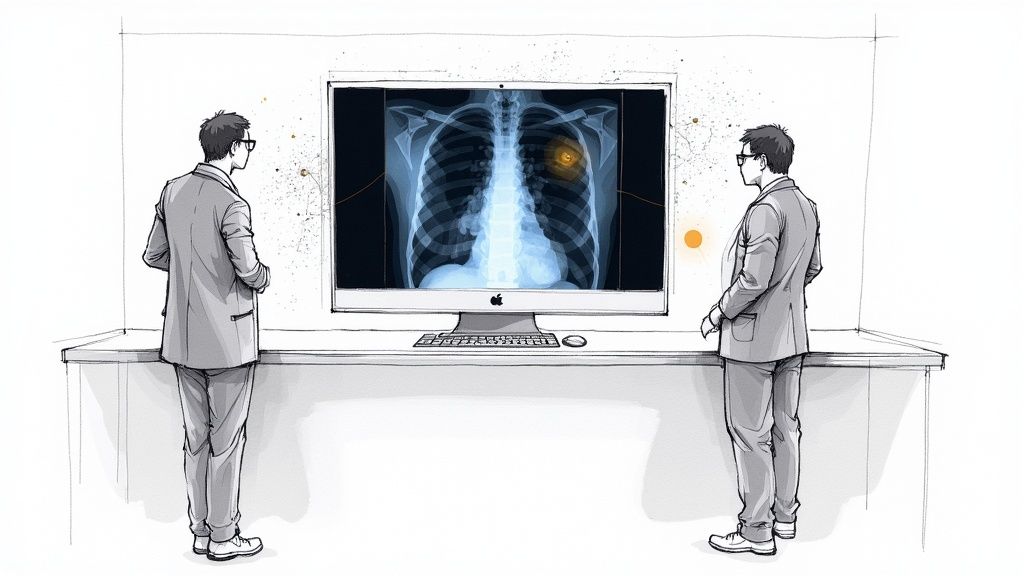
Let's be clear: these tools aren't here to replace doctors. Their purpose is to augment clinical skills, acting as a second set of digital eyes that can flag potential issues with remarkable accuracy. This simple function allows clinicians to confirm findings faster, prioritize the most urgent cases, and spend their valuable time on complex diagnoses and patient care.
For example, an AI algorithm trained on millions of mammograms can instantly highlight suspicious areas that might signal early-stage breast cancer. This directs the radiologist’s attention right where it’s needed most. In neurology, AI can help pinpoint tiny brain lesions on an MRI that could be the first signs of multiple sclerosis. AI handles the heavy lifting of the initial scan, freeing up human experts to apply their critical thinking where it truly counts.
AI’s ability to analyze and reconstruct enormous amounts of data from medical imaging in a very short time is monumental. It helps clinicians find cancer cells that are easy to miss, or even invisible to the human eye, leading to earlier and more effective treatment plans.
This isn't just a future concept; it's happening now. A staggering 80% of hospitals worldwide are already using AI to improve patient care and make their operations more efficient. That marks a huge shift from small-scale experiments to everyday clinical tools. You can find more data on this trend over at litslink.com.
The practical uses of AI in medical imaging are growing every day. For organizations looking to bring these capabilities in-house, platforms like Ekipa's Diagnoo AI are designed to help build, validate, and deploy medical imaging models much more smoothly.
Here are just a few concrete examples of AI in action:
By making diagnoses more accurate and analysis much faster, AI gives medical professionals the power to act sooner. The result is better patient outcomes and a more efficient healthcare system for everyone.
Think about the traditional path to a new drug: it’s a journey that often takes more than a decade and costs billions of dollars. That entire timeline is being compressed, thanks to the power of AI in the medical field. AI isn't just an incremental improvement; it's fundamentally reshaping how we find and develop new medicines.
Finding a new drug has always been like searching for one specific needle in an impossibly large haystack. Scientists would have to manually screen thousands, sometimes millions, of chemical compounds. It's a slow, brutally expensive process where most leads go nowhere. AI completely flips that script. It acts like a super-magnet, zeroing in on the most promising candidates almost instantly.
AI models can chew through massive biological and chemical datasets at a speed no human team could ever hope to match. They dig into everything from genetic information and protein structures to past clinical trial data, all to pinpoint molecules with the best shot at becoming effective treatments.
This gives the earliest, most uncertain stages of research a massive boost. What used to take years of painstaking trial and error can now be accomplished in just a few months. Here’s how:
Beyond finding drugs for broad populations, AI is finally making personalized medicine a reality. The old "one-size-fits-all" model is giving way to treatments designed for an individual's unique genetic and biological profile. This is a central goal for many advanced AI solutions.
AI algorithms can analyze a patient's genetic code, lifestyle, and environment to build a detailed personal health blueprint. This gives doctors the power to move beyond generic prescriptions and create care plans tailored specifically to that one person. You can see how this plays out in many compelling real-world use cases.
By digging into genomic data, AI can help predict how an individual will respond to a specific treatment. This opens the door to truly personalized care, pushing medicine toward more precise and effective outcomes.
This hyper-personalization means treatments aren't just more effective—they often come with fewer side effects. Take cancer treatment, for example. AI can analyze a tumor's specific genetic mutations to identify the chemotherapy drug most likely to destroy it, sparing the patient from rounds of grueling, ineffective alternatives. This is a critical piece of the puzzle that modern AI strategy consulting helps healthcare organizations solve.
The road from raw data to a personalized prescription is incredibly complex, but the results are worth it. By understanding each patient down to the molecular level, AI gives doctors the deep insights they need to make the best possible decisions. It's a shift from reactive care to something far more predictive and personal, a transition our expert team helps businesses navigate.
While the big clinical breakthroughs tend to grab all the headlines, the real engine of any hospital is its operational efficiency. This is an area where the use of AI in the medical field is quietly making a massive impact. Moving away from the lab and into the back office, AI is untangling the complex, systemic bottlenecks that drive up costs and burn out staff.
Intelligent systems are now automating everything from intricate patient scheduling and mind-numbing medical billing to optimizing the entire hospital supply chain. These aren't just small process improvements; we're talking about a fundamental rethinking of how hospitals run day-to-day.

Using predictive analytics, hospitals can finally get ahead of the curve. They can now forecast patient admission rates with surprising accuracy, which helps them manage bed capacity, prevent overcrowding, and slash those frustratingly long wait times.
This same tech can also make sure the right people are in the right place at the right time, dynamically matching nurse and doctor availability with real-time patient demand.
This practical approach to AI Automation as a Service does more than just trim the budget. It gives medical professionals back their most valuable asset: time. Instead of getting buried in administrative paperwork, they can focus on what they were trained to do—care for patients.
The AI in healthcare market is exploding, valued at $22.4 billion in 2023 and projected to surge to $208.2 billion by 2030. This incredible growth reflects a massive shift toward AI-virtualized care, with PwC forecasting it could save the U.S. healthcare system $300-900 billion annually by 2050. Discover more insights about these healthcare AI trends.
The sheer scale of this adoption points to one clear reality: operational AI is no longer a "nice-to-have" novelty. It’s becoming a core part of modern hospital management because leadership teams understand that a smooth-running back office leads directly to a better patient experience on the front line.
Behind these large-scale automations are powerful internal tooling platforms that give hospital administrators a clear dashboard and control over incredibly complex processes. These custom-built tools can automate repetitive chores, manage inventory with precision, and serve up data-driven insights that lead to smarter decisions. As we explored in our AI adoption guide, getting the internal systems right is absolutely critical for success.
The following table breaks down how AI is making a tangible difference in some of the most challenging areas of hospital operations.
| Operational Challenge | AI Application | Primary Benefit |
|---|---|---|
| Patient Bottlenecks & Long Wait Times | Predictive patient flow models | Reduced emergency room congestion and shorter wait times. |
| Supply Shortages or Overstocking | AI-powered inventory forecasting | Optimized supply levels, preventing waste and critical shortages. |
| Manual & Error-Prone Billing | NLP for automated medical coding | Faster revenue cycles and significantly improved billing accuracy. |
| Complex Staff Scheduling & Burnout | Intelligent shift scheduling algorithms | Reduced overtime costs and fairer workloads for staff. |
By tackling these essential but often thankless operational jobs, AI frees up healthcare professionals to pour their energy and expertise into what actually matters: patient health and well-being. This operational support is every bit as vital as the clinical advancements we’ve already explored.
It's easy to get excited about the potential of AI in healthcare, but we can't ignore the very real ethical and practical hurdles that come with it. With any powerful technology, there's a flip side. A serious conversation about medical AI has to tackle the tough questions about privacy, bias, and accountability head-on.
Getting AI implementation right is about more than just slick technology; it requires a genuine commitment to doing the right thing. This is why a thoughtful AI strategy consulting process is absolutely essential for any healthcare organization looking to use these tools responsibly.
Medical AI runs on patient data, but that data is profoundly personal and sensitive. The moment you start working with massive health datasets, you immediately run into major privacy and security concerns. Every AI application must be built from the ground up to comply with strict regulations like the Health Insurance Portability and Accountability Act (HIPAA).
In a field as regulated as medicine, you have to know the compliance landscape inside and out. A critical starting point is understanding the differences between standards, like the various HIPAA vs. SOC 2 compliance frameworks, to build a rock-solid data governance plan. This means putting concrete measures in place, such as:
An AI model is a mirror—it only reflects the data it was trained on. If that training data contains existing societal biases or doesn't include a representative mix of demographic groups, the algorithm will not only repeat those inequalities but can actually make them worse.
Algorithmic bias is one of the most serious risks in medical AI. If a diagnostic tool is mostly trained on data from one population, it’s almost guaranteed to be less accurate for others. This can create massive health disparities and deepen the systemic inequities already present in our healthcare system.
Imagine an AI built to spot skin cancer. If it was trained almost exclusively on images of lighter skin, it could easily miss a dangerous melanoma on a patient with darker skin. Fighting this requires a deliberate, focused effort to collect diverse datasets and constantly check the algorithms for fairness. This is a central part of any effective AI requirements analysis.
Another huge challenge is what’s known as the "black box" problem. Many of the most powerful AI models, especially deep learning networks, can give you an answer without showing their work. They can’t explain the why behind their conclusions. This is a massive issue in a clinical setting, where a doctor absolutely needs to understand the reasoning behind a diagnosis or treatment plan.
If an AI gets it wrong, who’s on the hook? The hospital? The software developer? The doctor who trusted the recommendation? We have to establish clear lines of responsibility. The solution lies in two areas: developing more "explainable AI" (XAI) models that can justify their decisions in plain language and creating clear regulatory frameworks to govern their use. For any organization building its own tools, this accountability has to be woven into the AI Product Development Workflow from day one. By prioritizing transparency and strong governance from the very start, we can build the trust needed to ensure AI helps patients safely and equitably.
Bringing AI into a healthcare organization isn’t like flipping a switch. It's a strategic journey, and for leaders in the field, having a clear roadmap is what turns a promising idea into a practical, life-saving tool. The whole process really kicks off by figuring out where AI can actually make the biggest difference.
The first, and most critical, step is a deep dive into an AI requirements analysis. This is about cutting through the hype to find specific, high-value use cases that solve real problems your organization is facing. This initial work lays the groundwork for everything else, from building the right data infrastructure to making sure the final tool fits neatly into a clinician's workflow.
Once you've zeroed in on a promising use case, the next phase is all about creating the right environment for it to thrive. This is about more than just technology—it requires a real cultural shift and genuine buy-in from the people who will be using these tools every day. Getting clinicians on board is absolutely non-negotiable, and that happens when you show them how AI will enhance their expertise, not try to replace it.
Solid training programs are just as crucial. Your staff needs to feel confident and capable with any new system. A well-structured AI Product Development Workflow ensures that solutions are not just built well but are also intuitive and integrate smoothly with existing clinical processes. A clear plan for adoption is every bit as important as the algorithm itself.
This visual flow shows the ethical pillars that need to be part of your roadmap from day one.
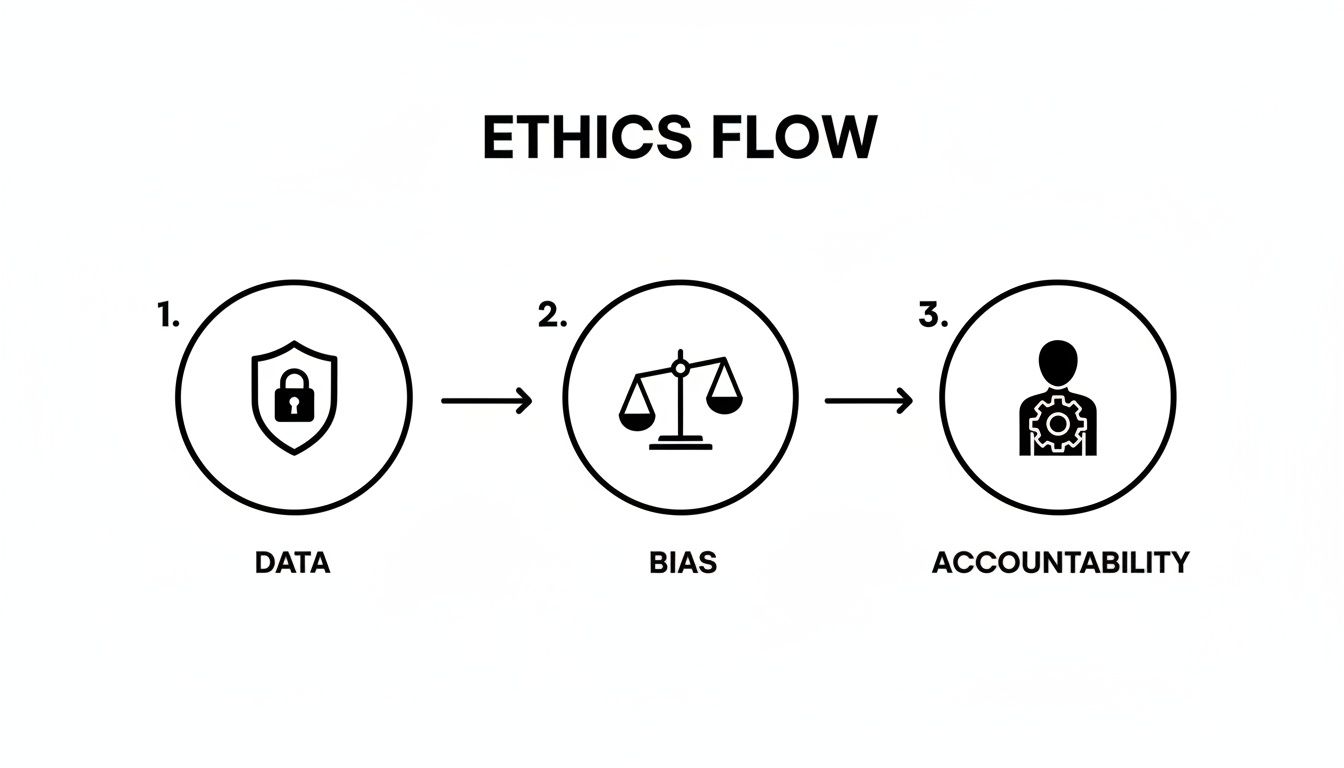
As the diagram makes clear, a responsible AI implementation must systematically tackle data privacy, work to reduce bias, and establish clear lines of accountability right from the start.
A Custom AI Strategy report can act as your North Star, laying out a direct path that links the technology to real-world business and clinical outcomes. This document should detail key milestones, how resources will be allocated, and the metrics you'll use to measure success and keep the project on track. This strategic alignment is what separates a successful rollout from a failed pilot.
The momentum is already building at an incredible pace. AI adoption among physicians is surging—66% of U.S. doctors are now using AI tools in their practice, which is a 78% jump from the year before. This isn't just a U.S. phenomenon. Nearly every major hospital system is running AI pilots or has live deployments, and 27% of health systems are now implementing domain-specific AI. Learn more about the rapid AI adoption in U.S. hospitals.
By starting with a clear strategy, engaging clinicians early, and building a robust technical and ethical foundation, healthcare organizations can ensure their AI initiatives deliver lasting value for both patients and providers.
The journey from a great idea to a clinical reality can be complicated, but you don't have to go it alone. Whether you're just starting to explore the possibilities or are ready to scale an existing solution, having the right expertise in your corner is key. To ensure your implementation succeeds from start to finish, the guidance of our expert team can make all the difference.
As AI becomes a bigger part of medicine, it’s natural for doctors, hospital leaders, and even patients to have questions. Getting a clear picture of what this technology can—and can’t—do is the first step toward using it responsibly. Let's tackle some of the most common things people ask.
Not at all. The goal isn't to replace healthcare professionals but to give them a powerful assistant. Think of AI as a tool designed to do the heavy lifting on repetitive, data-heavy tasks, like scanning thousands of medical images or spotting risk factors buried in patient histories.
This lets doctors, nurses, and radiologists do what they do best: focus on tricky diagnoses, talk with patients, and deliver compassionate care. It’s an advanced support system that sharpens a clinician's judgment, not a substitute for it. This human-AI partnership is the whole point of a well-designed AI solution.
Patient privacy is the absolute top priority, and it's non-negotiable. Any AI system used in a medical setting has to follow strict regulations like HIPAA. This is done by putting multiple security measures in place, such as data anonymization (stripping out personal details), end-to-end encryption, and storing everything in highly secure, access-controlled environments.
A solid AI strategy consulting tool always builds in a strong data governance plan from day one. This makes sure privacy and security are baked into every step, from how data is gathered to how the AI model is trained and used. It's a fundamental part of any custom healthcare software development project.
Protecting sensitive health information is paramount. A responsible AI strategy is built on a foundation of trust, transparency, and an unwavering commitment to patient privacy, ensuring that technological advancement never comes at the cost of security.
Interestingly, the biggest roadblock often isn't the technology itself—it's getting it to work with existing systems and earning trust. Rolling out AI effectively demands a real investment in modernizing data infrastructure and making sure it connects smoothly with the electronic health record (EHR) systems already in place. If it can't, even the most brilliant algorithm is basically useless.
Beyond that, you have to get the staff on board. That means providing great training so they feel comfortable and capable using the new tools. Building trust with clinicians by showing them exactly how these AI tools for business work, proving their accuracy, and highlighting the real-world benefits is the key to getting everyone to embrace them.
AI is used across healthcare for medical diagnostics (analyzing scans like X-rays and MRIs), accelerating drug discovery, personalizing treatment plans based on genetics, and streamlining hospital operations through automation of tasks like scheduling and billing.
AI's strength lies in augmenting, not replacing, human expertise. AI models, particularly in medical imaging, can detect subtle patterns that are difficult for the human eye to see, leading to earlier and more accurate detections. The final diagnosis, however, remains the responsibility of a qualified clinician who uses AI as a powerful support tool.
AI analyzes vast amounts of data, including a patient's genetic makeup, lifestyle, and medical history, to predict how they will respond to different treatments. This allows doctors to move away from a one-size-fits-all approach and create highly tailored care plans that are more effective and have fewer side effects.
The primary ethical challenges include ensuring patient data privacy and security (complying with regulations like HIPAA), preventing algorithmic bias (where AI models are less accurate for certain demographic groups), and establishing clear accountability when an AI system makes an error.
Ready to define your healthcare AI strategy and accelerate implementation? Ekipa AI delivers a Custom AI Strategy report in just 24 hours, turning your vision into a clear, actionable roadmap. Our expert team is here to guide you every step of the way.
How to build HIPAA-compliant AI: when LLM providers need a BAA, data minimization, de-identification, audit controls and a reference architecture.
Practical data migration planning guide for healthcare teams. Scope, mapping, compliance, validation, cutover and rollback decisions explained end to end.
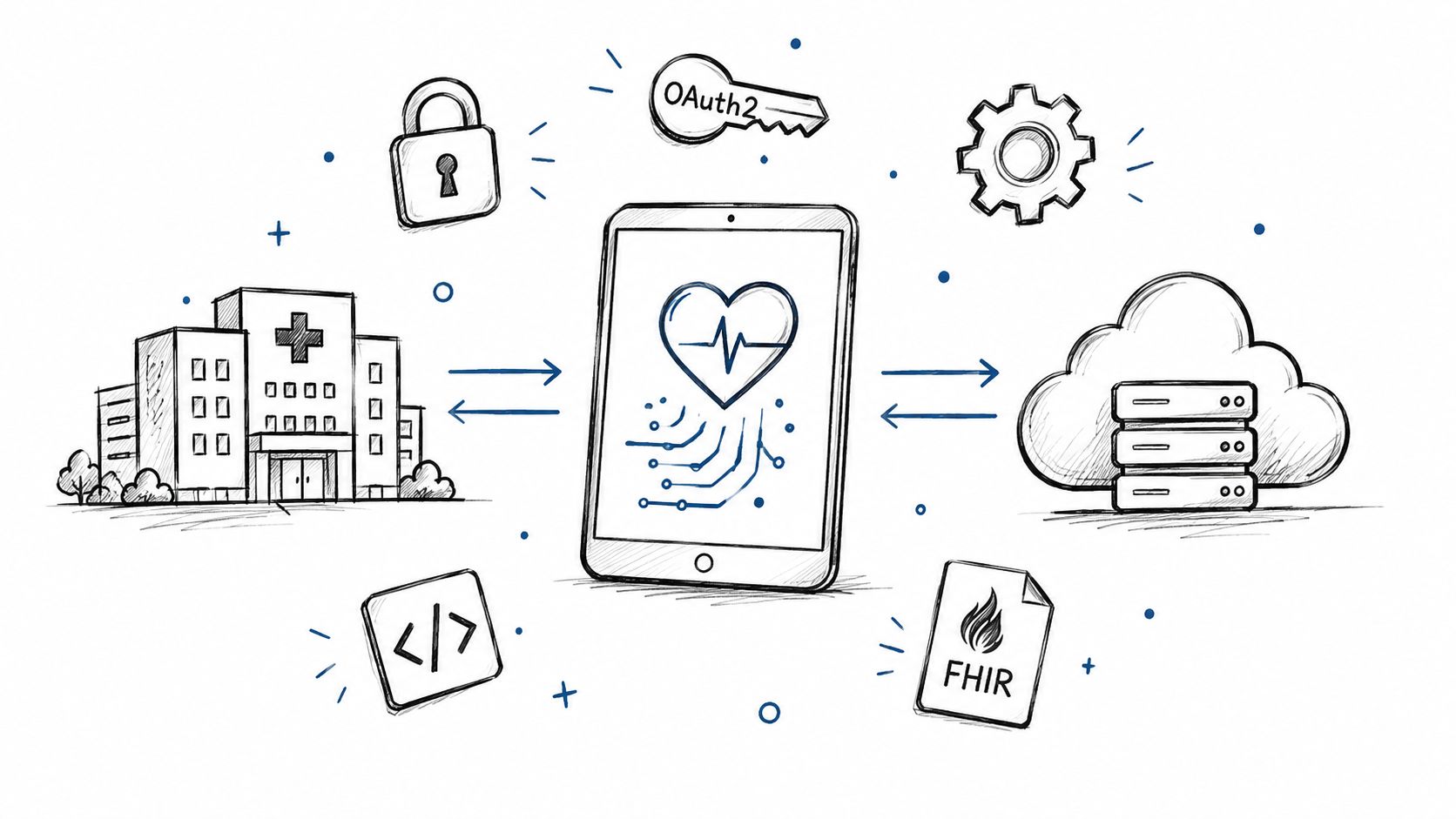
Smart on FHIR guide for healthtech engineers. Learn the OAuth 2.0 launch model, scope syntax, backend services, and US regulatory requirements.
Connect with our team to explore how AI expertise can transform your business.