Think about traditional automation for a moment. It’s like a highly efficient assembly line worker, perfectly executing the same task over and over based on a strict set of rules. AI for automation, on the other hand, is more like the factory supervisor—the one who not only watches the line but learns from it, spots potential problems before they happen, and tweaks the entire workflow to get better results.
Beyond Rules: How AI for Automation Changes Everything
Standard automation is great, but it’s rigid. It’s all based on simple “if-then” logic. If a customer fills out a form, then send a templated email. This is fantastic for simple, high-volume tasks. But the moment something unexpected happens—a variable it wasn't programmed for—it breaks. Consistency is its strength, but it has no room for judgment.
AI for automation brings intelligence into the mix. Instead of just following a script, it uses technologies like machine learning and natural language processing to understand context, see patterns, and make decisions. This is the leap from just doing things fast to doing things smart.
The Shift from Doing to Thinking

The real game-changer here is adaptability. A traditional automation tool will get stuck if it receives an invoice in a slightly different format than its template. An AI-powered system, however, can be trained to find the "invoice number" and "due date" no matter where they are on the page. It understands the goal, not just the steps.
This ability to "think" and adapt is exactly why the market is exploding. The global AI market is on track to grow from around USD 371.71 billion in 2025 to a massive USD 2,407.02 billion by 2032. That’s a compound annual growth rate of 30.6%, fueled by companies that see the power of making their automated processes more intelligent and resilient. You can discover more about this explosive market growth and what’s driving it.
Key Takeaway: Moving to AI for automation isn't just a minor upgrade. It’s a fundamental shift that takes your operations beyond simple task completion and creates systems that learn, adapt, and actually drive strategic value.
What This Means for Your Business
When your processes move from being rule-based to intelligence-driven, you unlock a whole new level of capability. This isn't just about getting things done quicker; it’s about building a smarter, more robust operation that can handle the messiness of the real world.
With this new approach, your business can:
-
Handle Unstructured Data: Finally make sense of all those customer emails, support tickets, and social media comments to understand what people are really saying.
-
Make Predictive Decisions: Forecast inventory needs not just on past sales, but by factoring in things like upcoming holidays or even weather patterns.
-
Improve Over Time: Create systems that learn from every outcome, constantly refining processes to reduce errors and boost performance.
Ultimately, adding this layer of intelligence turns automation from a simple efficiency tool into a genuine strategic asset that gives you a major competitive edge.
Decoding the Tech Behind Intelligent Automation
To really get what makes AI for automation tick, you have to look under the hood at the core technologies making it all possible. These aren’t just abstract ideas; they're the practical tools that, when put together, create systems that can think, act, and learn.
Think of them as a highly specialized digital team, where each member brings a unique skill to the table.
Machine Learning: The Brains of the Operation
At the very center of it all is Machine Learning (ML). Imagine hiring a new analyst who gets smarter with every single task they do. On day one, they might need a lot of hand-holding. By day 100, they're not just doing the work—they're anticipating what's next and spotting patterns you might have missed entirely. That’s ML in a nutshell.
ML algorithms learn directly from data. You feed them historical information—past sales figures, customer support tickets, equipment maintenance logs—and they figure out the patterns on their own. Instead of being explicitly programmed with a long list of "if-then" rules, they build their own logic and constantly fine-tune it as new data comes in.
This is exactly how an automated system can decide whether to approve a loan by assessing risk factors or predict which customers are about to leave.
Natural Language Processing: The Communications Expert
Next up is Natural Language Processing (NLP). This is your team's master communicator, fluent in every human language. NLP gives software the power to understand, interpret, and even generate human language, whether it's spoken or written.
It's the technology that makes a chatbot genuinely helpful instead of frustrating. It’s also what allows a system to sift through thousands of customer reviews and instantly tell you if the overall sentiment is positive or negative. Without NLP, the messy, unstructured world of human communication would be a closed book to our software.
Robotic Process Automation: The Diligent Doer
Finally, we have Robotic Process Automation (RPA). Picture a digital assistant who handles all of your most boring, repetitive, rule-based tasks with perfect accuracy, 24/7. That's an RPA bot.
These bots are designed to mimic human actions on a computer—clicking buttons, logging into systems, copying and pasting data, and filling out forms. They are the "hands" of your automation strategy, executing tasks exactly as instructed.
On its own, RPA is a game-changer for simple jobs like moving data from a spreadsheet to a CRM. But when you combine it with the "brain" of ML and the "ears" of NLP, you get something truly special: intelligent automation that can manage entire complex workflows from start to finish.
To make this clearer, let's break down these core technologies and what they actually do in a business context. Each one plays a distinct but complementary role in building a smart automation system.
Key AI Technologies for Automation Explained
|
AI Technology
|
Core Function
|
Business Analogy
|
|
Machine Learning (ML)
|
Learns from data to find patterns and make predictions.
|
The seasoned analyst who spots trends and forecasts outcomes.
|
|
Natural Language Processing (NLP)
|
Understands, interprets, and generates human language.
|
The communications director who can read any message and grasp its intent.
|
|
Robotic Process Automation (RPA)
|
Mimics human actions to execute rule-based digital tasks.
|
The detail-oriented assistant who handles all the repetitive data entry.
|
As you can see, each piece has its place. RPA handles the "doing," NLP handles the "understanding," and ML handles the "thinking." It's their synergy that unlocks real business value.
An RPA bot might extract data from an invoice, but it's the ML model that determines if the invoice is fraudulent, and it’s NLP that allows the system to read the emailed invoice in the first place.
This is where the theory hits the road. The combination of these technologies delivers concrete benefits that show up on the bottom line.
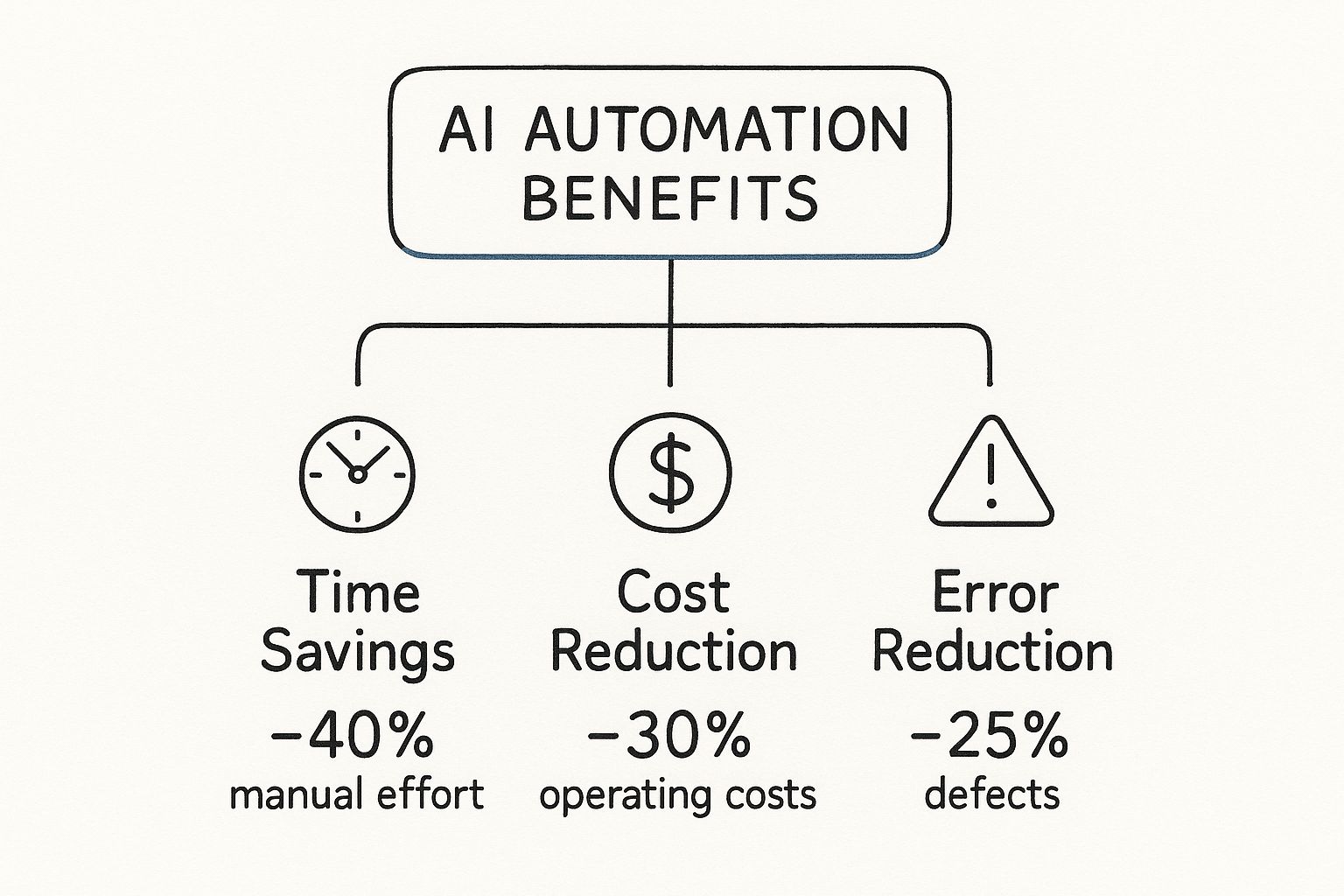
The numbers speak for themselves. When these AI components work together, businesses see huge operational gains, like slashing manual effort by 40% and cutting operational costs by 30%.
How It All Comes Together
The real magic of AI for automation happens when you layer these technologies. Each one solves a different piece of the puzzle, and the result is a system far more capable than the sum of its parts.
Let’s walk through a common business scenario:
-
Step 1: NLP Listens In. An AI-powered system scans all incoming customer emails. Using NLP, it instantly understands that a particular email is a complaint about a product that arrived damaged.
-
Step 2: RPA Gets to Work. This automatically triggers an RPA bot. The bot logs into your CRM, creates a brand new support ticket, and fills it in with the customer's name, contact info, and the complaint details it pulled from the email.
-
Step 3: ML Adds the Intelligence. An ML model then analyzes this new ticket against thousands of past cases. It predicts the best resolution—a replacement or a full refund—based on the customer's purchase history and the complaint details. It then flags the ticket for a human agent, complete with a recommended next step.
Getting a handle on these underlying technologies is the first step. To see how this plays out in the real world with specific software, it's worth exploring the leading AI tools for business automation. Once you understand how these components work, you'll start seeing opportunities everywhere in your own operations.
The Real-World Impact of AI Automation
It’s one thing to understand the tech, but it’s another thing entirely to see how it hits the bottom line. That's where AI for automation really shines. It moves beyond theory and delivers real, measurable results.
We're talking about the difference between just saying you "boosted efficiency" and proving you cut operational spending by thousands last quarter. This is where concepts like machine learning and natural language processing stop being abstract and start creating serious value.
Let's look at how these intelligent systems are already driving growth, building better customer relationships, and giving companies a sharp competitive edge.
Driving Smarter Operational Decisions
Think about a modern logistics company. Old-school automation can schedule trucks, but it just follows a pre-set plan. An AI-powered system is in a different league. It chews on real-time traffic data, weather reports, and even social media chatter about road closures to reroute deliveries on the fly.
This isn’t just a small adjustment. It's a strategic pivot that saves a fortune in fuel and ensures packages arrive on time, keeping customers happy.
The same thing is happening in manufacturing. An AI system can monitor equipment, picking up on tiny vibrations or temperature shifts that scream "imminent failure." Instead of dealing with a costly breakdown, the system schedules maintenance during a planned shutdown. That simple, proactive step saves countless hours of lost production.
These aren't just one-off wins. This is AI for automation giving businesses a predictive edge, turning them from reactive problem-solvers into proactive strategists.
Uncovering Hidden Revenue Opportunities
Intelligent systems have an uncanny ability to spot patterns in massive datasets—patterns that human teams would almost certainly miss. A retail business, for instance, can use AI to sift through purchase histories, browsing habits, and demographic info to find unexpected cross-selling chances.
The AI might notice that customers who buy a specific brand of coffee are also highly likely to purchase a certain organic snack three weeks later. Boom. The marketing team now has the insight to launch a laser-focused promotion, capturing revenue that was just sitting there.
This applies directly to creative work, too. By analyzing the performance of past campaigns, AI can predict which ad designs or messages will connect with a specific audience. This takes the guesswork out of marketing spend and directly improves conversion rates. We dive deeper into this in our guide on AI for creative ops.
By sifting through the noise of big data, AI automation acts as a strategic advisor, pointing directly to the most profitable actions your business can take.
Enhancing Customer Experiences at Scale
Everyone wants personalization, but it’s incredibly difficult to deliver when you have thousands of customers. AI automation finally makes it possible. Picture an e-commerce site where the entire experience adapts to each individual visitor.
Based on their past behavior, the AI can:
-
Personalize the Homepage: Immediately show products and categories the user actually cares about.
-
Offer Proactive Support: A chatbot can guess a user's question based on the pages they've visited, offering help before they even have to ask.
-
Send Tailored Recommendations: Email promotions stop being generic blasts and become genuinely helpful suggestions.
This level of personal attention forges a much stronger bond with customers. They feel understood and valued, which leads directly to higher retention and lifetime value.
The data backs this up. As of 2024, around 60% of companies worldwide have brought some form of automation on board. Tools like AI-driven robotic process automation (RPA) can deliver a stunning return on investment of 30% to 200% in the first year alone. On average, businesses are seeing a 22% reduction in operating costs.
The impact is undeniable. AI for automation isn't just a tool for backend efficiency. It’s a front-and-center strategic asset that directly grows revenue, strengthens operations, and builds lasting customer loyalty.
Of course. Here is the rewritten section, designed to sound completely human-written and natural.
AI Automation at Work Across Industries
The real story of AI automation isn’t about abstract theories; it’s about what’s happening on the ground, right now. Seeing how these intelligent systems solve specific, high-stakes problems is where their true power becomes clear. These aren't just futuristic concepts anymore. They are practical tools that businesses are deploying to get real results.
From the factory floor to the hospital ward, AI is fundamentally changing how work gets done. Let's look at a few powerful examples of how different industries are using this technology to become faster, smarter, and more resilient.
Manufacturing Forges the Smart Factory
Picture a huge manufacturing plant—a complex dance of machinery working in perfect sync. Traditionally, a single, unexpected equipment failure could grind the entire production line to a halt. We're talking thousands of dollars lost for every minute of downtime. AI automation flips that script entirely, creating a much more proactive environment.
Here’s what that looks like in a smart factory:
-
Predictive Maintenance in Action: AI-powered sensors are attached to critical machines, constantly monitoring everything from temperature and vibration to energy use. An ML algorithm, trained on months of data, picks up a microscopic change in a machine’s vibration pattern—a tiny signal that a key bearing is about to fail.
-
Automated Response: Instead of waiting for a breakdown, the AI system automatically generates a maintenance ticket, checks technician schedules, and slots the repair into the next planned maintenance window.
-
Optimized Operations: Just like that, a costly shutdown is avoided, emergency repair costs are eliminated, and the machine's lifespan is extended.
This shift from reactive repairs to predictive maintenance isn't just a small tweak; it's a cornerstone of modern industrial strategy. The market growth tells the same story. The global AI in industrial automation market was valued at USD 20.2 billion in 2024 and is projected to hit USD 111.8 billion by 2034, growing at an impressive CAGR of 18.8%. That kind of expansion is driven by the undeniable benefits of the smart factory. You can learn more about the growth of AI in industrial settings and its wider impact.
Finance Fortifies Against Fraud
The financial world runs on speed and trust. Every second, millions of transactions fly across the globe. Hidden inside that massive stream of data are fraudulent activities that threaten both customers and financial institutions. Let's be honest—human oversight just can't keep up.
This is where AI automation becomes an essential line of defense. An AI-powered fraud detection system can analyze thousands of data points for every single transaction, all in real-time. It’s looking for subtle anomalies that a human analyst would never spot, like a small purchase in one country followed minutes later by a large one on another continent.
When the algorithm flags a transaction as high-risk, it can instantly set off a chain of automated actions. It might temporarily block the card, shoot an immediate alert to the customer’s phone for verification, and open a case file for a human fraud specialist to review. This whole sequence happens in milliseconds, stopping criminals cold and protecting people’s hard-earned money.
By processing immense volumes of data at machine speed, AI provides a level of security and vigilance that is simply not humanly possible, building a more secure financial ecosystem.
Healthcare Heals Administrative Headaches
Healthcare professionals get into the field to care for patients, but they often find themselves buried in administrative work—scheduling, billing, managing records. These manual tasks are not only a drag on their time but are also prone to errors that can hurt the patient experience and the hospital's bottom line.
AI automation is stepping in to lift that burden. Take a hospital’s patient scheduling system, for example.
-
An AI-powered system can manage appointment bookings, automatically finding open slots that work for both the patient and the doctor.
-
It sends out automated reminders to cut down on no-shows and can even reschedule appointments instantly through a chatbot if a patient’s plans change.
-
On the billing side, Natural Language Processing (NLP) can scan a doctor's notes to help generate accurate medical codes, which means fewer claim denials and faster payments.
By taking over these repetitive but critical tasks, AI frees up nurses, doctors, and administrative staff to focus on what truly matters: providing high-quality, compassionate care. The result is a more efficient healthcare system, less staff burnout, and a better experience for every patient who walks through the door.
Building Your AI Automation Implementation Plan
Moving from understanding AI for automation to actually putting it to work can feel like a massive jump. The secret is to resist the urge to do everything at once. A "big bang" overhaul is a recipe for disaster. The best strategies start small, prove their worth quickly, and build momentum from there.
Think of it like building a house. You don't start with the roof; you lay a solid foundation. For AI automation, that foundation is a clear, step-by-step plan that delivers real results right from the get-go.
Identifying Your Starting Point
The best place to begin is with tasks that are low-hanging fruit—the ones that promise a big impact for relatively low complexity. These are your quick wins, the projects that show everyone the power of AI and get them excited for what’s next.
So, what are you looking for? Hunt down the processes that are repetitive, follow clear rules, and eat up a huge chunk of your team’s time.
A few classic starting points include:
-
Data Entry and Migration: Think about all the time spent copying information from spreadsheets into your CRM. Automating this not only saves hours but also slashes the human errors that inevitably creep in.
-
Customer Support Triage: Use AI to instantly read and categorize incoming support tickets, automatically sending them to the right person or department. No more manual sorting.
-
Invoice Processing: This is a big one. AI can pull vendor names, invoice numbers, and payment amounts from PDFs and plug them straight into your accounting software.
Picking that first project is crucial. It needs to be visible enough that its success gets noticed, but small enough that it won't derail your entire operation if you hit a bump in the road.
A successful pilot project does more than just solve a problem; it serves as a powerful proof of concept. It demonstrates real ROI and builds the confidence needed to tackle more ambitious automation initiatives.
Launching a Pilot Project
Once you’ve found a great candidate for automation, it’s time to launch a pilot project. This isn't the full-scale rollout; it's a small, controlled test designed to prove your idea works, measure the results, and learn as much as possible before going all in. A smart pilot is your best defense against the common stumbles of implementation.
Your pilot project should follow a simple, clear sequence:
-
Define Success: What does a win actually look like? Get specific. Are you trying to reduce processing time by 50%? Cut down on errors by 90%? Or maybe free up 20 hours of your team's time every week?
-
Get Your Data Ready: An AI system is only as smart as the data it learns from. You need to make sure your data is clean, accessible, and structured in a way the AI can understand.
-
Choose the Right Tools: The market is flooded with AI automation platforms. Your choice should fit the specific task at hand and match your team's technical skills.
-
Execute and Monitor: Run the pilot and watch it like a hawk. Track its performance against the goals you set and, most importantly, get feedback from the people who are directly involved.
This phased approach keeps risks low and learning high.
Avoiding Common Implementation Mistakes
So many companies trip up on their AI journey by making the same avoidable mistakes. Knowing what these traps are ahead of time can help you navigate the process with much more confidence.
One of the biggest blunders is failing to involve the people who actually do the work. Your frontline employees know the ins and outs of a process better than anyone. If you leave them out of the planning, you’re guaranteed to miss critical details. Bringing them in early doesn't just make the solution better; it turns potential critics into your biggest champions.
For businesses looking for a structured way forward, our expert implementation support can provide a clear roadmap from initial idea to successful launch.
Another common pitfall is poor communication. If you don't clearly explain why you're automating something, people will naturally assume the worst. Frame it as a way to get rid of the boring, repetitive parts of their job so they can focus on more interesting, strategic work. When your team sees AI as a helper instead of a competitor, you start building a culture that truly embraces innovation.
Frequently Asked Questions About AI Automation
Even with a clear grasp of the benefits, it's natural to have questions when you first start exploring AI for automation. Getting solid answers is the first step toward building a strategy you can feel confident about. Here, we'll tackle the most common questions we hear from leaders just starting their journey.
Our aim is to give you straightforward answers, cutting through the jargon to offer the practical insights you need to take the next step.
What Is the Difference Between Traditional Automation and AI Automation
Traditional automation is all about following a script. It runs on rigid, pre-programmed rules. Think of it like a macro in a spreadsheet: if X happens, then do Y. It's incredibly dependable for straightforward, predictable tasks, but it hits a wall the moment something unexpected pops up.
AI automation is a different beast entirely. It’s dynamic. It uses machine learning to get the gist of what's happening, make sense of unstructured data like emails or images, and adjust its actions as new information comes in.
The real difference is intelligence. Traditional automation follows a map you’ve already drawn. AI automation learns the terrain and figures out the best route on its own, even if the landscape changes.
This ability to learn and adapt makes AI for automation perfect for tackling much more complex, real-world workflows. It stops being just a tool and starts becoming a strategic asset.
Do I Need a Team of Data Scientists to Get Started
Not like you used to. While massive, enterprise-wide projects will always benefit from specialized expertise, the game has changed. The new wave of user-friendly, low-code AI platforms has made this technology accessible to almost anyone. Many businesses can get their first automation projects off the ground with the tech-savvy people already on their team.
These modern tools take care of the heavy lifting behind the scenes, letting you focus on the business problem you want to solve. For bigger or more critical projects, bringing in an expert partner can definitely speed things up and help you sidestep common mistakes. But an in-house data science team is no longer a barrier to entry. You can start small and build up your capabilities as you grow.
Will AI Automation Replace Jobs in My Company
The goal here is really to augment your team, not replace them. AI is fantastic at handling the repetitive, soul-crushing tasks that burn people out. Freeing your team from that grunt work lets them focus on the things humans are uniquely good at.
This shift means your people can spend more of their time on:
-
Strategic Thinking: Looking at the big picture and planning for the future.
-
Creativity and Innovation: Coming up with new ideas, products, and solutions.
-
Customer Relationships: Building the genuine connections that drive loyalty.
What we usually see is an evolution of roles, not an elimination of them. New positions often emerge, centered on managing and working alongside these smart systems. Instead of replacing people, AI gives them the space to do more meaningful—and valuable—work.
For more answers to common questions, you can explore our detailed AI automation FAQ page.
Ready to move from questions to action? Ekipa AI is your rapid-response strategy partner, delivering tailored AI roadmaps in 24 hours to help you identify and execute high-impact automation opportunities. Start your AI transformation journey with us today.