AI in Healthcare
HIPAA-Compliant AI: How to Use LLMs With PHI Safely
How to build HIPAA-compliant AI: when LLM providers need a BAA, data minimization, de-identification, audit controls and a reference architecture.
October 16, 2026Read more
Develop a practical AI investment strategy for hospitals. Learn to assess readiness, prioritize high-impact use cases, and ensure ROI for smarter care.
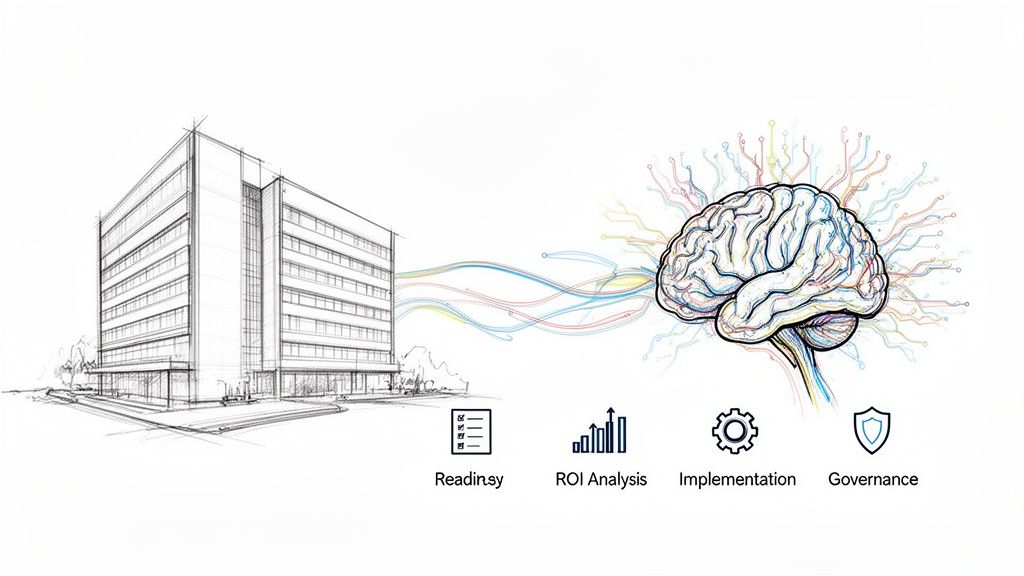
Having a formal AI investment strategy for hospitals isn't some far-off idea anymore; it's a fundamental tool for staying afloat and getting ahead. Think of it as a detailed roadmap for putting money into technologies that genuinely improve patient outcomes, create financial stability, and keep you competitive in a healthcare world that's changing faster than ever.
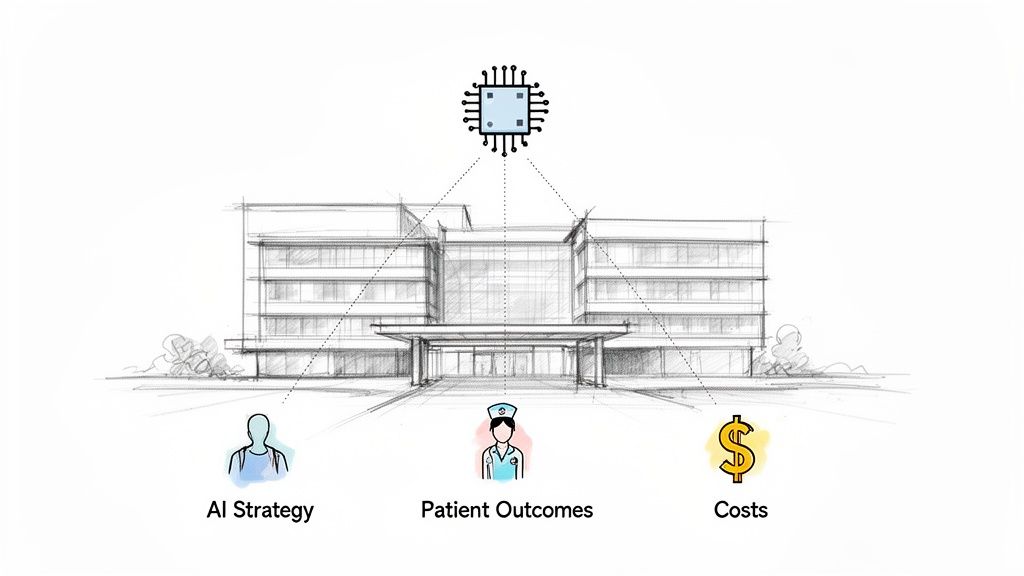
Let's cut through the hype. The pressures forcing hospitals to get serious about artificial intelligence are real and they're here today. We're talking about crippling operational costs, ongoing staff shortages, and the constant demand for better, more personalized patient care. This isn't about buying fancy tech; it's about finding real answers to the biggest problems we face every day.
Jumping in without a plan is a recipe for wasted resources. The market is moving incredibly fast, and big money is pouring into specialized healthcare AI. Consider this: by mid-2025, AI startups in healthcare were already capturing 62% of all digital health venture funding in the U.S. The average funding round? A staggering $34.4 million.
For hospital leaders, the writing is on the wall. It’s time to get strategic about AI, focusing on high-impact areas where others are already seeing success. You can dig deeper into these AI healthcare investment trends to see where the momentum is heading.
So, why is a coherent AI investment strategy for hospitals so critical? It all comes down to a few core pressures that hit both your quality of care and your bottom line. Without a clear plan, your AI investments become a scattershot of disconnected projects that don't align with what your hospital is actually trying to achieve. As we explored in our AI adoption guide, a well-thought-out strategy makes sure every AI initiative builds toward a stronger, more efficient future.
Here are the key drivers making an AI strategy non-negotiable:
A formal AI strategy turns AI from a series of disjointed projects into a cohesive engine for growth. It aligns technology with business objectives, ensuring every dollar invested contributes to measurable improvements in patient outcomes and operational efficiency.
This guide is designed to be your framework for that journey. We'll walk you through how Ekipa AI's specialized Healthcare AI Services are helping leaders navigate this shift. With expert AI strategy consulting, we help turn big goals into a practical, step-by-step roadmap. Because in this environment, being proactive isn't just an option—it's the only way forward.
Before you even think about vendors or budgets, any smart AI investment strategy for hospitals has to start with an honest look in the mirror. Jumping into an AI project without knowing your starting point is like planning a major surgery without running the pre-op labs. This initial assessment gives you a reality check, ensuring your entire strategy is built on solid ground.
This isn't just about servers and software. A real readiness check looks at everything: your tech, your data, and, most importantly, your people. You have to get past the high-level talk and dig into the nitty-gritty of how your hospital actually operates.
First things first: let's talk about your hospital's technical backbone. AI models are hungry. They need massive amounts of clean data and serious computing power to work. If your current infrastructure isn't up to the task, even the most brilliant AI tool will fall flat.
Start by asking some tough questions about your data ecosystem:
A critical part of this phase is a detailed analysis to define your AI requirements. This process ensures that the technical specs of any AI solution you consider will actually work with your existing systems and help you meet your long-term goals.
A great way to get a baseline is to measure your organization's current capabilities, often done through an AI Quotient assessment. This gives you a score—a concrete number—that shows you exactly where you stand and what gaps you need to fill before writing any big checks.
Technology is only half the battle. Your people—from the seasoned surgeons to the frontline IT staff—are the ones who will ultimately determine if an AI initiative succeeds or fails. A frank look at your team’s skills and the hospital’s culture is just as critical as checking your server capacity.
Take stock of your human capital:
I’ve seen it time and time again: successful AI adoption is almost always more about the people than the platform. This assessment tells you what kind of human landscape you're navigating.
Once you have a clear picture of your readiness, you can start setting real goals. One of the biggest mistakes I see is aiming for fuzzy targets like "improve efficiency." That’s not a strategy; it’s a wish. You need to define specific, measurable, achievable, relevant, and time-bound (SMART) goals.
Don't just say you want to "improve patient outcomes." Get specific. A much stronger goal sounds like this: "Reduce patient readmission rates for congestive heart failure by 15% within 18 months by implementing a predictive analytics tool."
This kind of clarity turns an AI experiment into a focused business initiative. It also gives you concrete benchmarks for measuring success and proving the ROI of your investment in Healthcare AI Services. You’re tying every dollar spent directly to results that matter for your patients and your bottom line.
Once you have a clear-eyed view of your hospital's AI readiness, it's time for the exciting part: deciding where to direct your efforts. This is where a smart AI investment strategy for hospitals really starts to take shape. The temptation can be to chase the latest shiny object, but the most successful initiatives start by finding that sweet spot between a project’s potential impact and its real-world feasibility.
Let's be honest—jumping into a complex clinical AI project without the right data pipelines or skilled teams is a fast track to a stalled, over-budget initiative. A much better approach is to start with a structured method for identifying both quick wins and bigger, game-changing projects.
A prioritization matrix is one of the most effective tools I've seen for this. It takes the guesswork out of the equation and forces a data-driven conversation about what truly matters.
To get started, you'll want to evaluate each potential AI use case against a consistent set of criteria. This creates an apples-to-apples comparison that quickly separates the high-value opportunities from the high-risk distractions.
Your scoring system should be simple but comprehensive. I recommend focusing on these four areas:
By running your ideas through this scoring process, you’ll quickly see which projects rise to the top. Those high-impact, low-complexity projects are your green-light initiatives. They deliver tangible results fast, building the momentum and trust you need to tackle more ambitious goals down the road.
To help visualize this, here is a sample matrix that hospital leaders can adapt to evaluate and score potential AI projects.
| AI Use Case | Potential Clinical/Operational Impact (1-5) | Estimated Financial ROI (1-5) | Implementation Complexity (1-5) | Data & Tech Readiness (1-5) | Priority Score |
|---|---|---|---|---|---|
| Predictive Sepsis Detection | 5 | 4 | 4 | 4 | 17 |
| Automated Prior Authorization | 3 | 5 | 2 | 5 | 15 |
| AI-Powered Supply Chain | 3 | 4 | 3 | 4 | 14 |
| Patient No-Show Prediction | 4 | 3 | 2 | 5 | 14 |
| Clinical Trial Matching | 5 | 2 | 5 | 3 | 15 |
This scoring helps quantify the trade-offs, making it easier to build consensus around which projects should be funded and staffed first.
The market is buzzing with powerful real-world use cases that are already delivering impressive returns for hospitals. We’re seeing everything from predictive analytics for early sepsis detection—which has a massive impact on patient outcomes—to AI tools that automate supply chain management and cut down on operational waste.
The growth here is staggering. In 2025, AI adoption in healthcare soared, with 22% of organizations deploying specialized tools, a massive seven-fold jump from 2024. Health systems are leading the investment, pouring $1 billion of the total $1.4 billion provider spend into AI. Interestingly, startups captured 85% of generative AI spending, showing just how valuable niche, purpose-built tools have become. You can dig into more of these AI adoption trends on menlovc.com.
This data really drives home the point: focus is everything. For a deeper dive into your hospital’s unique opportunities, a Custom AI Strategy report can provide the specific insights needed to move forward with confidence.
To get any project funded, you need a business case with hard numbers. It’s non-negotiable. Let’s walk through a quick, back-of-the-napkin ROI calculation for an AI-powered prior authorization tool, a universal headache in healthcare administration.
Scenario: A mid-sized hospital handles 20,000 prior authorizations per year.
This simple math often seals the deal. And that doesn't even touch on the "soft" benefits—like getting paid faster due to quicker approvals, seeing fewer claim denials, and boosting team morale by automating away soul-crushing paperwork. These are the kinds of numbers that turn a proposal into an approved project.
The chart below gives a snapshot of where many hospitals stand in their readiness journey.
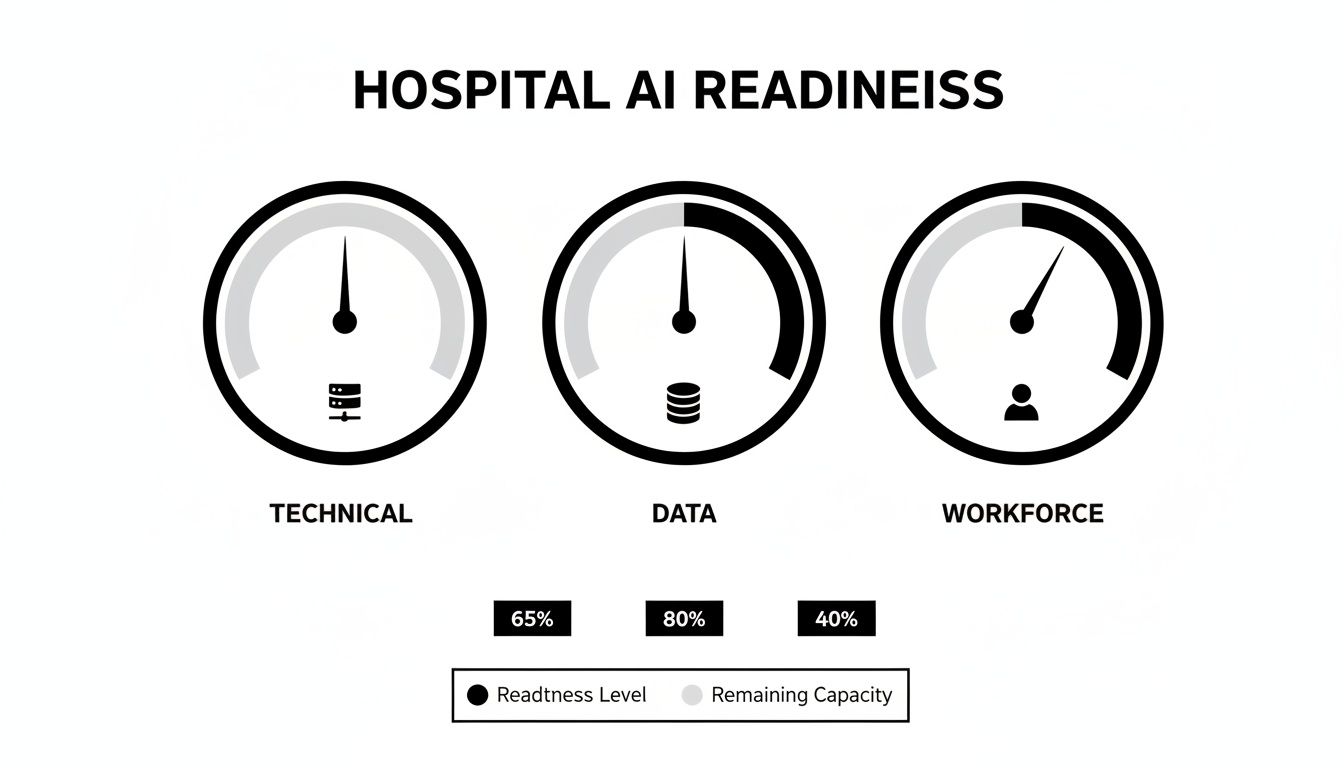
It highlights a common pattern: data infrastructure is often quite strong, but the workforce skills needed to actually use that data effectively are lagging. This points to a clear need for targeted training and support. One way to bridge that gap is with specialized tools like the Ekipa Clinic AI Assistant, which is designed to fit right into existing clinical workflows.
By carefully selecting use cases that play to your strengths while also addressing your strategic goals, you position your AI investments for maximum impact and long-term success.
A brilliant AI strategy is just a starting point. Without a solid execution plan, even the most promising ideas will fall flat. Once you've pinpointed your high-impact use cases, the real work begins: building a detailed roadmap that takes you from a small-scale pilot to a full-fledged, hospital-wide deployment.
This isn't just about Gantt charts and technical timelines. It’s a comprehensive game plan covering technology procurement, vendor selection, robust governance, and a clear path to scaling up. Our AI Product Development Workflow provides a structured approach for this entire journey.
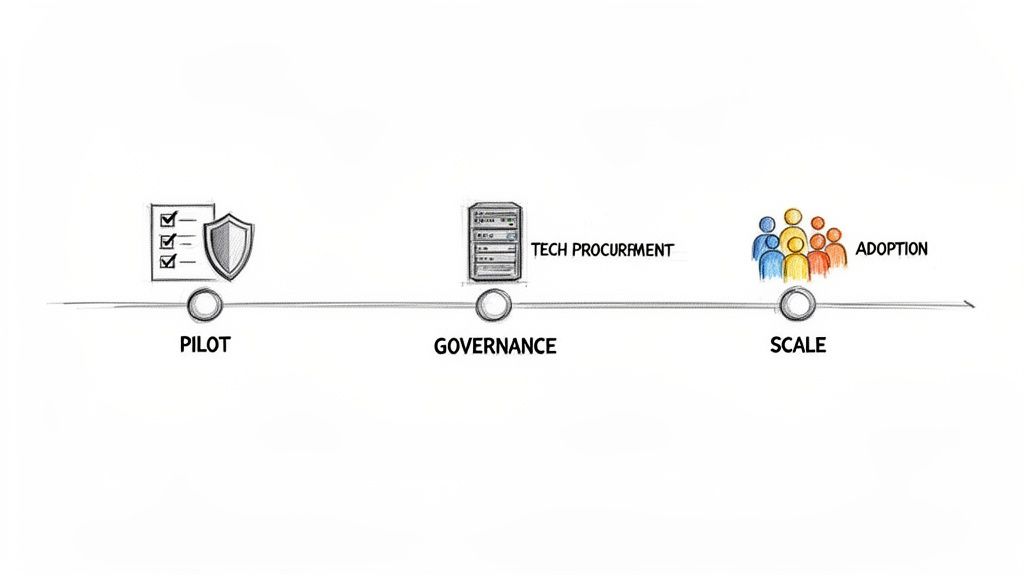
The market is crowded with AI vendors, and choosing the right one is arguably one of the most critical decisions you'll make. The best partner for you depends entirely on your specific needs, your team's current readiness, and the complexity of the problem you're trying to solve.
First, you need to decide what kind of solution fits your situation. Are you looking for off-the-shelf tools that can plug into your existing workflows with minimal fuss? Or is your challenge so specific that it demands custom software development?
When you start evaluating potential partners, here's what you need to zero in on:
The investment world is already voting with its dollars. In 2025, venture capital investment in healthcare AI surged to nearly $18 billion, accounting for a massive 46% of all healthcare investments. Investors are laser-focused on companies that deliver tangible ROI, especially in workflow automation. This trend underscores the need to partner with vendors who offer specialized tools that can deliver immediate wins.
Whatever you do, don't try to boil the ocean. The most successful AI initiatives I've seen all started small with a tightly controlled pilot project. The goal here is simple: test your assumptions, iron out the kinks in a low-risk environment, and gather the data you need to justify a wider rollout.
Pick a single department or workflow to start. For instance, if you're exploring an AI-powered diagnostic tool, focus on the radiology department first. Define clear, measurable success metrics from day one, like "reduce diagnostic turnaround time by 30%" or "decrease radiologist administrative tasks by 5 hours per week."
Once the pilot proves its value, you can confidently move toward scaling the solution. This next phase requires its own detailed plan, covering everything from staff training and change management to ongoing performance monitoring. We've built a structured framework for this entire lifecycle in our comprehensive AI implementation support model, which guides you from the initial concept all the way through full-scale deployment and continuous improvement.
In healthcare, technology and ethics are two sides of the same coin. A robust governance framework isn't a "nice-to-have"—it's an absolute necessity for protecting your patients, your staff, and your hospital's reputation. Honestly, this is where many AI projects stumble.
Governance is the essential immune system for your AI strategy. It protects against the risks of bias, privacy breaches, and ethical missteps, ensuring your technology is used safely and responsibly.
Your governance plan must tackle several critical areas head-on:
By building these guardrails from day one, you ensure your AI investments don't just drive efficiency but also uphold the highest standards of patient care and trust.
Getting the technology right is just the start. When we talk about a successful AI investment strategy for hospitals, the real make-or-break moments happen at the human level. You can have the most sophisticated AI solutions on the planet, but if your people don’t embrace them, you’re left with an expensive, unused tool and a frustrated team.
The trick is to stop thinking about this as a software rollout and start seeing it as a people-centric evolution. Your clinicians and staff are already under incredible strain. Pushing new tools on them without their input is a surefire way to hit a wall of resistance. Real, lasting adoption comes from a solid plan for change management in digital transformation—one that supports your staff every step of the way with clear communication, hands-on training, and a few influential friends.
You can't just send out a memo and expect everyone to jump on board. You have to build a genuine groundswell of support by proving the value of these new tools and tackling concerns head-on. This isn't a top-down mandate; it's a collaborative effort that has to respect the deep expertise your clinical and operational teams bring to the table.
Here’s a tactic I’ve seen work wonders: start with projects that make your staff’s lives easier first. Before you even think about patient-facing AI, deploy internal tooling that gets rid of the tedious, soul-crushing administrative work. When a physician realizes an AI assistant just cut their charting time by 30%, they don't just adopt the tool—they become its biggest fan. That’s how you create a positive feedback loop that builds the trust and momentum needed for the bigger, more ambitious projects down the road.
To lead the charge, find and empower "AI champions" in your hospital. These are the respected clinicians and department heads who see the promise of this technology and are excited to explore it.
These champions become your most authentic advocates. They’re the ones who can translate the high-level strategy into tangible "what's-in-it-for-me" benefits that actually resonate with their colleagues. As we've seen time and again, this kind of bottom-up support is the secret sauce for long-term success.
To keep the momentum going and justify the investment, you absolutely have to track your performance. And I don’t mean vague goals like “improving efficiency.” Your Key Performance Indicators (KPIs) need to be specific, measurable, and tied directly back to the goals you set during your AI requirements analysis.
This data-driven feedback loop is your best friend. It’s what proves the value of your AI initiatives to the C-suite and gives your team the insights they need to tweak and improve things over time—a core principle of our AI Automation as a Service philosophy.
Don't get caught up in measuring simple tech metrics like system uptime. Focus on the operational and clinical outcomes that connect directly to your hospital's core mission.
Think about tracking metrics with this level of impact:
| Domain | Key Performance Indicator (KPI) | Example Target |
|---|---|---|
| Operational Efficiency | Average patient wait time in the emergency department | Decrease by 20% within 6 months |
| Clinical Outcomes | Rate of hospital-acquired infections (HAIs) | Reduce by 15% annually |
| Financial Health | Claim denial rate for specific procedures | Lower by 25% in the first year |
| Staff Satisfaction | Time spent on administrative tasks per clinician | Reduce by 5 hours per week |
When you consistently measure and report on these kinds of KPIs, you build an undeniable case for your AI strategy. You're no longer just talking about implementing technology; you're demonstrating measurable improvements to patient care, operational excellence, and your hospital's bottom line. The expert team at Ekipa AI has helped countless healthcare organizations zero in on and track the metrics that truly move the needle.
We've walked through a detailed framework, but let's be honest: making an AI investment strategy work is a continuous effort. It’s not just about planning. Success comes from having a clear vision, sticking to strong governance, and being relentless about tracking real, measurable results. The chance to truly improve patient care and make operations smoother is here, and it’s time to act with confidence.
Taking that first step, however, can feel daunting. You need a partner who gets the unique pressures and complexities of the healthcare world. That’s where we come in. At Ekipa AI, our specialized AI strategy consulting is all about turning ambitious goals into a practical, on-the-ground roadmap. We help you cut through the hype, pinpoint the opportunities that will actually make a difference, and build a business case that gets everyone on board.
When hospital leaders start exploring AI, a lot of the same questions tend to pop up. Let's tackle some of the most common ones we hear when building an AI investment strategy for hospitals.
Before you even glance at a vendor demo or look into sophisticated AI tools for business, you have to take a hard, honest look in the mirror. The most critical first step is a thorough AI readiness assessment. A solid assessment, which is a core part of any real AI requirements analysis, grounds your strategy in reality, not hype. This means getting granular on your data infrastructure, technical resources, workforce skills, and organizational culture to understand where you truly stand today.
Start small and focused. Pick one high-pain, high-impact problem and launch a tightly controlled pilot project. Instead of trying to overhaul the entire hospital, zero in on a specific workflow, like automating prior authorizations for a single department. Set a crystal-clear, measurable goal, track every metric, and use that hard data to build an undeniable business case for a wider rollout of solutions, such as AI Automation as a Service. This approach contains risk while demonstrating tangible wins.
It’s almost always about people and processes. Change management is the biggest hurdle. Clinicians and staff may resist due to genuine concerns about job security, skepticism about the technology's reliability, or disruption to established routines. The key to overcoming this is transparent communication, practical training, and involving clinical champions from day one. Another massive challenge is establishing solid ethical governance to manage potential bias, which is non-negotiable for ensuring fairness, transparency, and maintaining patient trust.
An AI strategy aligns technology with your hospital’s core business objectives. Simply buying tools without a strategy leads to a collection of disconnected, siloed projects that don’t work together and often fail to deliver meaningful value. A formal strategy ensures every AI initiative—from improving diagnostics to streamlining billing—contributes to a larger goal, such as reducing readmission rates or cutting operational costs. It turns your investment from a series of expensive experiments into a cohesive engine for growth and improved patient care.
Ready to build an AI strategy that actually works in the real world? Ekipa AI delivers tailored AI roadmaps and provides the end-to-end support to make it happen. You can start by getting to know our expert team. Explore our AI strategy consulting services today.
How to build HIPAA-compliant AI: when LLM providers need a BAA, data minimization, de-identification, audit controls and a reference architecture.
Practical data migration planning guide for healthcare teams. Scope, mapping, compliance, validation, cutover and rollback decisions explained end to end.

Smart on FHIR guide for healthtech engineers. Learn the OAuth 2.0 launch model, scope syntax, backend services, and US regulatory requirements.
Connect with our team to explore how AI expertise can transform your business.