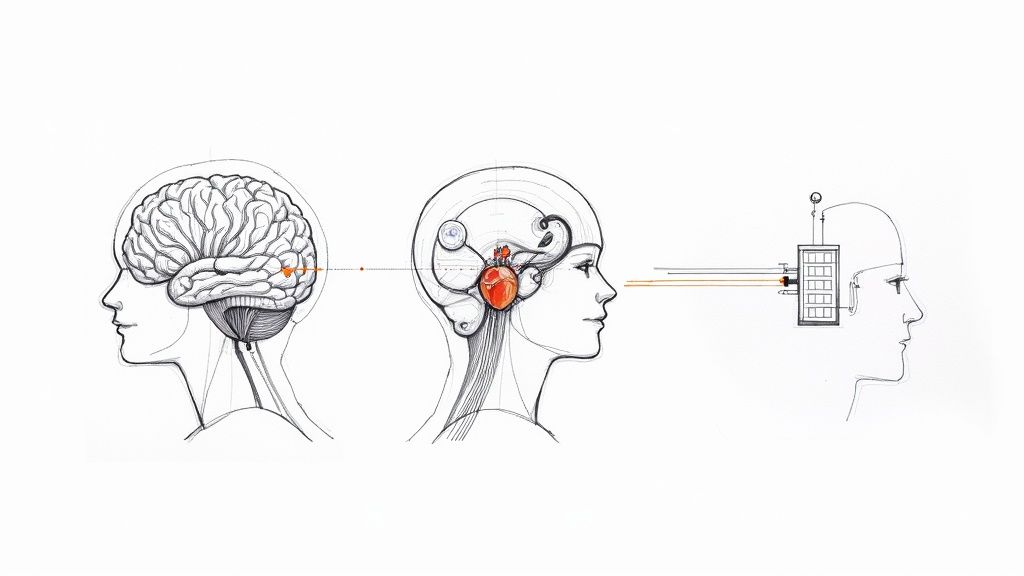
When you think about AI in a hospital, what comes to mind? Maybe a new tool that helps radiologists spot tumors, or an algorithm that predicts patient readmissions. These are fantastic innovations, but too often they're built in isolation. One department creates its own solution, while another team down the hall builds something completely different. They don't talk to each other, they don't share data, and they certainly don't follow the same rules.
This siloed approach is like building a hospital with a series of disconnected extension cords. The radiology department has its own generator, the lab has another, and the billing office is running on yet another. It might work for a while, but it's inefficient, risky, and impossible to scale.
Building Your AI Foundation in Healthcare
AI platform engineering is the answer to this chaos. It’s the discipline of building a central, reliable infrastructure for every single AI initiative across the health system. Think of it as installing a proper power grid and data network for the entire hospital, ensuring everything works together securely and efficiently.
This strategy moves AI from a collection of one-off science experiments to a core part of your hospital's operational backbone.
The Shift to a Unified Platform
So, what does this actually look like? Instead of each new AI project starting from scratch, teams tap into a shared, governed foundation. This centralized platform provides all the core services needed to bring an idea to life, from managing data to training models and deploying them safely into a clinical setting.
It's about creating a digital nervous system for your organization.
This foundational approach is essential for turning isolated AI experiments into a coherent, system-wide strategy. It provides the standardized infrastructure necessary for responsible innovation, ensuring that all AI initiatives are secure, compliant, and aligned with clinical and business objectives.
When you stop reinventing the wheel for every project, you gain some powerful advantages. This model is at the heart of how we build robust healthcare software solutions for our partners. A solid platform delivers clear benefits:
- Scalability: You can finally move promising pilot projects into widespread use across the entire organization without having to re-engineer everything from the ground up.
- Governance and Compliance: With centralized controls, you can be confident that every AI model is HIPAA compliant and that sensitive patient data is protected everywhere, all the time.
- Efficiency: Development cycles get shorter. Your teams can deliver new AI tools much faster and at a lower cost because the foundational work is already done.
- Strategic Alignment: A common platform ensures everyone is pulling in the same direction. It aligns all your AI work with the broader organizational goals, a critical outcome we focus on with our AI strategy consulting.
For any healthcare organization serious about the future, moving from project-based thinking to a platform strategy isn't just a good idea—it's a necessity.
The Blueprint for a Healthcare AI Platform
So, what exactly goes into a well-built AI platform for healthcare? It's not just a piece of software. Think of it as a complete, interconnected ecosystem where every component has a specific job, all working together seamlessly. For any executive looking to establish a scalable and secure AI foundation, understanding this architectural blueprint is the critical first step.
The entire system is designed to create a clear path from foundational infrastructure and smart planning to real, measurable growth and better patient outcomes.

This diagram shows how a solid server and data foundation makes a clear AI strategy possible, which in turn fuels real organizational growth. Each stage builds directly on the one before it, creating a cohesive system instead of just a box of disconnected tools.
Core Architectural Components
A healthcare AI platform is built upon a few essential pillars. Each one handles a specific part of the AI lifecycle, from grabbing the initial data to keeping models running smoothly for years—all while respecting the strict regulatory world of healthcare.
These core building blocks include:
Data Ingestion and Integration: This is the front door for all your data. The platform needs to securely tap into and pull information from a huge variety of sources, including Electronic Health Records (EHRs), Picture Archiving and Communication Systems (PACS), lab systems, and even data from patient wearables.
Data Security and Governance: In healthcare, security is never an afterthought; it's baked into the platform's DNA from day one. This layer is all about enforcing HIPAA compliance, locking down Protected Health Information (PHI), and running automated audit trails to make sure every piece of data is handled with extreme care.
Model Development and Training: This is where the magic happens—where the "brains" of the AI are actually built. It gives data scientists the sandboxed environments and tools they need to create, train, and test diagnostic or operational models using clean, well-prepared data.
MLOps and Deployment: A model isn't useful until it's actually helping clinicians. This component automates the process of deploying models into live clinical workflows, making sure they run reliably and can scale up as needed without a hitch.
Explainability and Monitoring: AI can't be a "black box" in medicine. This final, crucial layer makes sure your models are transparent, fair, and stay accurate over time. It continuously watches for any drop in performance or emerging bias, which is absolutely essential for building trust with clinicians and regulators.
This structured, platform-based approach is quickly becoming the standard. A Deloitte report found that over 80% of executives believe generative AI will bring moderate-to-significant value to clinical areas like diagnostic imaging by 2026. Yet, the same report shows that 49% of healthcare organizations are still stuck in the pilot phase. This highlights a big gap between potential and reality, proving the need for platforms that can turn strategy into real, scalable impact.
Building In-House vs. Partnering with a Vendor
One of the first major decisions you'll face is whether to build this entire platform from the ground up or partner with a specialized vendor. The choice has massive implications for your budget, timeline, and long-term success.
Building in-house gives you complete control, but it also demands a huge investment in resources, a team of highly specialized (and expensive) talent, and a lot of time. On the other hand, partnering with a vendor can get you to market much faster and lowers your risk by giving you access to pre-built, compliant infrastructure right away. For example, creating secure internal tooling from scratch is a monumental task, while a good partner can provide proven solutions on day one.
The table below breaks down the key factors to weigh when making this critical decision.
In-House vs Vendor-Based AI Platform: A Strategic Comparison
| Factor |
Building In-House |
Partnering with a Vendor (e.g., Ekipa) |
Strategic Implication |
| Time to Market |
Slow (18-36 months): Requires extensive design, development, and testing cycles from scratch. |
Fast (3-6 months): Utilizes a pre-built, production-ready platform. |
Speed is a competitive advantage. A faster launch means quicker ROI and clinical impact. |
| Upfront Cost |
High: Significant capital expenditure on infrastructure, talent acquisition, and software licenses. |
Lower: Shifts from a massive CapEx to a more predictable OpEx model. |
Frees up capital for other strategic initiatives and lowers the initial barrier to entry. |
| Talent & Expertise |
Difficult to acquire: Needs a full team of specialized AI/ML engineers, data scientists, and security experts. |
Access to experts: Leverages the vendor’s dedicated team of specialists. |
Mitigates the risk and cost associated with a highly competitive talent market. |
| Compliance & Security |
Sole responsibility: Your team is fully responsible for navigating HIPAA, GDPR, and other regulations. |
Shared responsibility: The vendor provides a compliant-ready foundation, reducing your burden. |
Reduces compliance risk and accelerates the path to regulatory approval. |
| Focus |
Diverted to infrastructure: Your team spends time managing infrastructure instead of solving clinical problems. |
Focused on innovation: Your team can focus on building high-value models and applications. |
Aligns your internal resources with core business goals—improving patient care. |
| Long-Term Maintenance |
High ongoing cost: Requires a dedicated team for updates, security patches, and scaling. |
Included in service: The vendor handles all platform maintenance and upgrades. |
Ensures the platform remains current and secure without ongoing internal effort. |
Ultimately, the right path depends on your organization's resources, risk tolerance, and strategic priorities. For many, partnering with an experienced vendor offers a more pragmatic and efficient way to harness the power of AI without the immense overhead of building everything from scratch.
Solving Healthcare's Toughest Compliance and Data Challenges
Healthcare doesn't just have rules; it has regulations with some serious teeth. Navigating strict HIPAA compliance, managing Protected Health Information (PHI), and proving clinical validity aren't just best practices—they're the absolute price of admission. This is precisely where AI platform engineering shows its real value, turning these tough constraints from roadblocks into built-in safeguards.
Instead of treating compliance as a final check-box, a well-designed platform weaves governance directly into its architecture from day one. It creates a secure, controlled environment where every single action, from who accesses data to how a model is deployed, is automatically logged and auditable. This is a core principle of our Healthcare AI Services, ensuring innovation can happen quickly, but always within a safe and compliant framework.

Weaving Compliance into the Platform DNA
Think of a robust AI platform as a central guardian for your data and models. It enforces security and privacy by its very design, so you're not just hoping individual teams get it right every time.
This proactive approach to governance handles several critical jobs automatically:
- Automated PHI De-identification: The platform can automatically strip or mask patient identifiers from datasets before they're used for model training, protecting privacy without someone having to do it by hand.
- Role-Based Access Controls (RBAC): It ensures only authorized personnel can access specific data or models, which dramatically limits exposure and minimizes risk.
- Immutable Audit Trails: Every interaction with data and every decision a model makes gets recorded in a tamper-proof log. This makes audits transparent and far less painful.
By building governance directly into the platform, healthcare organizations can speed up innovation without cutting corners on safety. Compliance becomes a systematic, automated process—a key goal we identify during a thorough AI requirements analysis.
From Data Silos to True Interoperability
The other massive headache in healthcare is the fragmented data. Information is often trapped in separate systems—EHRs, PACS, lab software—that simply don't talk to one another. An AI platform tackles this head-on by creating a unified data layer.
This layer uses modern standards like Fast Healthcare Interoperability Resources (FHIR) to pull these disconnected sources together. The result is a single source of truth, allowing models to train on rich, comprehensive patient data for far more accurate insights. Of course, managing all this data requires a compliant data retention policy for HIPAA to ensure it's handled securely from start to finish.
This shift is already creating new pressures in the market. As providers adopt AI that improves their claims, payers face rising administrative costs and medical loss ratios, pushing them to adopt AI in their own administrative stacks. The growth is explosive; some healthcare AI firms have hit $100M-$200M ARR in less than five years. For comparison, it often takes traditional software companies over a decade to reach that milestone, a trend highlighted in recent analyses on key healthcare AI trends.
By solving these fundamental data and compliance problems at the platform level, healthcare organizations are freed up to focus on what really matters: building powerful AI tools that improve patient outcomes and make operations more efficient.
Your Roadmap for Implementing a Healthcare AI Platform
Bringing an AI platform to life in a healthcare setting is less about a single, massive project and more about a deliberate, phased journey. It's about moving from a big-picture goal to a concrete plan that delivers real, measurable results every step of the way. If you're a leader, you know the challenge is turning the promise of AI into something tangible.
So, how do you actually get this done? We've found a four-phase approach works best. This roadmap is designed to build momentum, sidestep common pitfalls, and make sure every dollar and hour you invest is tied directly to improving clinical outcomes and your bottom line.

Phase 1: Strategy and Use Case Selection
Before anyone writes a single line of code, you have to define what winning looks like. This first phase is all about alignment—connecting your AI ambitions to specific, high-impact problems within your organization. The goal here is to get granular, moving past vague ideas like "improving efficiency" to pinpointing exactly where the pain is.
Start by looking for the bottlenecks with the greatest potential for a quick win. Are your clinicians drowning in paperwork? Are you seeing delays in the diagnostic imaging queue? Is patient scheduling a constant headache? A focused AI requirements analysis is non-negotiable for picking the right initial targets, as we explored in our AI adoption guide.
A solid strategy phase should deliver:
- A short, prioritized list of use cases: Aim for 2-3 high-value but low-complexity projects to get started.
- Crystal-clear goals: Not just "make things better," but something concrete like, "Reduce clinician documentation time by 30%."
- A business case built on data: You need a document that clearly articulates the expected value to get executive buy-in and funding.
Phase 2: Pilot Program and Proof of Concept
With your strategy locked in, it's time to test your assumptions in the real world. A pilot program, or Proof of Concept (PoC), takes one of your chosen use cases and builds a small-scale, working model to prove it can deliver the goods.
This isn’t about building a perfect, polished product. Think of it as a focused experiment. It's designed to generate data, get early feedback from the people who will actually use the tool, and demonstrate tangible value—fast.
The whole point of a pilot is to learn quickly. It lets you test your most critical assumptions on a small scale, minimizing financial risk while you gather the hard evidence needed to justify a bigger investment.
A successful pilot is all about the metrics. For example, if you're piloting an AI scribe, you need to be tracking the exact reduction in time clinicians spend on notes. That data becomes the fuel for your argument to scale up.
Phase 3: Foundational Platform Development
Once the pilot proves its worth, it's time to build the backbone. This is where true AI platform engineering kicks in. You aren't just scaling up the pilot's code; you're building the reusable, secure, and well-governed foundation that will support every AI initiative you launch from here on out.
This means putting those key architectural components in place: the secure data ingestion pipelines, the robust governance frameworks, and a standardized MLOps environment for deploying and monitoring models. This phase is what turns AI from a series of one-off projects into a true system-wide capability. Following a structured AI Product Development Workflow is crucial here to keep development on track and efficient.
Phase 4: Scaled Rollout and Governance
With a solid platform built and a use case validated, the final phase is all about expansion. First, you roll out the initial AI application to a wider group of users. Then, you start development on the next use cases from your prioritized list.
But this is far more than a technical rollout. It demands a strong change management plan. You'll need to develop comprehensive training for clinicians and staff, communicate the benefits clearly and often, and have governance bodies in place to oversee everything from model performance to ethics and security. In this phase, success is measured by adoption rates, user satisfaction, and the steady stream of clinical and operational value your growing AI ecosystem delivers.
How AI Platforms Are Changing Patient Care Right Now
It's easy to get caught up in theory and roadmaps, but the real measure of an AI platform in healthcare is the impact it's having on the ground. While good planning is essential—and understanding the basics of AI roadmap development is a smart move—results are what truly matter. And right now, health systems across the country are seeing real, measurable returns from their platform investments.
These aren't science fiction concepts anymore. We’re talking about predictive models that are actively reducing hospital mortality rates and AI scribes that are giving clinicians precious time back with their patients. This is happening today.
Driving Real Clinical and Financial ROI
The shift from experiment to everyday tool is well underway. A recent survey found that over 80% of health system executives believe generative and agentic AI will create significant value in clinical care by 2026. This isn't just wishful thinking; the early numbers from pioneering organizations are backing it up.
Epic's AI pilots have been shown to cut mortality by an incredible 27%. Wearable devices are helping teams predict 50% of patient deteriorations before they happen. Some AI models are even achieving 85% accuracy in mortality predictions. You can dig into more of these executive outlooks on Deloitte.com. These aren't just statistics; they are direct proof that a well-built platform saves lives and improves care.
The best AI platforms don't just solve one isolated problem. They create an ecosystem where continuous improvement is the default, delivering value by boosting both clinical quality and operational efficiency at the same time.
Tangible Success Stories
Let's look at how this plays out in the real world. These aren't one-off wins; they are the direct outcomes of a unified platform strategy.
Easing Clinician Burnout: AI-powered ambient scribes are a perfect example. These tools listen to a conversation between a doctor and patient and automatically draft the clinical notes. This has been shown to cut documentation time by nearly 10%, letting physicians focus on the person in front of them instead of a computer screen. This is a direct shot at one of the biggest drivers of burnout. The same thinking can be applied to optimize other workflows by developing better internal tooling.
Boosting Revenue Cycle Accuracy: On the financial front, AI is making a huge difference in coding reviews. A platform can scan clinical notes and suggest the correct medical codes, catching errors that would otherwise lead to denied claims. Health systems using this approach are seeing a significant lift in reimbursements while easing the workload on their coding staff.
Improving Diagnostic Precision: Think about radiology. AI models, deployed through a central platform, can help radiologists spot subtle anomalies on scans that the human eye might miss. This means faster, more accurate diagnoses, which leads to earlier treatment. Our overview of Healthcare AI Services dives deeper into applications like these.
These examples show the clear clinical and financial ROI that a strategic AI platform can unlock. To see what else is possible, you can browse through more of these real-world use cases. By building a scalable, well-governed foundation, healthcare organizations are finally making the promise of AI a daily reality for their patients and providers.
Where Do We Go From Here? Your Next Steps
The AI platforms we've been discussing are far more than just technical infrastructure. Think of them as the foundation for what's coming next in healthcare technology: agentic AI.
We're not just talking about predictive models anymore. These are autonomous systems that can handle complex, multi-step tasks while operating under strict, predefined rules. Imagine an AI agent that doesn't just suggest an appointment slot, but independently manages the entire patient scheduling workflow based on clinical urgency, navigates pre-authorizations with insurance payers, and flags at-risk patient groups from population health data—all while following every security and privacy protocol to the letter.
This isn't science fiction. The groundwork you lay with AI platform engineering for healthcare is precisely what makes this future possible. Every component, from the secure data pipelines to the MLOps frameworks, is a building block for these more advanced, autonomous systems. Waiting for this future to simply arrive means you’ll already be behind. The time to build is now.
From Automation to Autonomy
The real shift is moving from systems that simply automate tasks to systems that actively manage outcomes.
For example, an automated system can draft a clinical note from a transcript, which is a fantastic time-saver. But an agentic system takes it further. It could review that same note, check it against the patient’s full history and current treatment plan, spot a potential drug interaction the clinician might have missed, and immediately flag it for review. This represents a completely different level of capability.
This evolution will be built directly on top of the platforms we've outlined in this guide. The ability to manage models, guarantee compliance, and seamlessly integrate into clinical workflows is the bedrock these intelligent agents need to function. Trying to deploy them without a unified platform would be an impossibly complex and risky undertaking.
The path to agentic AI in healthcare isn’t a single, giant leap. It’s a series of deliberate, well-planned steps that start with building a robust and scalable AI platform today—one that can support the increasingly sophisticated applications of tomorrow.
Your Path Forward: A Strategic Imperative
For healthcare leaders, the message is clear: don't wait. The clinical and competitive advantages of a platform-based AI strategy are already becoming obvious.
Getting started requires two things: a solid strategy and the right partner to help you execute it. You first need to define where AI can deliver the most significant value for your organization, and then map out a clear, actionable plan to get there.
Ekipa can help with both. You can begin right now by using our AI Strategy consulting tool to build a detailed roadmap that pinpoints the highest-impact use cases for your specific needs. From there, our expert team has the deep technical skill and healthcare-specific experience to turn that vision into a reality for your clinicians and operations.
To take your first tangible step, explore our AI Automation as a Service. This service is designed to deliver immediate value by automating high-priority tasks, giving you a quick win that demonstrates the power of a platform approach and builds momentum for the larger journey ahead. Don't just plan for the future—start building it.
Frequently Asked Questions (FAQ)
As a leader in healthcare, you’re probably asking some tough questions about investing in a new AI platform. That’s a good thing. Let’s tackle a few of the most common ones we hear from CTOs and hospital executives.
How Can We Justify The Initial Investment In An AI Platform To Our Board?
When you talk to the board, it's not about a new IT expense; it's about a fundamental shift in how you operate. The conversation shouldn't be about cost, but about value.
You can build the business case around three clear areas of return:
- Operational ROI: Think about tangible financial gains. For instance, AI-driven coding automation can directly boost reimbursement rates and cut down on administrative overhead.
- Clinical ROI: This is about patient outcomes. Highlight how predictive models can lead to measurable improvements, like a reduction in patient mortality or faster, more accurate diagnoses.
- Strategic ROI: This is the long game. An AI platform is the foundation for every future AI initiative you'll launch. It future-proofs the organization and makes innovation scalable, not a series of one-off projects.
Our Custom AI Strategy report can help you put hard numbers behind this vision and present a clear path to value for your specific organization.
Our Data Is In Multiple Legacy Systems. Is AI Platform Engineering Still Possible?
Absolutely. In fact, that's one of the main problems a well-designed AI platform is built to solve. It’s a common scenario—EHRs, LIS, PACS, and billing systems all speaking different languages.
A modern AI platform doesn't require you to rip and replace those systems. Instead, it creates a robust data integration layer on top of your existing infrastructure. Using standards like FHIR, it pulls data from these disparate sources and acts as a central hub to clean, standardize, and secure it for modeling. We often solve this exact issue through custom healthcare software development.
What Is The Difference Between Buying AI Tools And Building An AI Platform?
Buying individual AI tools for business is like buying a collection of high-end kitchen gadgets. You might have a great blender and a fancy stand mixer, but they don't work together, they take up counter space, and you have to clean them all separately.
Building an AI platform is like designing a professional, fully integrated kitchen. Everything has its place, the workflow is seamless, and the entire system is designed for safety, efficiency, and scale.
A platform gives you centralized governance, security, and a single source of truth for monitoring. This is crucial for avoiding disconnected "shadow AI" projects and ensuring everything you build is manageable, compliant, and aligned with your core strategy.
How Long Does It Take To See ROI From A Healthcare AI Platform?
You don't have to wait years to see a return. Targeted pilot projects can start showing value within 6-12 months. For example, our AI Automation as a Service can deliver quick wins by deploying AI scribes that immediately reduce clinician documentation time.
The broader, system-wide ROI—like major shifts in clinical outcomes or massive operational efficiencies—tends to emerge over 18-36 months as more models are deployed and the platform scales. The trick is to follow a phased approach that secures quick wins to build momentum while you work toward long-term transformation. This is a core principle of our AI strategy consulting engagements.
Ready to build a future-proof healthcare system? Ekipa AI provides the strategic expertise and technical execution to turn your vision into reality. Let our expert team help you build a compliant, scalable AI platform that improves patient outcomes and streamlines operations.