AI in Healthcare
HIPAA-Compliant AI: How to Use LLMs With PHI Safely
How to build HIPAA-compliant AI: when LLM providers need a BAA, data minimization, de-identification, audit controls and a reference architecture.
October 16, 2026Read more
Achieve AI readiness in healthcare organizations with our guide. Learn to assess your foundation, build a strategic roadmap, and implement AI solutions safely.
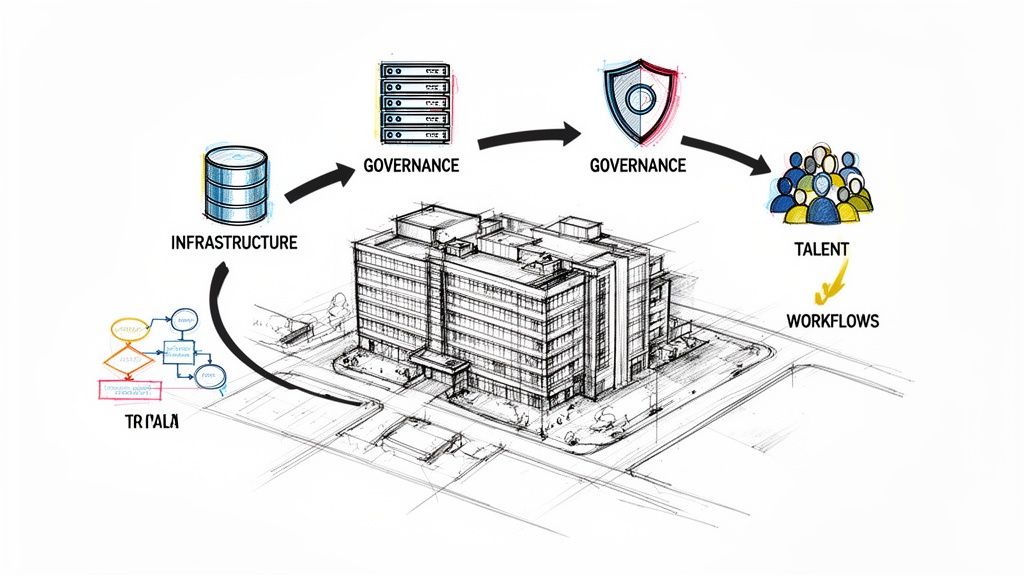
The days of "wait and see" with artificial intelligence in healthcare are long gone. For healthcare leaders, AI readiness has moved from a topic for future conferences to a critical, here-and-now strategic priority. Getting a clear-eyed view of your organization's readiness isn't just a technical check-the-box exercise; it's a fundamental business capability that directly impacts competitive standing and patient outcomes.
Cautious experiments with AI are rapidly being replaced by confident, full-scale deployments in both clinical and administrative settings. The data tells a compelling story, one that should create a sense of urgency for any leader who's been sitting on the sidelines. Before diving in, it’s helpful to have a solid grasp of the fundamental concepts of Artificial Intelligence.
This shift is about more than just plugging in new software. It's about rethinking how healthcare is delivered from the ground up. We're seeing organizations move past isolated pilot programs to weave AI directly into their core workflows—and the results speak for themselves.
The numbers don't lie. In 2025 alone, the use of generative AI in healthcare organizations has jumped from 72% in Q1 2024 to an estimated 85% by the end of the year.
What’s driving this? Tangible return on investment. A full 82% of organizations now report seeing moderate or high returns from their AI projects. In fact, healthcare is now deploying AI at 2.2 times the rate of the broader economy, a stunning reversal that has turned a historically cautious sector into a tech-adoption leader.
AI readiness is no longer a forward-thinking luxury but a present-day necessity. Organizations that delay building their capabilities risk falling behind in efficiency, innovation, and quality of care.
So, what does it actually mean to be "AI-ready"? It means methodically preparing your organization to seize these opportunities, not just react to them. It starts with an honest, holistic look at where you stand today across several key domains.
Assessing your AI readiness involves a deep dive into five core pillars. These are the foundational elements that will either support or undermine any AI initiative you launch.
Core Pillars of AI Readiness in Healthcare
| Pillar | Key Focus Area | Why It Matters |
|---|---|---|
| Data Maturity | Availability, quality, and accessibility of clinical and operational data. | AI models are only as good as the data they're trained on. Messy, siloed data is a project killer. |
| Tech Infrastructure | Scalable cloud computing, data storage, and integration capabilities. | Your systems must be able to handle the intense computational demands of AI without buckling. |
| Governance & Compliance | Ethical guidelines, data privacy policies (HIPAA), and model validation. | Without clear rules of the road, you risk patient trust, regulatory penalties, and reputational damage. |
| Talent & Culture | In-house data science skills and a culture open to data-driven change. | You need the right people—and the right mindset—to move from concept to successful implementation. |
| Clinical & Business Workflows | Identifying high-impact use cases and ensuring seamless user adoption. | Technology for its own sake is useless. AI must solve a real problem for clinicians or staff to be effective. |
Understanding where your organization stands on each of these pillars is the first step toward building a successful AI program.
This guide is designed to give you a practical framework for that assessment and help you build an actionable roadmap. By focusing on these core components, you can move AI from a buzzword to a powerful engine for growth and better patient care. A well-defined strategy is essential, and our expert team providing Healthcare AI Services can help you navigate this complex journey.
Before you can build anything ambitious, you have to know what you’re working with. It’s the same with AI in healthcare. Before you jump into a major AI solutions project, you need a brutally honest blueprint of where your organization stands right now. This isn't about theory; it's a diagnostic that gives you a clear snapshot of your strengths and, more importantly, your weaknesses across five critical areas.
Think of it as the starting point for any serious AI strategy consulting effort. Without it, you’re just guessing.
The gap between ambition and reality is often wider than leaders think. One recent survey found that while most healthcare executives know their systems need work, only 15% felt they had easily scalable infrastructure ready for AI. That’s a massive disconnect and exactly why a thorough, structured assessment is non-negotiable.
AI is fueled by data, but in healthcare, that fuel is rarely clean or easy to access. It’s usually scattered across EHRs, billing platforms, imaging archives, and lab information systems. The real challenge isn't just finding the data; it's about its quality and whether you can actually connect the dots.
You need to start asking some tough questions:
Getting straight answers here is the very first step in a proper AI requirements analysis.
Your current technology has to be up to the task. The intense computational muscle needed for modern AI just isn't available on most legacy, on-premise servers. You need a solid technical foundation whether you're building better internal tooling for your staff or deploying complex diagnostic algorithms.
Take a hard look at your infrastructure:
Let’s be clear: just having data isn't enough. If you can’t process, secure, and analyze it at scale, it’s a wasted asset. A detailed inventory of your tech stack is absolutely essential.
In healthcare, you can't innovate at the expense of trust. It’s interesting that while 70% of executives say they’re confident in their AI governance, many will admit their existing frameworks need a major overhaul. This is a make-or-break area for anyone providing Healthcare AI Services.
A solid governance plan is your safety net. It ensures you’re deploying AI ethically, protecting patient privacy under HIPAA, and have clear lines of accountability. This means having real policies for mitigating bias, ensuring human oversight, and making models transparent. Working with specialists in custom healthcare software development can help you build compliance in from the very beginning.
Technology is just a tool. The real engine of change is your people. But here’s a worrying statistic: only 6% of healthcare organizations have comprehensive AI training programs in place.
It's time to assess your human capital:
You can't just expect people to get on board. Overcoming skepticism means investing deliberately in training and building a culture that values curiosity and experimentation.
Finally, every AI project has to be anchored to a core business goal. You're not doing AI for the sake of AI; you're doing it to solve a real, pressing problem. As we detail in our guide to the AI Product Development Workflow, every project needs a clear "why" behind it.
Is the goal to slash administrative overhead? Improve the accuracy of diagnoses? Or create a better, more engaging patient experience?
When you tie every initiative to a specific, measurable outcome, you build a powerful business case that ensures your investment actually pays off. This whole evaluation process gives you the raw material for a Custom AI Strategy report that is grounded in your reality, not just wishful thinking.
An honest look at where you stand with AI readiness is a crucial first step, but it’s not the finish line. The real work begins when you turn that self-assessment into a clear, actionable, and prioritized roadmap for the next few years. This strategic plan is what bridges the gap between knowing your current capabilities and actually launching high-impact AI solutions that deliver real results.
I've seen many organizations get this wrong. They end up chasing shiny, exciting AI projects without a solid plan, which almost always leads to wasted money and lost momentum. A methodical roadmap ensures every step you take builds on the last, creating a stable foundation for long-term success.
This process—Assess, Analyze, Strategize—is the only way to ground your roadmap in reality.
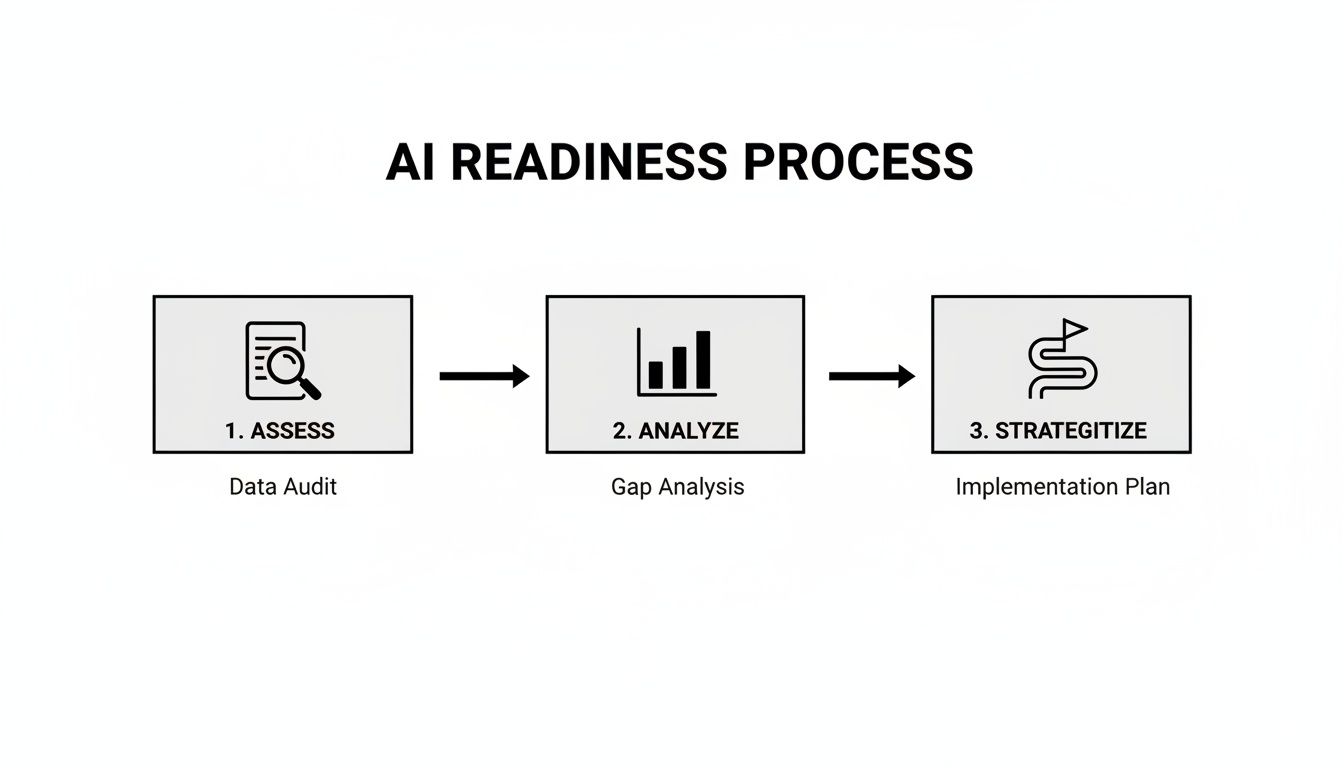
You can't skip ahead. First, you have to get a handle on your data and systems. Then, you figure out where the gaps are. Only after that can you build a smart strategy to close them.
It’s always tempting to jump straight into the cool, patient-facing AI applications. But if your readiness check revealed weak spots in your data maturity or infrastructure, you have to pump the brakes. Those foundational issues must come first.
Your roadmap should stack these enabling projects right at the beginning. Think of them as the groundwork for everything else you want to build.
These projects aren’t glamorous, but they are absolutely non-negotiable. They create the clean, accessible data and robust infrastructure that more advanced AI tools for business will ultimately rely on.
A smart roadmap is a mix of different types of initiatives. While that foundational work is critical, it can take a while to show a clear return on investment. To keep your executive team bought-in and build momentum, you need to deliver some early, visible successes.
Your AI roadmap should be a living document, not a static plan set in stone. It must be flexible enough to adapt to new technologies, changing business priorities, and the lessons learned from early pilot projects.
Look for "quick-win" pilots you can get off the ground in three to six months. These projects should tackle an immediate, well-known pain point, often by automating tedious administrative tasks or building smarter internal tooling that makes life easier for your staff. For example, using an AI model to automate the insurance pre-authorization process can deliver measurable cost and time savings almost right away.
These small victories do two things at once: they solve a real problem and they prove the value of AI to the skeptics in the room. This makes it much easier to get the resources you need for the bigger, long-term goals, like predictive diagnostics or personalized treatment plans. The whole cycle of planning and execution should follow a proven system, much like the one we use in our AI Product Development Workflow.
This last point is critical: every single item on your roadmap must connect to a specific, measurable business objective. Forget vague goals like "improve efficiency." Get precise. The goal isn't just to implement AI—it's to achieve a strategic outcome using AI.
Here’s what that looks like in the real world:
By anchoring every project to a clear "why," you ensure your AI strategy is directly improving the health of the organization. This disciplined approach is at the core of effective AI strategy consulting, turning your readiness assessment from a simple report into a powerful engine for meaningful change.
Once you have a strategic roadmap, it's time to get your hands dirty. The real test is moving from planning to action, and that means picking the right first projects. You want to select initiatives that deliver real value, build momentum, and prove the business case for going bigger with AI.
The key is to sidestep the "shiny object syndrome." Instead, focus on genuine use cases that solve immediate, nagging problems for your clinicians, administrative staff, and, ultimately, your patients.
It’s a bit of a balancing act. You need a practical way to weigh the potential return against the technical difficulty and how well a project fits your core mission. Get this right, and your first steps into AI will be confident and impactful, setting a positive tone for everything that follows.
With so many potential AI solutions out there, deciding where to start can feel like a huge task. I've found that a simple but powerful approach is to map out potential projects based on their business impact and technical feasibility. This quickly helps you spot the low-hanging fruit—projects that are relatively straightforward to implement but deliver a significant, visible return.
Think about starting with pilots in these key areas:
These kinds of projects are perfect for securing those quick wins. They build confidence across the organization and make it much easier to get buy-in for more ambitious AI initiatives later on.
AI adoption in healthcare is picking up speed, but it’s not happening evenly everywhere. By 2025, a notable adoption gap is expected across the sector: health systems are projected at 27%, outpatient providers at 18%, and payers at just 14%.
Even with these differences, the U.S. healthcare industry as a whole is deploying specialized AI tools 2.2 times faster than the broader economy. To put a finer point on it, by 2024, 71% of non-federal acute-care hospitals were already using predictive AI within their EHRs, with large hospital systems hitting nearly 96% adoption. The 2025 State of AI in Healthcare report dives deep into this trend if you want to explore the data further.
This tells us where the real momentum is. Here are a few concrete examples I've seen work incredibly well:
To bring this all together, a prioritization matrix is an invaluable tool. It forces you to think critically about each potential project, scoring it against the factors that matter most. It’s a straightforward way to compare apples to apples and make a data-informed decision rather than an emotional one.
| Use Case | Potential Business Impact (High/Med/Low) | Technical Feasibility (High/Med/Low) | Strategic Alignment (High/Med/Low) | Recommended Action |
|---|---|---|---|---|
| Automated Prior Authorizations | High | Medium | High | Prioritize as Pilot |
| Predictive Patient No-Shows | Medium | High | High | Quick Win |
| Ambient Clinical Scribe | High | Medium | High | Prioritize as Pilot |
| Real-time Bed Occupancy Dashboard | Medium | High | Medium | Quick Win |
| Oncology Treatment Recommendation | High | Low | High | Phase 2 / Long-term |
This framework isn't just about picking winners; it's about sequencing. You can identify the quick wins to start with while planning for the more complex, high-impact projects as part of your longer-term roadmap.
Prioritizing use cases is about solving today's problems to earn the right to tackle tomorrow's challenges. Start with projects that reduce friction and frustration for your staff. A happy, efficient workforce is the foundation for any successful tech implementation.
When you're brainstorming, looking at examples like those found in Health Economics and Outcomes Research (HEOR) Use Cases can show you what's possible when leveraging complex healthcare data.
Ultimately, a deep dive into your own specific challenges, often detailed in a Custom AI Strategy report, will provide the most tailored recommendations. By focusing on high-impact, feasible projects first, you build a powerful portfolio of real-world use cases that prove AI's value and accelerate your entire organization's readiness.
In healthcare, any innovation that doesn't build trust is dead on arrival. As we rush to bring AI into our organizations, building a solid governance framework isn't just a "nice-to-have." It's the only way to protect patients, manage risk, and make sure your AI programs have a future.
Think of it this way: proactive governance isn’t a roadblock to progress. It's the foundation that makes trustworthy and effective AI readiness in healthcare organizations possible in the first place.
Interestingly, while a recent survey showed that 70% of executives feel good about their current AI governance, most of them also admit those same structures need a major overhaul to keep up. That gap between confidence and capability is a huge red flag. When you're dealing with patient data and clinical decisions, you simply can't afford to "figure it out as you go."
A good governance framework isn’t just a document with high-level principles. It’s a set of concrete policies and real-world procedures that guide your AI solutions from the drawing board all the way to deployment and beyond.
Here are the pillars you need to build your framework on:
Principles on paper are one thing, but you need a dedicated group to put them into practice. The most effective way to do this is by forming an internal AI ethics committee. And no, this can't just be another IT task force.
An effective AI ethics committee has to be a multidisciplinary team. It should bring clinicians, data scientists, legal experts, compliance officers, IT leaders, and even patient advocates to the table. This is the only way to get a complete picture of the ethical side of any new AI project.
This group will become your go-to for vetting proposed AI initiatives, flagging potential risks, and making sure every project lines up with your organization's core mission. This kind of hands-on oversight is a central part of any serious AI strategy consulting engagement.
By developing clear policies, you’re not slowing things down; you’re building a culture of responsibility for your Healthcare AI Services. For especially tricky projects, like those involving highly sensitive data or new algorithms, working with experts in custom healthcare software development can ensure you get the compliance and ethical pieces right from day one. These deliberate steps are what build the trust needed to turn powerful technology into a genuine force for better patient outcomes.
Let's be blunt: Technology is only half the battle. Your people are the ones who actually make any transformation happen. You can have the most advanced AI solutions on the planet, but if your clinicians, nurses, and administrators don't get it, trust it, and use it, the investment is worthless. This final piece of the AI readiness puzzle is all about your people—creating a team that isn't just prepared for AI, but actively embraces it.
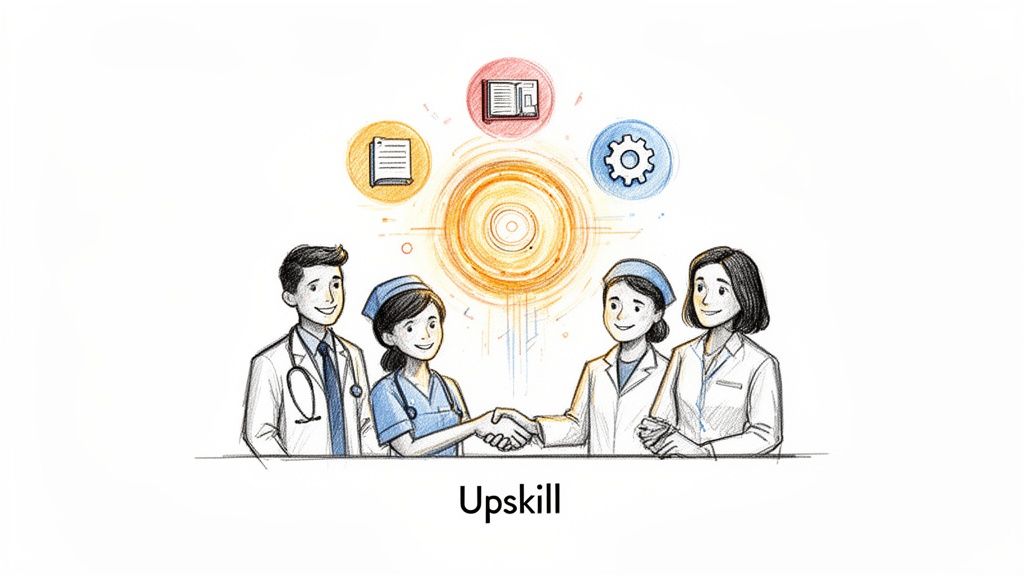
Unfortunately, recent data shows a massive gap here. A staggering 94% of healthcare organizations don't have extensive AI training programs in place. Nearly half are only just starting to think about AI education. This leaves you incredibly vulnerable, as your staff will struggle to tell the difference between truly valuable AI tools for business and those that are just hype.
Getting your workforce ready for AI isn’t about a few one-off training sessions. It’s about a sustained commitment to upskilling and reskilling your teams so they can collaborate with AI, not fight it. The real goal is to demystify the technology and show people how it makes their jobs easier, not how it replaces them.
Your strategy needs to include:
I've seen this work time and time again. One of the single most effective strategies for driving adoption from the ground up is to identify and empower clinical champions. These are the respected physicians, nurses, or technicians who are genuinely excited about AI and can advocate for it among their peers.
When a new AI tool is introduced by a trusted colleague who can speak to its real-world benefits, adoption rates skyrocket. These champions are the bridge between the IT department and the clinical front lines, translating technical jargon into tangible improvements in patient care.
Investing in your people is every bit as crucial as investing in platforms. As our expert team will tell you, a successful AI implementation is, at its core, a human achievement. By building a culture that values continuous learning and champions innovation, you create an environment where technology and talent can finally thrive together.
The most critical first step is a comprehensive readiness assessment. Don't even think about buying tech yet. You have to understand your baseline across data quality, infrastructure, staff skills, and governance. This audit shows you exactly where your gaps are and lets you build a realistic roadmap, not just chase after trendy but ill-fitting AI solutions.
You have to define your KPIs before you start. Otherwise, you're just guessing. These can be operational (like reducing administrative task time by 30%), financial (a 15% drop in patient no-shows with predictive scheduling), or clinical (a 10% improvement in early detection rates). Always start with pilot projects that have clear, easily measurable outcomes to build a strong business case.
Absolutely. AI readiness isn't just for massive hospital systems. Smaller practices can focus on high-impact, lower-cost initiatives. Maybe that means using the AI features already built into your EHR, adopting AI Automation as a Service for a few back-office tasks, or simply improving your data hygiene. The key is to be strategic and solve a specific problem where AI delivers quick, obvious value.
Ready to build a data-driven, AI-powered future for your healthcare organization? At Ekipa AI, we translate complex readiness assessments into actionable strategies, as we explored in our AI adoption guide. Our process is led by our expert team, ensuring you have the right guidance every step of the way.
How to build HIPAA-compliant AI: when LLM providers need a BAA, data minimization, de-identification, audit controls and a reference architecture.
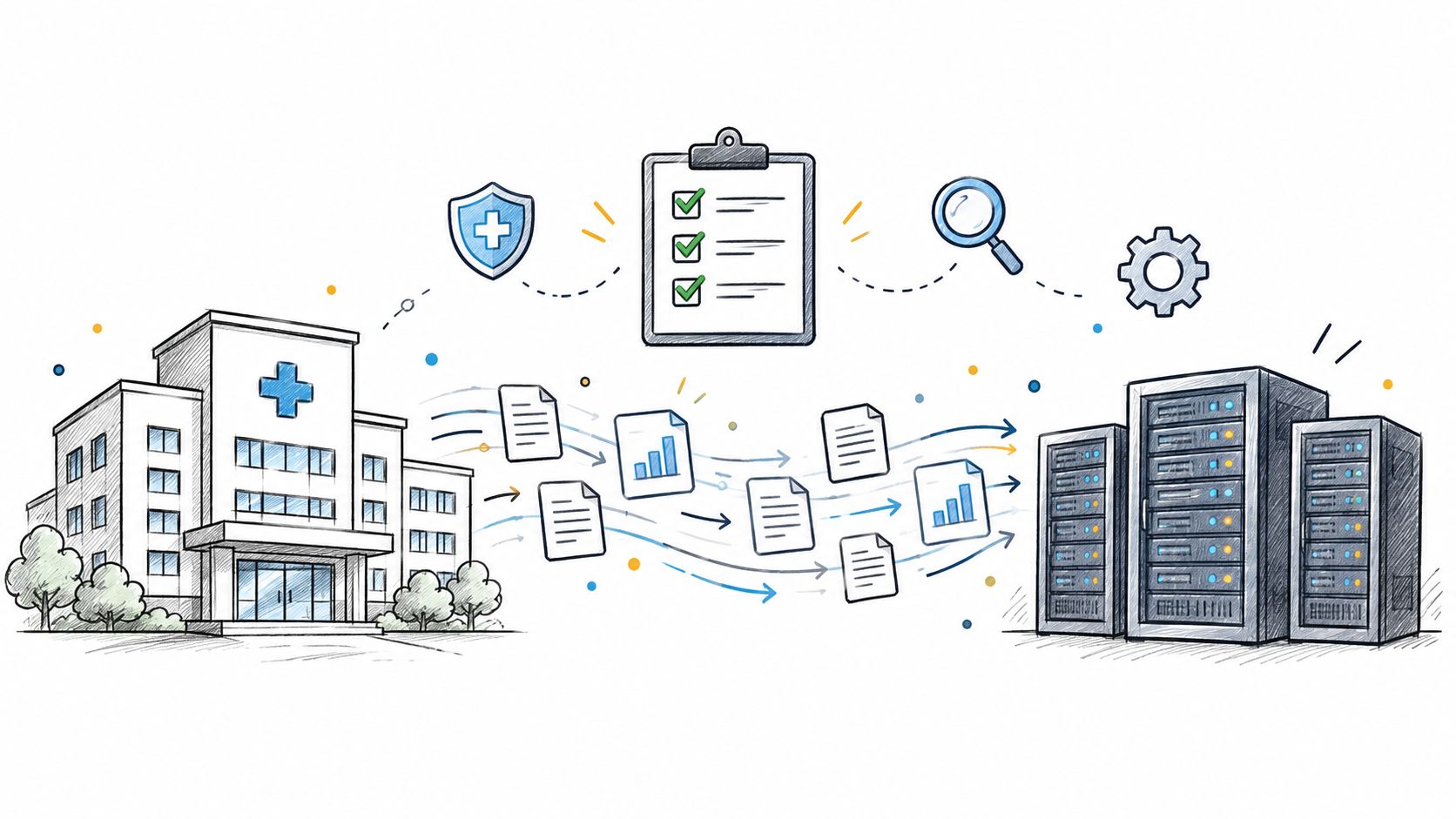
Practical data migration planning guide for healthcare teams. Scope, mapping, compliance, validation, cutover and rollback decisions explained end to end.
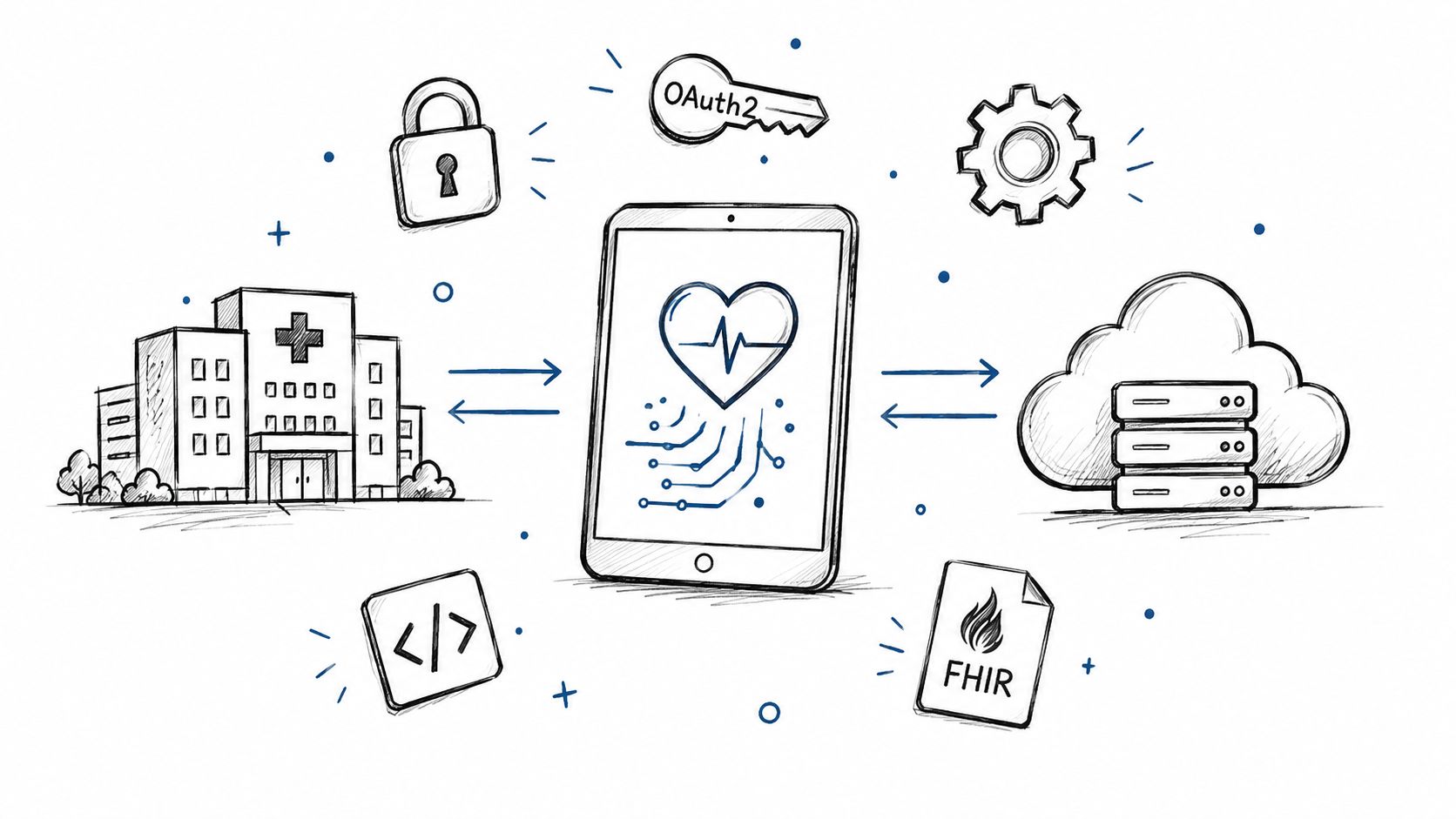
Smart on FHIR guide for healthtech engineers. Learn the OAuth 2.0 launch model, scope syntax, backend services, and US regulatory requirements.
Connect with our team to explore how AI expertise can transform your business.