
AI in Healthcare
Care Team Productivity Analytics Guide for HealthTech
Learn care team productivity analytics KPIs, EHR integration, dashboards and ROI roadmap for healthtech product and ops leaders.
September 08, 2026Read more
Aligning CareOps with revenue cycle processes helps healthcare organizations reduce operational leakage, improve care coordination, and strengthen financial performance. Integrated workflows enhance efficiency, minimize gaps, and support sustainable healthcare operations.
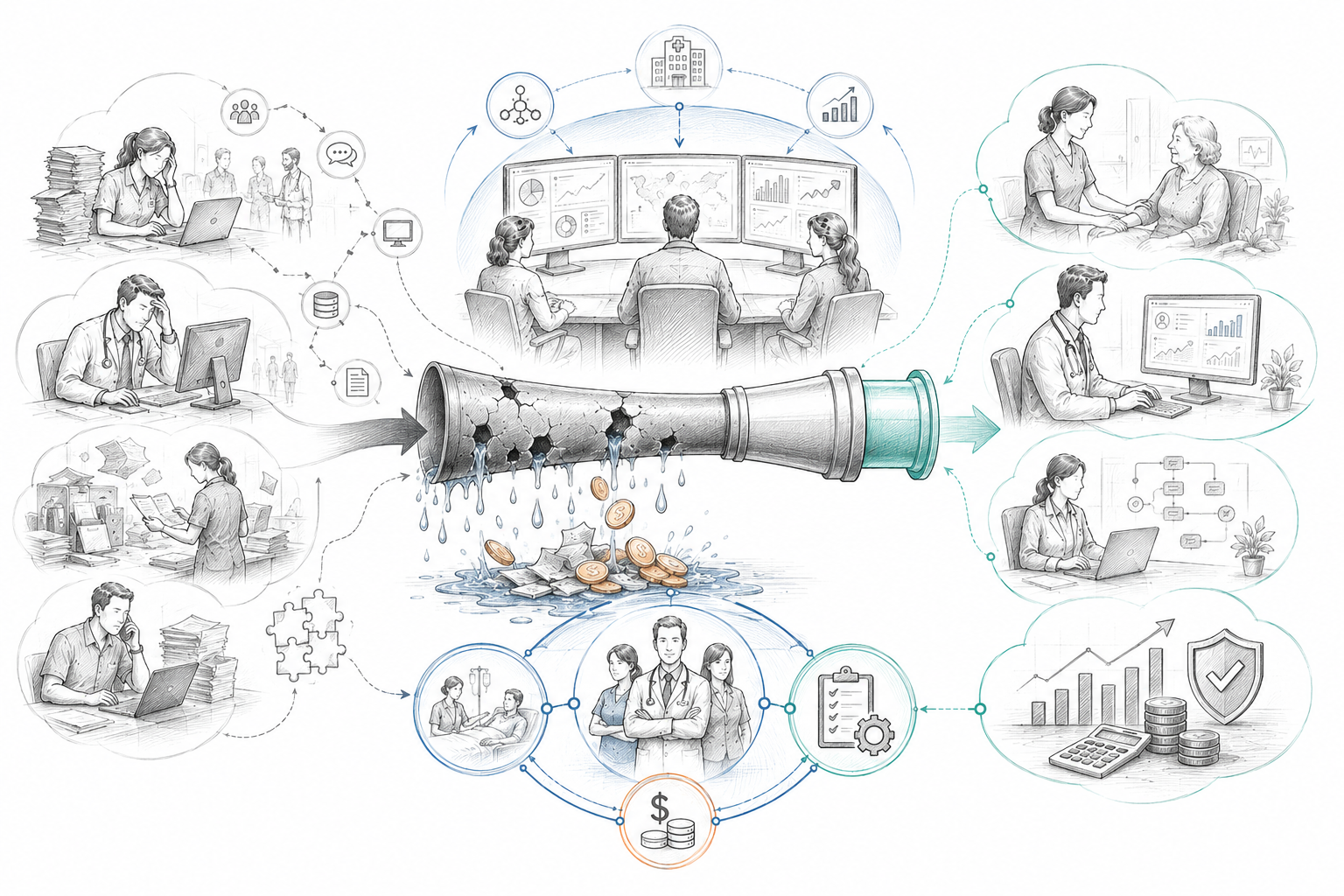
Healthcare organizations are under constant pressure to improve patient outcomes while maintaining financial sustainability. Yet many providers continue to experience operational leakage that affects both clinical performance and revenue generation.
Operational leakage occurs when inefficiencies, communication gaps, disconnected systems, and manual processes create friction across healthcare workflows. While these issues may appear small individually, their cumulative impact can result in delayed reimbursements, increased administrative costs, reduced productivity, and missed revenue opportunities.
Traditionally, healthcare organizations have managed clinical operations and revenue cycle processes separately. However, modern healthcare delivery increasingly requires a more integrated approach. Aligning CareOps initiatives with healthcare revenue cycle optimization strategies enables organizations to create seamless workflows that improve both operational performance and financial outcomes.
As healthcare systems continue to evolve, organizations that successfully connect clinical operations, administrative workflows, and financial processes are better positioned to reduce leakage and achieve sustainable growth.
Operational leakage refers to the loss of efficiency, productivity, or revenue caused by fragmented processes and workflow breakdowns.
In healthcare environments, leakage often occurs across multiple stages of the patient journey, including:
Patient scheduling
Registration and intake
Care coordination
Documentation management
Coding and billing
Claims processing
Follow-up activities
Even minor inefficiencies can create significant financial consequences when multiplied across thousands of patient encounters.
Healthcare leaders increasingly recognize that addressing operational leakage requires visibility across both clinical and administrative functions.
Revenue cycle performance depends heavily on operational effectiveness.
When clinical workflows are disconnected from administrative processes, organizations frequently experience:
Incomplete documentation
Delayed charge capture
Coding inaccuracies
Missed reimbursement opportunities
Increased claim denials
Longer payment cycles
Conversely, organizations that align CareOps strategies with revenue cycle goals create stronger operational foundations.
Integrated workflows improve communication between departments, reduce errors, and ensure critical information flows efficiently throughout the patient journey.
This alignment enables healthcare revenue cycle optimization efforts to begin long before billing activities occur.
Modern CareOps frameworks focus on creating operational consistency across healthcare organizations.
Rather than managing departments independently, CareOps emphasizes collaboration, visibility, and process standardization.
Key benefits include:
Organizations gain real-time insight into operational bottlenecks and performance metrics.
Connected systems help teams identify issues before they affect patient care or reimbursement.
Automation reduces repetitive tasks and improves workforce productivity.
Organizations can allocate staff and operational resources more effectively.
These improvements contribute directly to stronger financial performance while enhancing patient experiences.

Many operational inefficiencies originate from manual workflows.
Administrative staff often spend significant time managing repetitive tasks that can delay care delivery and revenue generation.
Healthcare process automation helps streamline activities such as:
Patient registration
Eligibility verification
Appointment scheduling
Documentation workflows
Claims processing
Follow-up communication
By automating routine processes, organizations can reduce errors, improve accuracy, and accelerate revenue cycle activities.
Automation also supports greater consistency across departments, which is essential for long-term operational success.
Artificial intelligence is becoming a valuable tool for optimizing healthcare revenue cycle optimization cycles.
Advanced healthcare AI services enable organizations to analyze operational data, identify risks, and automate complex workflows.
Common applications include:
AI systems can identify claims that are likely to be denied before submission.
Predictive analytics help organizations anticipate financial performance and resource requirements.
AI-driven insights reveal opportunities to improve operational efficiency.
Automation tools help ensure accurate and complete clinical documentation.
These capabilities reduce operational leakage while strengthening financial performance.
Operational improvement is not limited to administrative workflows.
SaMD solutions (Software as a Medical Device) increasingly support clinical decision-making, risk assessment, and patient management processes.
Examples include:
Clinical decision support tools
Diagnostic assistance platforms
Predictive risk monitoring systems
Remote patient management technologies
When integrated with broader operational strategies, these solutions improve care quality while supporting revenue cycle objectives.
Accurate clinical documentation and improved care coordination can contribute directly to reimbursement accuracy and operational efficiency.
One of the most effective ways to reduce leakage is by eliminating operational silos.
Organizations often operate multiple platforms for scheduling, clinical documentation, billing, reporting, and patient engagement.
Without integration, information must be transferred manually between systems, creating delays and increasing error rates.
Improving care operations efficiency requires:
Unified data environments
Standardized workflows
Cross-functional collaboration
Real-time reporting
Connected operational systems
These capabilities help organizations create seamless experiences for both patients and staff.
Achieving alignment between CareOps and revenue cycle operations requires more than technology adoption.
Healthcare organizations must integrate systems, maintain compliance, ensure security, and support long-term scalability.
A specialized healthtech engineering partner helps organizations build connected operational ecosystems that support both clinical and financial objectives.
Before investing in large-scale transformation initiatives, many organizations benefit from developing a custom AI strategy report that identifies operational inefficiencies, automation opportunities, integration requirements, and revenue optimization priorities.
Experienced engineering teams can assist with:
System integration
Data interoperability
AI implementation
Workflow optimization
Cloud infrastructure
Regulatory compliance
By aligning technology investments with operational goals, healthcare organizations can reduce leakage and improve long-term performance.
Reducing operational leakage requires continuous improvement rather than isolated projects.
Healthcare organizations should focus on:
Real-time insights into workflows and performance metrics.
Reducing manual effort across administrative processes.
Creating connected environments that support collaboration.
Using predictive analytics to improve efficiency and outcomes.
Regularly evaluating processes to identify improvement opportunities.
Organizations that embrace integrated CareOps strategies create stronger operational foundations that support both patient care and financial success.
Operational leakage remains one of the most significant challenges facing healthcare organizations today.
By aligning CareOps initiatives with healthcare revenue cycle optimization strategies, providers can improve efficiency, reduce administrative waste, strengthen financial performance, and enhance patient experiences.
Through healthcare process automation, healthcare AI services, connected operational workflows, and advanced clinical technologies, organizations can create sustainable systems that support long-term growth.
Healthcare leaders seeking to modernize operations can begin with a custom AI strategy report to identify opportunities for workflow improvement, automation, and revenue cycle transformation.
Explore how Ekipa's Healthcare AI Services help healthcare organizations build intelligent operational ecosystems that improve efficiency, reduce leakage, and support scalable growth.
Healthcare revenue cycle optimization involves improving processes related to patient registration, documentation, billing, claims management, and reimbursement to maximize financial performance.
Operational leakage typically results from fragmented workflows, manual processes, communication gaps, data silos, and inefficient operational practices.
CareOps improves operational visibility, workflow consistency, and cross-functional collaboration, helping organizations reduce inefficiencies that affect revenue generation.
Healthcare AI services support denial prevention, revenue forecasting, workflow automation, and documentation accuracy, helping organizations improve financial outcomes.
Healthcare process automation reduces manual effort, improves accuracy, accelerates workflows, and supports operational scalability across healthcare organizations.
Learn care team productivity analytics KPIs, EHR integration, dashboards and ROI roadmap for healthtech product and ops leaders.

Executive roadmap for healthcare operational excellence: define KPIs, optimize processes, integrate AI, and drive continuous improvement in 2026.

Learn how a care operations maturity model helps digital health teams benchmark workflows, governance, and AI safety, plus KPIs and roadmaps.
Connect with our team to explore how AI expertise can transform your business.