AI in Healthcare
HIPAA-Compliant AI: How to Use LLMs With PHI Safely
How to build HIPAA-compliant AI: when LLM providers need a BAA, data minimization, de-identification, audit controls and a reference architecture.
October 16, 2026Read more
Master healthcare AI ROI measurement with our guide. Learn to define KPIs, quantify clinical and financial returns, and prove the value of your AI investment.

Trying to measure the return on an AI investment in healthcare can feel like chasing a moving target. It’s not just about the direct financial savings you can see on a spreadsheet. The real impact is much broader, touching everything from clinical outcomes and operational flow to the patient experience itself.
To truly grasp the value, you have to look at the total picture. We're talking about everything from shaving off administrative costs to boosting diagnostic accuracy. This means moving away from old-school, siloed financial metrics and adopting a more strategic, holistic view of how an AI investment ripples across the entire organization.
Are you struggling to justify your AI investments with simple cost-cutting numbers? You're not the only one. Many healthcare leaders I've worked with find that traditional ROI models just don't cut it. They miss the full spectrum of benefits that powerful AI solutions bring to the clinical environment. The true value of artificial intelligence in healthcare goes way beyond the balance sheet.
A modern framework for healthcare AI ROI measurement is your key to building a business case that actually resonates. It reframes the entire conversation. Instead of just asking, "How much money did we save?" we start asking, "How did we make things better?" This requires a real shift in thinking—viewing AI not just as another cost-saving tool, but as a strategic asset for practicing better medicine, running smoother operations, and creating a better journey for every patient.
The heart of this new approach is recognizing that value comes in many forms. Instead of getting fixated on metrics like reduced headcount or lower supply costs, a smart strategy blends both qualitative and quantitative measures across different parts of the organization.
The returns from AI in healthcare are multifaceted. You can't just look at one number; you have to consider its impact across clinical, operational, and patient-centric dimensions. The table below breaks down these key areas to help you build a more complete picture of value.
| Dimension | Description | Example Metric |
|---|---|---|
| Clinical Value | Improvements in diagnostic accuracy, treatment effectiveness, and patient safety. | 15% reduction in diagnostic errors; improved patient risk stratification scores. |
| Operational Value | Efficiency gains in administrative tasks, workflow automation, and resource management. | 20% reduction in clinician administrative time; optimized OR scheduling. |
| Financial Value | Direct cost savings, revenue generation, and reduced financial waste. | Lower claims denial rates; increased patient throughput. |
| Patient Experience | Enhancements in patient communication, access to care, and overall satisfaction. | Higher patient satisfaction scores (HCAPS); reduced appointment wait times. |
Ultimately, a well-rounded ROI analysis tells a much more compelling story. It shows how clinical gains lead to long-term financial benefits and how a better patient experience strengthens your organization's reputation and bottom line.
This holistic view isn't just a nice theory; the numbers are backing it up across the industry. Healthcare organizations are seeing incredible returns from their AI projects.
In fact, 82% of healthcare organizations now report getting moderate to high return on their AI investments. For those who are actively tracking the results, 30% are seeing high or very high ROI, while only 18% report low or negative returns. What’s really turning heads is that 45% of organizations using generative AI saw measurable returns in less than 12 months.
As you get started, it helps to understand the broader ecosystem of tools available, like the best AI tools for product managers, which can spark ideas for new applications. Our Healthcare AI Services can also offer deeper insights into what's possible. By embracing this wider definition of value, you can paint a much more accurate picture of AI's true impact and build the momentum you need for future innovation.
Jumping straight to a calculator to measure AI's return on investment is a classic mistake. A real, sustainable measurement strategy starts with a solid framework—a blueprint that connects every metric you track back to your organization's core goals.
Without this foundation, you end up with a collection of "vanity metrics." They might look good on a slide deck, but they won't tell you the full story of the value you're creating. The goal here is to choose Key Performance Indicators (KPIs) that truly matter: improving patient care, making operations smoother, and boosting your financial stability.
Think of it as a journey. The value AI delivers often starts with simple cost savings, then flows into better clinical outcomes, and ultimately culminates in a superior patient experience.
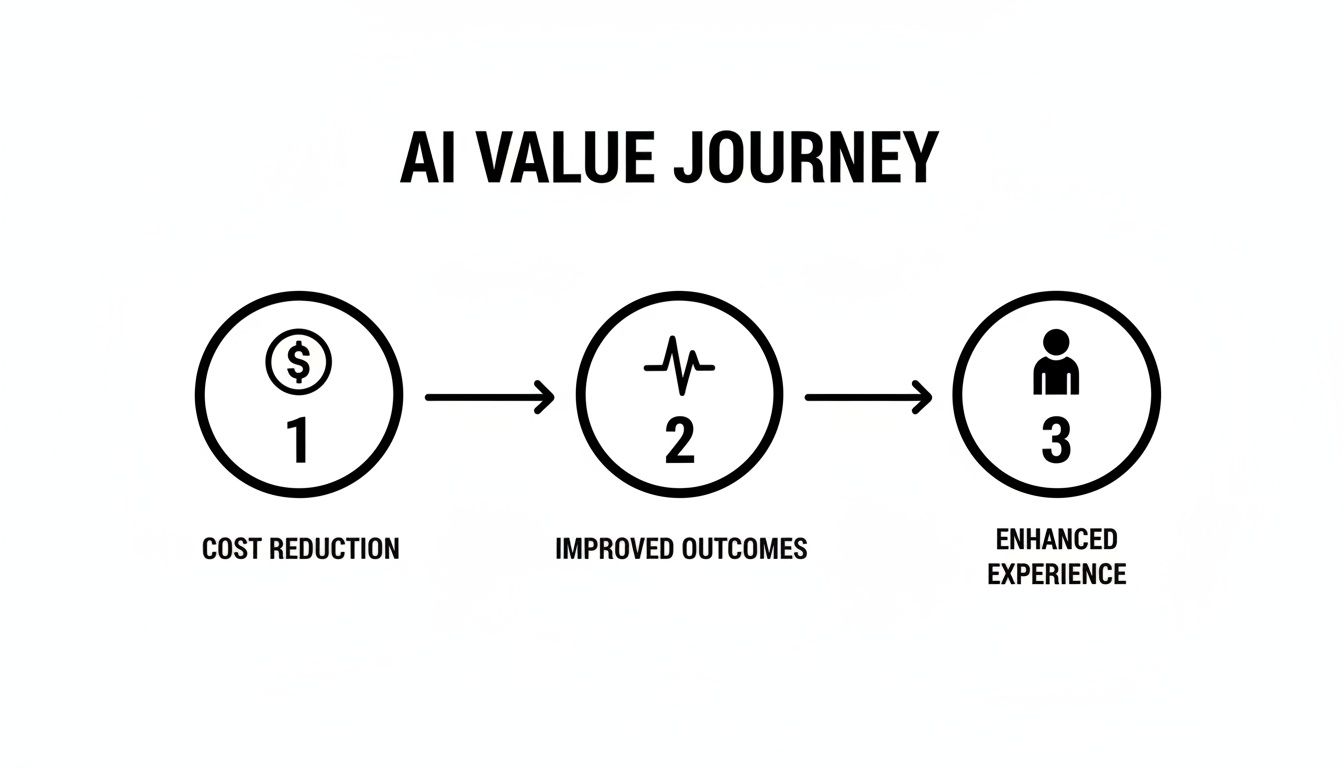
This graphic really captures it: true ROI is a chain reaction. Operational wins fuel better care, which in turn leads to happier, more loyal patients. Let's break down how to measure each part of that chain.
Let's be honest—the financial metrics are what get executives to sit up and listen. They are the most direct way to show the "return" in ROI and justify the initial investment in any new AI solutions. These are the hard numbers.
Closely tied to financials are the operational KPIs, which zero in on process efficiency. They show how AI is making the day-to-day grind easier and more effective. For example, optimizing your internal tooling can unlock huge gains in staff productivity. A key part of our Healthcare AI Services is finding and fixing these hidden operational drags.
A word of advice from the field: While financial KPIs are critical, they are often the result of better operations. Fix the workflow first. The money will follow. This is a core tenet of our AI strategy consulting.
Now we get to the heart of the matter. This is where AI’s real impact on your mission comes to light. Clinical KPIs measure the direct effect on care quality and patient outcomes, and while they can be tougher to assign a dollar value to, their long-term importance is undeniable.
The final piece of this puzzle is the patient experience itself. A smooth, positive patient journey builds trust, enhances your reputation, and can even have a direct impact on reimbursement rates.
The industry is finally catching on that ROI is about more than just dollars and cents. Healthcare leaders now see that it has to include time saved, better staff retention, and happier patients. We're seeing some impressive projections—certain AI tools for business, like ambient clinical scribes, are expected to create $600 million in financial impact by 2025. Still, the real challenge, as detailed in an excellent piece on measuring AI value at MedTech Dive, is connecting all the dots to trace that value back to the bottom line.
By building a framework that tracks KPIs across all four of these areas—financial, operational, clinical, and patient experience—you get a complete picture. You’ll capture not just the financial return, but the full human and clinical value that AI brings to the table. If you need help tailoring this to your specific goals, our expert team has built these frameworks for organizations of all sizes.
Alright, let's talk numbers. To get any AI initiative off the ground, you have to build a business case that clearly shows the financial impact. This isn't just about surface-level savings; it's about digging into both the direct, easy-to-see wins and the indirect gains that create value over the long haul.
You need to quantify everything. That means tracking reduced labor costs from things like AI Automation as a Service and even putting a number on less tangible benefits, like the financial upside of keeping your best physicians from leaving. Without a clear financial story, even the most innovative AI projects will stall before they even start.

Direct financial returns are the easiest part of your ROI story. These are the hard numbers that show up on a balance sheet—the immediate cost savings and revenue bumps that leadership can quickly grasp. Think of these as your quick wins.
Here’s where you’ll see the most direct impact:
Indirect returns are just as critical, but they take a bit more work to pin down. These are the ripple effects of your AI implementation—the value that comes from smoother processes, happier staff, and better patient care. They might not be as obvious, but their impact on the bottom line is huge.
Consider the cost of physician burnout. It can cost up to one-fifth of a doctor's annual salary to replace them. If an AI tool takes administrative headaches off their plate and improves their work-life balance, it directly boosts retention. That means you're avoiding massive recruitment and training costs—a very real financial win. If you're looking to visualize these kinds of second-order effects, a good financial insights dashboard can help connect the dots.
Pro Tip: Want to calculate the value of physician retention? Just multiply the number of doctors you kept on staff by the average cost to replace one. Keeping even a handful of key people can easily save you hundreds of thousands of dollars, making a powerful case for your AI investment.
Let's walk through a practical example. Imagine you're considering an AI diagnostic tool that helps radiologists spot early-stage cancers with greater accuracy.
The Initial Investment (Costs):
Total Year 1 Cost: $220,000
The Financial Returns (Gains):
The ROI Calculation:
This kind of simple, repeatable model gives you a powerful and defensible business case. To make this process even more robust, a Custom AI Strategy report can help formalize the framework and ensure you’ve accounted for every potential financial impact.
When we talk about the value of AI in healthcare, it's easy to get fixated on dollars and cents. A purely financial analysis is crucial for getting a project approved, of course, but it completely misses the bigger picture. The real story of a successful AI implementation is told through fewer medical errors, faster diagnoses, and smoother, less stressful workflows for your team.
You have to look at the human side of the equation. How is this technology actually improving the quality of care? How is it making life better for the clinicians on the front lines? This is exactly why our AI Product Development Workflow is designed to deliver tangible operational improvements, often through thoughtful custom healthcare software development.
Clinical metrics are the heart and soul of your healthcare AI ROI measurement. This is where you prove that the technology is contributing directly to better patient outcomes. These wins might not have an immediate price tag, but their long-term value—both financially and for your reputation—is immense.
You should be tracking several vital indicators:
Capturing these clinical wins is non-negotiable. They are the most compelling evidence you have that your AI investment is not just saving money, but saving lives and raising the standard of care.
Beyond the bedside, AI can be a powerhouse for streamlining hospital operations. These efficiency boosts free up your most valuable resource—your people—allowing them to focus on high-value patient care instead of administrative drag. A great place to start is often your internal tooling, where AI can automate tedious tasks and bring clarity to complex processes.
On the operational side, you’ll want to measure things like:
This push for efficiency is why the market is growing so fast. The generative AI healthcare market is expected to be worth $3.3 billion in 2025 and is projected to explode to $39.8 billion by 2035. That's a compound annual growth rate of 28%, which shows the industry's massive confidence in AI's ability to create value. You can find more details on these AI healthcare market trends and what they mean for the future.
But numbers don't tell the whole story, do they? The "softer" benefits, like better staff morale and higher job satisfaction, are just as critical for a healthy organization. These factors have a real, if sometimes indirect, impact on your bottom line by reducing burnout and costly staff turnover.
The best way to get at this information is to simply ask.
When a doctor tells you that a new AI tool has given them back an hour each day to spend with their family, that’s a real ROI indicator. It proves you’re not just investing in technology; you’re investing in your people. This is how you get the full picture—by blending the hard data with the human experience to measure AI's true value.
Calculating the ROI of a healthcare AI project isn't something you do once and file away. The real magic happens when measurement becomes an active, breathing part of your day-to-day operations. It's the shift from a static report to a dynamic, continuous process that really separates the organizations getting massive value from their AI from those just collecting interesting data.
This means building ROI tracking right into the fabric of your workflows. The numbers you're seeing shouldn't just be for a quarterly presentation; they should be informing decisions right now and shaping the next AI project you tackle. Think of it less as an audit and more as a compass guiding your entire AI strategy.
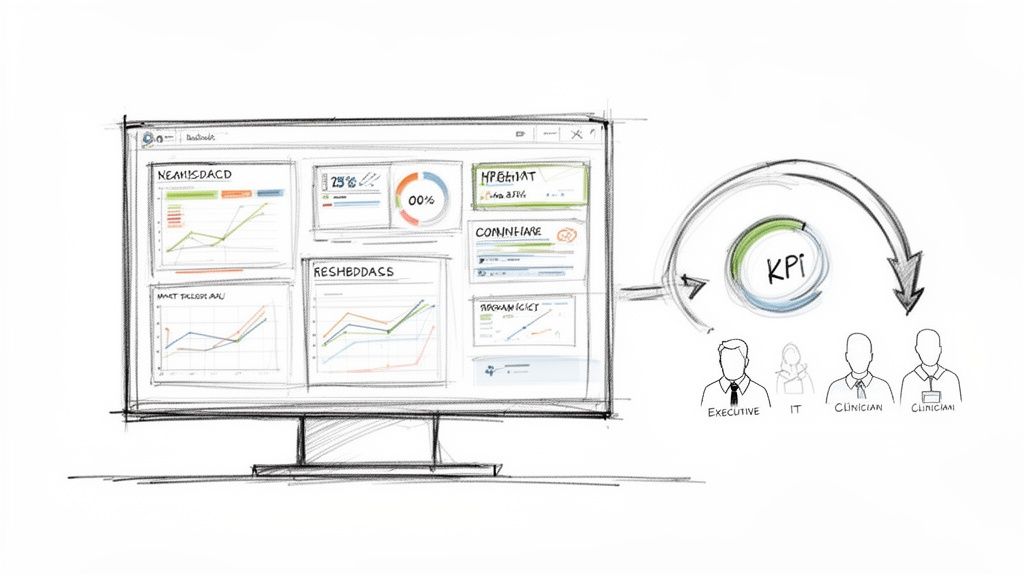
Let’s be honest: a dense spreadsheet is where data goes to die. To make your ROI findings stick, you need intuitive, role-specific dashboards that tell a clear story at a glance. What the C-suite needs to see is completely different from what a clinical team lead cares about.
These dashboards need to become the single source of truth, pulling live data from your systems. When everyone sees the same numbers, you build trust and get the entire organization rowing in the same direction. Designing these kinds of communication tools is often the first thing we tackle in our AI strategy consulting engagements.
Your ROI data should never be static. The most successful organizations I've seen use their metrics to create a powerful feedback loop that fuels constant improvement. This turns measurement from a passive chore into an active engine for growth.
The cycle is simple but incredibly effective:
By adopting this iterative rhythm, you ensure the value of your AI investments doesn't just hold steady—it compounds over time.
Key Takeaway: An ROI dashboard isn't a history book; it's a navigational chart. It shouldn't just tell you where you've been, but show you exactly where you need to head next. This philosophy is the cornerstone of our AI Product Development Workflow.
Measuring the full impact of AI is a team sport, plain and simple. It absolutely requires you to break down the walls between your clinical, financial, and IT departments. The finance team holds the cost data, the clinical team has the patient outcomes, and IT knows how the systems are performing. None of them have the full picture on their own.
True success depends on getting these people talking. Set up regular, structured meetings where everyone reviews the dashboards together, discusses what the numbers really mean, and agrees on what to do next. This shared understanding is critical for aligning the entire organization on the value of your AI initiatives.
Getting this kind of collaboration going can be tough, but it’s where the most powerful insights are born. It guarantees your healthcare AI ROI measurement captures the complete, holistic value of your investment. Our expert team has years of experience bridging these departmental gaps to build a unified and effective measurement strategy.
This is the big one, and the honest answer is: it depends entirely on the use case. Administrative tools, like those for revenue cycle management, can deliver a direct financial impact pretty quickly—often within 6 to 12 months. They get to work reducing claim denials and untangling billing snags right away. In contrast, clinical AI solutions, such as diagnostic support systems, play a longer game. You might see initial value in improved efficiency, but the hard financial returns could take 18-24 months to appear as better patient outcomes start to lower long-term care costs.
The toughest hurdles are almost always attributing outcomes directly to the AI, putting a dollar value on qualitative wins like better staff morale, and battling data silos. It’s difficult to prove an AI tool was the sole reason for an improvement when so many variables are in play. A solid AI requirements analysis done upfront can help you anticipate these data needs. The best approach is to run a pilot with a control group to isolate the AI's impact and use proxy metrics (like staff retention rates) for softer benefits.
If you're looking for the quickest and biggest returns, focus on data-heavy, repetitive areas ripe for automation. Top examples include Revenue Cycle Management (RCM), administrative workflow automation (scheduling, prior authorizations), and fraud detection. While clinical applications have immense long-term strategic value, these operational areas provide the quick wins needed to build momentum and stakeholder trust.
When a clear financial return is tough to pin down, shift the conversation to strategic value and risk mitigation. Frame the investment as essential for staying competitive, elevating care quality, or preparing for the future of healthcare. As we explored in our AI adoption guide, starting with a limited pilot project is key. It allows you to gather initial data and prove the concept while minimizing financial exposure. Our AI strategy consulting can help you craft a compelling story that balances potential financial returns with these critical strategic advantages.
Ready to unlock what artificial intelligence can really do for your healthcare organization? At Ekipa AI, we specialize in turning complex AI opportunities into measurable, scalable impact. Our platform and our expert team can help you build a robust ROI framework and execute a strategy that delivers real value.
How to build HIPAA-compliant AI: when LLM providers need a BAA, data minimization, de-identification, audit controls and a reference architecture.

Practical data migration planning guide for healthcare teams. Scope, mapping, compliance, validation, cutover and rollback decisions explained end to end.

Smart on FHIR guide for healthtech engineers. Learn the OAuth 2.0 launch model, scope syntax, backend services, and US regulatory requirements.
Connect with our team to explore how AI expertise can transform your business.