Job postings requiring AI skills grew 257% between 2015 and 2023, while total job postings grew 52% over the same period, according to the White House Council of Economic Advisers report on AI talent. Volume at that scale doesn't help a CTO decide who to hire. The supply of people carrying an AI title has grown much faster than the supply of people who can take ownership of a model after it reaches a clinician's screen, and the difference only shows up in production.
When you hire AI engineers for a healthcare product, the job is narrower than the market suggests. The person has to ship through an EHR interface, produce evidence a quality system will accept, and keep a deployed model inside HIPAA safeguards and FDA change control. A candidate who can't do those three things is a research hire wearing an engineering title.
The sections below cover the five roles and what each owns after launch, the scoping work that has to happen before a job description exists, the skills that separate a healthcare AI engineer from a generalist, how to run work samples, and how to choose between in-house hires, contractors, dedicated teams and delivery partners.
Which AI engineering roles your product needs
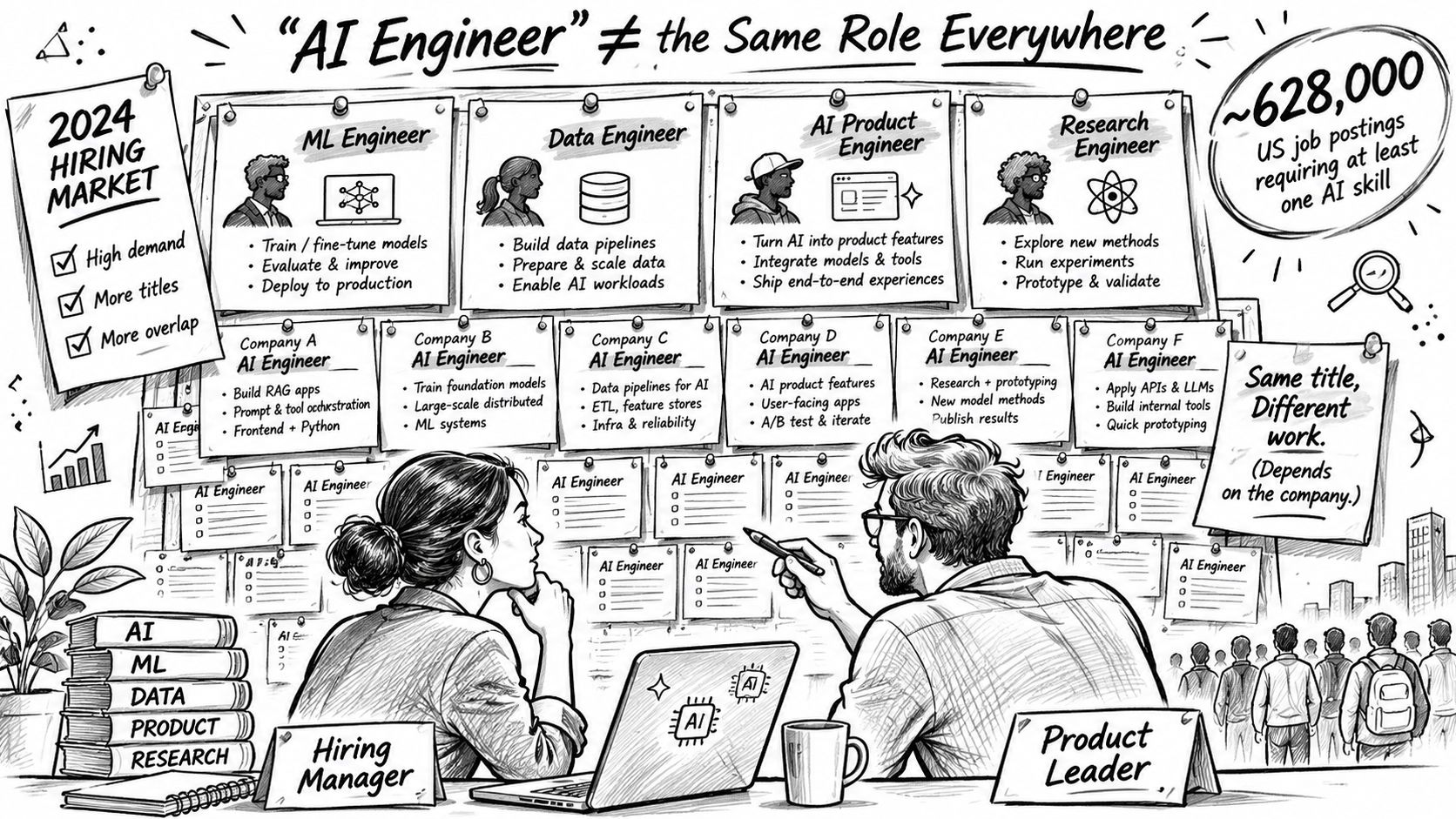
In 2024, nearly 628,000 job postings in the United States required at least one AI skill, according to the Federal Reserve Bank of Atlanta. At that volume, title matching stops working. "AI engineer" at one employer means someone who fine-tunes models, at another it means someone who builds retrieval pipelines over clinical documents, and at a third it means a backend developer who calls a hosted model API.
The table below shows the five roles that cover the work, and what each one owns once the product is live.
| Role |
Core output |
Owns in production |
What breaks when missing |
| ML engineer |
Trained and packaged model |
Experiment tracking, metrics, model artifacts |
Results cannot be reproduced between releases |
| Data engineer |
Ingestion and feature pipelines |
Data contracts, lineage, de-identification |
Silent schema changes corrupt inputs |
| AI or LLM application engineer |
Inference service and workflow layer |
Retrieval, prompts, tool calls, output validation |
Model output reaches clinicians unchecked |
| MLOps or platform engineer |
Deployment and monitoring pipeline |
Model registry, release gates, drift alerts, rollback |
Updates ship without a tested path back |
| Applied scientist |
Evaluation protocol |
Subgroup analysis, clinical performance measures, error review |
Accuracy is reported without clinical meaning |
Small teams combine rows. A first AI hire at a healthtech startup often covers ML engineering and the application layer, with data engineering sitting with whoever owns the interface engine. That arrangement can work. It works only if someone is named for every row before the job description is written, because the rows without an owner are the ones that fail six months after launch.
Titles also drift between employers, and the split between machine learning and AI engineering is often organizational rather than technical. Write the posting around the outputs in the table, not the title.
How to define scope, data and owners before hiring
A hire made before the problem is defined produces an engineer with nothing to release against. The order below is deliberate: each step produces an artifact the next step depends on, and those artifacts become the acceptance criteria for both the job description and the interview.
Write down the decision, the user and the cost of being wrong. If the output is a deterioration risk score, the user is the admitting nurse and the failure cost is a missed escalation, so the role carries evaluation ownership. If the output is a draft discharge summary, the role is an LLM application engineer with retrieval and output validation ownership. Same title on the posting, different job.
Inventory the data you have. Name the EHR system and version, the interface feeds you can consume, the FHIR APIs you can reach, the consent and de-identification status of each dataset, and where labels come from. Label quality determines whether a model can be evaluated at all, and it's the item teams discover last.
Set numeric acceptance criteria. Sensitivity and specificity at a stated operating threshold, a latency budget tied to the clinical workflow, subgroup performance across the populations you serve, and a calibration target. Without numbers, a new engineer can't show progress and a reviewer can't reject a release.
Decide the regulatory status. Whether the intended use makes the software a device under FDA rules, and whether you plan to file a Predetermined Change Control Plan for model updates. This decision sets the evidence the engineer has to produce, so it comes before the interview, not after the first release.
Assign an owner to each step. Engineering, product, clinical, quality and regulatory, security, and any vendor in the data path. A release gate with four co-owners has none.
Mark what must stay internal. Clinical risk ownership, architecture, data governance and vendor oversight belong inside the company. Build capacity can be sourced.
Steps 1 through 3 are the ones teams skip when there's pressure to show AI progress. A hire made without them lands on exploratory work with no release criteria, and the usual outcome is a capable engineer who looks unproductive for a quarter.
The checklist turns those steps into evidence someone can audit before you post the role.
| Item |
Evidence that it is done |
Owner |
| Intended use statement |
Signed one-page description of the decision, the user and the failure cost |
Product lead with clinical lead |
| Data inventory |
Data map of source systems, interfaces, consent and de-identification status |
Data engineering lead |
| Acceptance criteria |
Numeric thresholds and a defined test dataset |
Applied scientist with clinical lead |
| Regulatory status |
Written device determination and a decision on whether to file a PCCP |
Regulatory lead with manufacturer |
| Security scope |
Signed data-flow diagram naming access, audit, integrity and transmission controls for each system that holds PHI |
Security lead |
| Build or source decision |
List of capabilities owned internally and those sourced |
CTO |
The scoping work is not preparation for the hire. It's the specification the hire will be measured against for the first year.
We run engagements in that order, starting from the client's goals, users and existing workflows before any model work, and the AI delivery framework describes how discovery turns into phased delivery.
Skills that matter for production healthcare AI
The OECD analysis of digital and AI skills in health occupations examined about 55.5 million online job postings in Canada, the United Kingdom and the United States, and found that explicit demand for AI-specific skills in health jobs is still limited.
Employers ask for model skills, and the gap sits at deployment. In healthcare the profile is hybrid: model development plus interoperability, evaluation, security and clinical validation. An interview that tests only the first area selects for the wrong half.
Interoperability
A candidate should name the FHIR R4 resources behind a clinical data element without hesitating. Ask which resource carries a lab result, which carries the patient, which carries the diagnostic report, and then which SMART on FHIR scopes govern access to each. If the answer stops at "we'd pull it from the EHR," that person can't own an integration and will depend on someone else for every data contract.
Legacy messaging and acknowledgments
HL7 v2 still moves clinical events inside provider organizations, and a hire who has only touched FHIR APIs will meet it within the first month. Ask a candidate to walk through an ADT admission and an ORU result, including how they handle acknowledgments, duplicate messages and out-of-order delivery. The failure mode is concrete: the same admission arrives twice, the pipeline writes two rows, and the model sees a patient admitted twice in a minute. Our guide to HL7 v2 to FHIR migration covers the mapping work these interfaces involve.
Evaluation, safeguards and clinical validation
Evaluation means reproducible test sets, sensitivity, specificity and calibration at a stated threshold, and drift monitoring wired into the Measure function of the NIST AI Risk Management Framework. Security means the technical safeguards in 45 CFR 164.312 implemented rather than listed: access control, audit controls, integrity, and transmission security across every store that holds PHI.
Clinical validation means the population, the human override path and the failure modes are defined before release, consistent with FDA guidance on AI-enabled device software functions. Data engineering belongs in the same profile: versioned datasets, data contracts and lineage from source system to feature.
A strong publication record proves someone can run an experiment. It says nothing about whether they have shipped through an interface, a release gate or an audit.
Few candidates carry all five areas, so the practical options are pairing a strong ML hire with an interoperability engineer or bringing in a team that already covers both. Ekipa AI's healthcare engineering practice staffs that combined profile on clinical products. Either way, the interview loop should test every area above, because the skills that fail in production are the ones nobody asked about.
How to run a work sample
A work sample replaces trivia with the job itself. Give every candidate the same small, sanitized task drawn from your product, a fixed time box, and a written rubric agreed before the first interview.
For an AI or LLM application engineer, that might be wiring a hosted model into a mock clinical workflow with output validation and a fallback for low-confidence answers. For an ML engineer, it might be evaluating a supplied model on a held-out test set and reporting sensitivity, specificity and calibration at a stated threshold. For a data engineer, it might be tracing a lab result from an HL7 v2 message to a FHIR Observation and handling a duplicate message.
Score the rubric on production evidence: how the candidate handles bad inputs, what they log, how they would roll back a release and what they would hand over. Use synthetic or fully de-identified data only. If any part of interview scoring is AI-assisted, keep a human reviewer on every decision and apply the same criteria to every candidate.
Choosing an engagement model for AI work
Six models cover most of the choices, and they trade speed, cost, retained knowledge and control against each other. Pick the model after you've decided which capabilities have to stay internal. For clinical products that decision also determines who signs off on HIPAA safeguards and FDA change-control evidence, so it is harder to reverse than a contract clause.
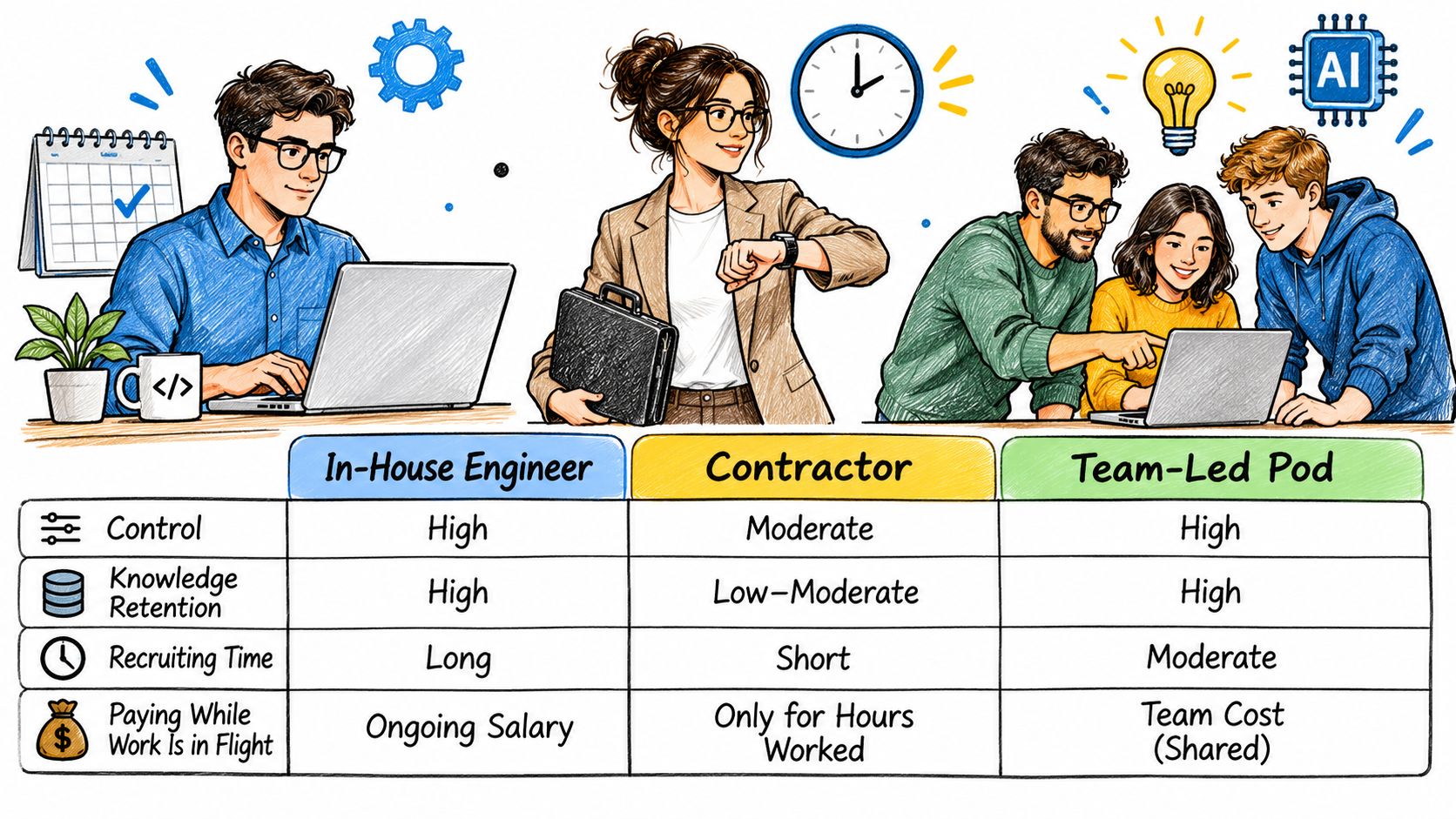
The chart maps the three broad choices before the table breaks them down further.
| Model |
Speed to start |
Cost pattern |
Knowledge retention |
Control |
| In-house hire |
Slowest, recruiting and onboarding take months |
Salary and benefits paid whether or not work is active |
Strongest, stays with the company |
Highest |
| Individual contractor |
Fast |
Hourly or daily rate with less overhead |
Weak unless documentation is required |
Set by the contract |
| Dedicated external team |
Fast to moderate |
Committed team cost for a defined period |
Depends on handover terms |
Shared |
| Forward deployed engineers |
Fast |
Embedded engagement cost |
Moderate, transfers through pairing |
Shared, works inside your workflow |
| Delivery partner with defined outcomes |
Moderate |
Fixed scope or phased billing |
Depends on ownership and documentation clauses |
Shared on delivery, retained on outcome definition |
| Hybrid model |
Moderate |
Mixed internal and external cost |
Retained for internally owned roles |
High for internally owned roles |
In-house gives the most control and keeps the most knowledge. It's also the slowest route to a working release, and the salary runs whether or not work is in flight. For a team that will keep building clinical AI for years, that trade is worth it. For one integration project, it usually isn't.
Contractors add capacity in days. What they leave behind depends on what the contract demands: code, tests, runbooks and evaluation sets written into the deliverables, or nothing. A lone contractor on a clinical inference service also leaves no second reviewer for calibration and release decisions, and that gap surfaces at the first audit.
A dedicated external team works as a defined unit for a set period and scales faster than hiring. Knowledge stays with you only as far as the handover obligations require, so name repository ownership, documentation, evaluation datasets and pairing sessions in the agreement.
Forward deployed engineers sit inside your workflow and transfer knowledge as they go. The model suits teams that have internal engineers to absorb the knowledge and a workflow too specific for a statement of work. If nobody internal can pick up the pairing, the knowledge walks out when the engagement ends.
Delivery partners commit to defined outcomes and phased releases, which fits integration work on systems already in production: connecting a model to HL7 and FHIR feeds, modernizing a legacy platform, or adding AI capability without a full rebuild. Phased delivery lets you validate each release against your compliance needs before the next phase starts. The agreement has to spell out the outcome definitions, the evidence artifacts and the owner of each deliverable, or "delivery" is just a bigger contractor invoice.
Regulatory responsibility does not transfer with the engineers
FDA's December 2024 final guidance on predetermined change control plans for AI-enabled device software functions recommends three parts: a description of modifications, a modification protocol and an impact assessment, submitted as part of the device's marketing submission.
The manufacturer retains responsibility for describing the intended modifications and demonstrating continued safety and effectiveness, whatever engagement model produced the evidence.
An outside team can produce that evidence. Accountability stays with you. Any engagement model that implies otherwise is a liability, whatever it saves on the invoice.
Cost also moves with geography, so compare any contractor or partner rate against a fully loaded internal salary rather than base pay.
When a hybrid model makes sense
Use it when three conditions hold. A named internal owner carries clinical risk. The external work has written handover terms covering repositories, runbooks and evaluation sets. And those assets live in your organization's repositories under your name.
We work as an extension of in-house engineering, product and design teams, and implementation support covers the hands-on work of integrating AI into systems already in production.
AI Engineering
Need AI engineers who can ship in healthcare?
Our engineers own integration, release and monitoring for clinical AI, working as an extension of your team.
Prefer to pick a time? Book a call directly
Hiring mistakes and the final staffing check
The failure modes below share one root cause. The role was scoped as a search for the strongest model builder, and the failures all sit in ownership of the system around that model: the interface, the release evidence, the PHI controls.
Before you post a role or sign an engagement, get four things in writing. The same gaps hide in contractor terms as easily as in a job spec, so apply the check to both.
Every row of the roles table has an owner, internal or external, with accountable deliverables named.
Handover terms cover code, documents, runbooks and evaluation sets, and state who holds each one at the end.
The work sample and rubric are approved, with human review for any AI-assisted interview scoring.
The security scope names the controls for each system that touches PHI, mapped to the technical safeguards you're relying on.
| Mistake |
Why it happens |
Fix |
| Hiring research scientists for production work |
Strong publication record is mistaken for deployment skill |
Test interface, release and monitoring skills in the work sample |
| Hiring before the problem and data are clear |
Pressure to show AI progress |
Complete the scoping checklist and acceptance criteria first |
| Treating the model as the deliverable |
Evaluation stops at accuracy on a static test set |
Require integration, rollback and monitoring as part of the definition of done |
| Relying on one senior AI hire |
Knowledge sits with one person |
Require documentation, pairing and a second owner for each production path |
| Using generic interviews |
Fluency is scored above production evidence |
Replace trivia with the work sample and rubric |
| No named owner for clinical risk |
Ownership is spread across teams |
Assign clinical risk, quality evidence and user notification owners in writing |
Teams without internal delivery capacity can start with a technical capability assessment of the current architecture, team strengths and bottlenecks, then bring in dedicated engineers, cross-functional teams or targeted expertise aligned to the technology stack and roadmap, with the work delivered in phases so progress is validated and features release incrementally. For clinical products, our healthcare AI consulting engagements start with that assessment.
For automation work specifically, see how an AI automation agency compares with in-house teams.
Conclusion
Start from the production ownership map and let the hiring decision follow from it. Assign a named internal owner to each row of the roles table, define the decision, the data and the numeric acceptance criteria before writing a posting, and test candidates on the interface, release and monitoring work they will do.
Then pick the engagement model that matches your real constraint: time, cost, retained knowledge or control. Whatever you source externally, keep clinical risk, architecture, data governance and vendor oversight inside the company. Accountability for a clinical AI system stays with the manufacturer, so an external team can build and hand over while your own owners sign off on each production change.
Hire for ownership first. A small internal team that owns integration, release and monitoring beats a larger team built around model-building talent, because FHIR and HL7 interfaces, HIPAA safeguards and change evidence are where clinical AI products succeed or fail.
If you want a second view on your staffing plan before you post a role or sign an engagement, talk to our team.
Frequently asked questions
Which AI engineering role should we hire first?
Start with the row nobody else can cover. If the product trains its own models, hire the ML engineer who can own evaluation. If it wraps a hosted model in a clinical workflow, hire the AI or LLM application engineer and assign data engineering to whoever already owns the interface. Platform and release work can start part-time or external, provided a named owner exists.
How do we test FHIR and HL7 integration ability in an interview?
Give the candidate a sanitized extract and ask them to trace one lab result from the source message to a FHIR Observation, covering acknowledgment handling, duplicates and de-identification. Then ask which resource and scope governs access to the result. Engineers who have done this work describe the duplicate-message and out-of-order cases without prompting. Engineers who haven't will stall on the acknowledgment step.
When should a healthtech company hire AI engineers in-house rather than through a partner?
Go in-house when clinical AI work is continuous, when clinical risk ownership and architecture need to sit with employees, and when your engineers can absorb knowledge from outside help. Use a partner when build capacity is the constraint and the scope is bounded enough to define outcomes and handover terms. A hybrid model covers the middle case: the partner builds, your team owns.
Does an external engineering team take on FDA responsibility for model updates?
No. FDA's December 2024 final guidance on predetermined change control plans keeps that accountability with the manufacturer. A partner can build the validation pipelines, deployment controls and monitoring, but an internal owner has to sign for the evidence.
How many AI engineers does a first production release need?
Headcount follows the production paths you have to cover. A clinical documentation tool wrapping a hosted model can ship with one application engineer owning the model path, a fractional data engineer on the interface, and release support borrowed from the platform team. A product training its own imaging model needs all three paths staffed from day one, because evaluation, data pipelines and deployment controls run in parallel rather than in sequence.