
AI Automation
Internal Tools Development: Options, Costs and Safeguards
Internal tools development explained: use cases, SaaS versus custom build, AI safeguards, a step-by-step process and healthcare controls.
November 17, 2026Read more
A practical guide to intelligent document processing healthcare teams use to classify, extract and validate referrals, prior authorizations and claims.

Prior authorization is still one of the most paper-heavy workflows in US healthcare. The 2022 CAQH Index found that only 28% of prior authorizations ran as fully electronic transactions, with the rest moving through web portals, phone calls and fax. That split is the operational problem: the clinical content exists, but it reaches downstream teams as images and PDFs that cannot be trusted, routed or reused without classification, extraction and validation. Treat IDP as a governed workflow and data-quality program rather than an OCR utility. Production success depends on field-level accuracy thresholds, risk-tiered human review for exceptions, controlled FHIR write-back, and HIPAA change control whenever templates, models or integration logic change.
Intelligent document processing is software that classifies an incoming document, extracts each field with a confidence score attached, validates the result against business rules and source systems, sends uncertain cases to a person, and writes the surviving values into the EHR or another system through an API or a FHIR resource.
That definition carries weight because the alternative, a capture tool that returns raw text, leaves the expensive work untouched. A payer fax can bundle a referral letter, two pages of prior imaging, an insurance card and a lab result. Something has to decide these are four documents, that one belongs to a different patient's chart, and that the authorization form is missing the ordering provider's identifier before anything moves forward.
The manual tail of this work lands on intake clerks, referral coordinators and utilization management reviewers. Their day is rekeying, chasing missing pages, and re-faxing documentation a payer says never arrived.
Optical character recognition converts an image into characters. Robotic process automation drives an existing interface, clicking and typing through screens a human would otherwise use. Neither one knows whether the value it produced is correct.
| Capability | Basic OCR | RPA | Intelligent document processing |
|---|---|---|---|
| Primary output | Text from an image | Task completion on an existing interface | Classified documents with structured, validated fields |
| Handles varied layouts | Poorly, needs fixed templates | Not applicable, follows scripted rules | Yes, classification plus layout models |
| Reads handwriting and poor scans | Limited | No | Partially, with confidence scores |
| Validates against rules and source systems | No | Only scripted checks | Yes, business rules, terminologies and EHR lookups |
| Routes uncertain cases to humans | No | No | Yes, confidence-based exception queues |
| Writes structured data to the EHR | No | Through existing screens or APIs | Yes, via APIs and FHIR resources |
Read that table as a division of labor rather than a ranking. A pipeline still needs RPA when a payer exposes only a web portal, and it still needs character recognition as the first step for scanned pages. The difference sits in the middle: classification, validation and exception routing, which are what turn a page of readable text into a record a downstream system can trust.
A pipeline that reads documents but can't validate them moves the error earlier and makes it faster to reach the claim.
Three capabilities separate IDP from document capture, and each one fails on its own terms.
Varied layouts. Semantic extraction reads what a field means instead of where it sits on the page, so a payer that redesigns its form doesn't break the model the way it breaks a coordinate-based template.
Validation in context. A diagnosis code gets checked against a terminology set, a member identifier against the eligibility response, a requested service against the order catalog. Those checks catch misreads before they reach a claim or a chart.
Integration into clinical and administrative systems. The output has to land in the EHR, the revenue cycle system or the payer portal in the format that system accepts, with the source document still retrievable behind it.
The broader workflow context, including where document handling sits inside referral and authorization processes, is covered in our guide to healthcare workflow automation. For teams scoping the platform work around it, our healthcare AI and integration practice covers the EHR and interoperability side. When the same documents also need to answer clinician questions, our guide to RAG for clinical documents covers retrieval over the source files.
Back-office volume comes from a small set of recurring document types, and each one fails for a different reason. Pair the type with its key fields and its failure source, and the pilot scope picks itself.
| Document type | Key fields to capture | Why it is hard | Typical destination |
|---|---|---|---|
| Faxed referral | Patient demographics, referring provider, diagnosis, requested service | Fax noise, handwriting, inconsistent referral letters | EHR referral or ServiceRequest |
| Prior authorization paperwork | Procedure or drug codes, clinical justification, coverage details | Payer-specific forms, attachments, frequent form changes | Payer portal or authorization workflow |
| Patient intake forms | Demographics, insurance, history, consents | Handwriting, checkboxes, multi-page packets | EHR registration and chart |
| Insurance cards | Payer, member ID, group number, plan type | Photo or scan glare, partial captures | Registration and eligibility checks |
| Lab and outside records | Results, units, reference ranges, dates | Narrative text, abbreviations, variable report formats | Chart via DocumentReference and results interfaces |
| Claims attachments | Supporting documentation for billed services | Mixed formats, missing pages, deadline pressure | Claims or revenue cycle system |
Handwriting lowers character-level confidence unevenly. A printed page and a handwritten medication name on the same form produce very different certainty, and a single misread digit in a dose can survive a document-level accuracy check because the rest of the page scored well. Scoring each extracted field separately, rather than averaging confidence across the page, is what surfaces that failure.
Scan quality degrades the pipeline before any language model runs. Skewed pages, thermal fax artifacts, low resolution and speckle noise reduce the character signal that everything downstream depends on.
Variable layouts break position-based extraction the moment a form version changes. Template-based capture defines a field by its coordinates, so when a payer revises its criteria and reissues a form, the field moves and extraction returns the wrong value at full confidence. The queue that catches this has to detect the new version, hold the affected documents and route them to a reviewer before bad data reaches the claim. That routing layer is usually assembled with workflow tooling rather than custom code, because the rules change as often as the forms do.
Test handwritten and poorly scanned pages as their own group. Their accuracy will sit well below printed text, and a blended average hides that gap.
Electronic transmission removes the transport delay, and the historical benchmark is worth keeping. In CMS's esMD workflow overview, providers reported payment turnaround of about 6 days when they submitted documentation through the Electronic Submission of Medical Documentation program, against roughly 3 weeks for the paper process. The lesson that carries over: turnaround improves when documents are treated as tracked digital objects wired into review processes, and recognition accuracy alone doesn't deliver it.
The build-versus-buy decision turns on one measurable thing: form churn. Count how many versions of a given form each payer issues in a year and how many payers you accept. High churn across many payers favors a vendor or a semantic extraction layer that absorbs layout change; a handful of stable forms can justify templates you own and maintain. Prior authorization packets concentrate that churn hardest, because each payer combines its own form, its own criteria and its own attachment list.
A cardiology practice receives a faxed referral from a primary care clinic: one page of referral letter plus a medication list. The path from the fax gateway to a filed order runs through six stages, and each stage produces artifacts that audits, retries and later reprocessing depend on.
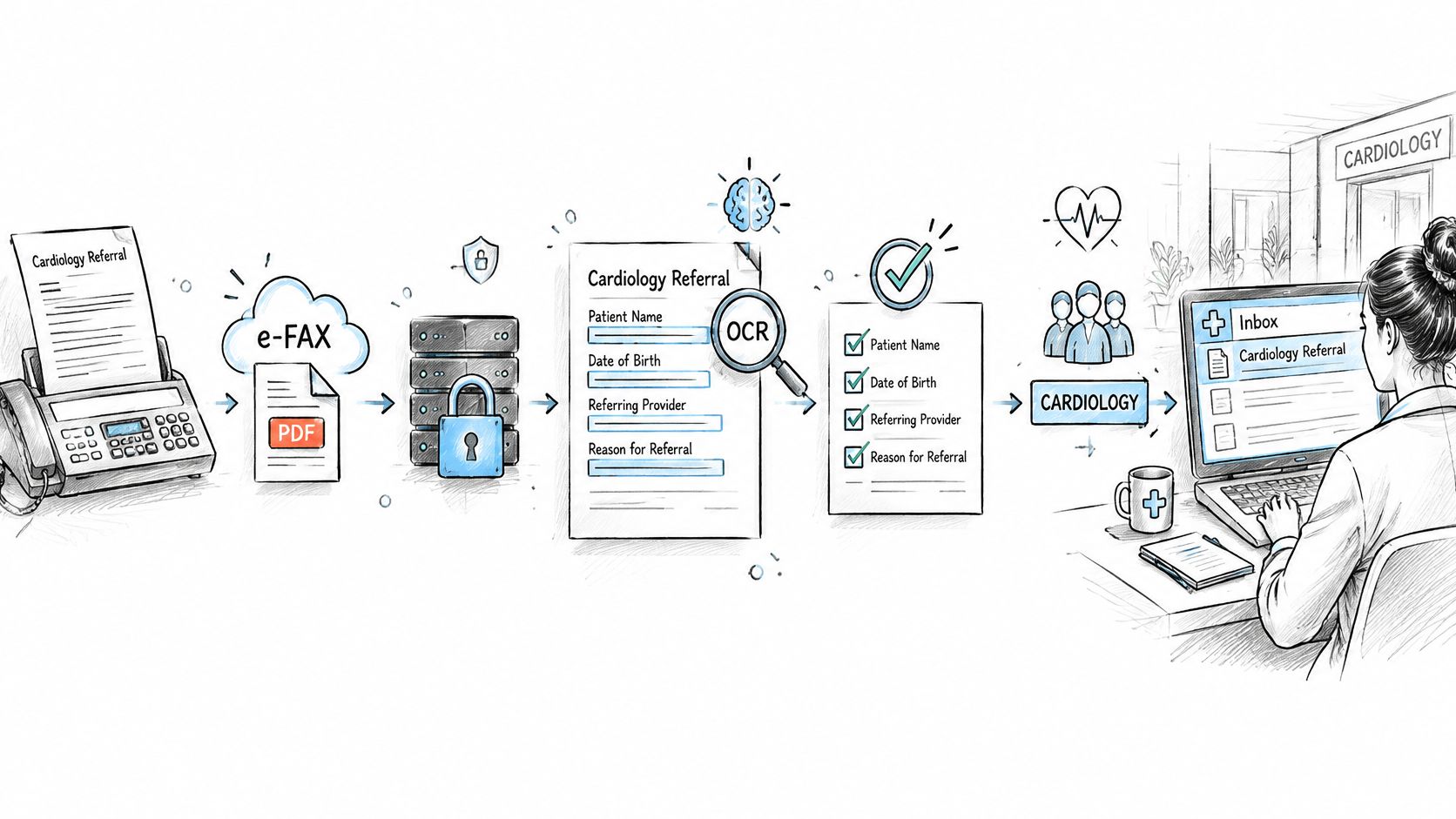
Ingestion. The e-fax gateway writes the incoming transmission as a PDF to controlled object storage, with a checksum and a retained copy of the original bytes. The pipeline creates a FHIR DocumentReference carrying the patient, author, creation date, status and MIME type, with the content exposed through a Binary endpoint or a referenced URI.
Classification. A model labels the packet as a referral rather than a lab report, a statement or a payer notice, splits bundled pages if the fax carried more than one document, and routes it to the referrals queue. Misclassification here sends the document to the wrong reviewer, which is the most common silent failure in the whole chain.
Extraction. OCR and clinical NLP pull patient name and date of birth, referring provider, diagnosis text, requested consult and current medications. Every field carries a confidence score and a link back to its source span, so a reviewer can see the exact page and region the value came from.
Validation. The system matches the patient against the EHR index through a FHIR Patient lookup or an HL7 v2 ADT feed, normalizes the diagnosis text to ICD-10, confirms the requested service exists in the order catalog, and flags missing mandatory fields or contradictions such as a service date that precedes the referral date.
Human review. A handwritten medication name that extracts at low confidence goes to an exception queue, where a reviewer confirms or corrects it. The correction is written to the extraction record with a reviewer identifier and the model version that produced the original value.
Write-back. The pipeline creates a FHIR ServiceRequest for the requested consult, links the source DocumentReference as supporting information, and writes an audit entry that ties the order to the document, the extraction run and the reviewer.
The two FHIR resources have distinct jobs. The FHIR R4 DocumentReference resource is the index record that makes the fax discoverable and tells a downstream client what it is, who it belongs to and whether it is current. The FHIR R4 ServiceRequest resource is the order or referral the document justifies, and it carries its own reason code, requester and timing. Keeping them separate means the source image survives every downstream change.
Duplicate faxes arrive from two numbers and resolve to the same document unless ingestion deduplicates on content hash and sender plus timestamp. Unreadable scans pass OCR with plausible but wrong characters, which is why validation against the patient index matters more than raw confidence. Abbreviations do the rest of the damage: a two-letter token can mean several different clinical concepts, and only terminology mapping plus a reviewer settles it.
Packets that mix two patients are the worst case, because a single bad write can attach one patient's documentation to another's chart. Route exceptions by risk rather than by volume: identity conflicts and mixed-patient packets go to a senior reviewer, low-confidence fields go to a correction queue, and clean packets file without a touch. The exception queue needs staffing and turnaround targets rather than acting as a log nobody monitors. That operating model is the design constraint behind Ekipa AI's AI-powered data extraction engine: every extracted value stays tied to its source span, the reviewer correction and the model version that produced it.
Write-back is where most IDP projects lose their value. Extraction can look excellent in a demo and still produce records no clinician can trust, usually because the pipeline returned a text blob instead of metadata a downstream client can act on. Every field written becomes part of the clinical record, so the write step deserves the same change control as the data it carries.
The split between the document index and the order it justifies was set up in the pipeline stage, and the DocumentReference resource definition is what enforces it at write time. Content stays behind a URI or a Binary resource, and reprocessing creates new versioned metadata while the original scan stays retrievable.
Where the EHR runs on HL7 v2, extracted values map onto message types instead of resources. Patient identity flows through ADT triggers and results flow through ORU, both defined in HL7 International's v2 standard. Authorization between the ingestion service and the EHR runs through SMART App Launch scopes, which keeps a background extraction job from holding broader access than it needs. If you are moving those feeds to FHIR, our guide to HL7 v2 to FHIR migration covers the mapping work.
Patient mismatch. A write keyed on name and date of birth alone can still land on the wrong chart. Send the patient identifier resolved during validation, and hold a low-confidence match in the exception queue with nothing written until a reviewer confirms it.
Duplicate orders on retry. A timed-out ServiceRequest call that succeeded server-side will produce a second referral when the client retries. Idempotency keys on the create, plus a lookup before write, are cheaper than reconciling duplicates later.
Lost provenance. Returning only OCR text discards the patient, author, date and lifecycle a clinician needs to interpret the document, and it removes the link back to the source when someone disputes the value.
Terminology drift. Mapping free text to ICD-10-CM, LOINC and RxNorm requires the right code system versions. In the US, the CDC's National Center for Health Statistics maintains ICD-10-CM, the Regenstrief Institute maintains LOINC, and the National Library of Medicine maintains RxNorm. A value coded against last year's release can fail without notice after an update, so pin the versions in use and re-validate each mapping table when they change.
Test write-back the way a downstream client would use it.
The acceptance test I'd hold a build to is concrete. A downstream client can discover the document, retrieve the correct content, identify the patient and author, and determine whether the artifact is current or superseded. If any of those four fails, the integration isn't finished, regardless of extraction scores. Each write should also land as an auditable event, recording which service wrote which value from which source version, so a disputed field can be traced and corrected under normal change control.
Fix three metrics before a pilot starts, because they determine staffing, scope and whether anyone can prove the project worked.
| Metric | What it measures | Why it matters |
|---|---|---|
| Field-level accuracy | Share of extracted fields that match the source or a reviewed gold standard | Shows whether individual values are safe to use, not just whether a document was handled |
| Straight-through processing rate | Share of documents completed with no human touch | Estimates real workload relief and cost impact |
| Exception rate | Share of documents or fields routed to human review | Drives reviewer staffing and reveals weak document types |
| Precision and recall per field | False positives and false negatives for each extracted concept | Protects downstream registries, coding and decision support |
| Correction rate | How often reviewers change an extracted value | Signals drift, template changes or weak validation rules |
| Baseline comparison | Current manual time, cost and error profile | Turns automation claims into a measurable delta |
Published performance does not transfer between document sets, so the baseline has to be local. A systematic review of NLP used to extract data from clinical text for clinical registries reported a median micro F1-score of 81.2%, with a range of 45.5% to 94.9% across included studies, according to the peer-reviewed review in PMC. A similar spread appears in cancer entity extraction, where best article-level F1 scores ranged from 0.355 to 0.985 depending on task and corpus, as reported in the JMIR review of clinical text extraction.
The second review makes an operational point worth carrying into design: schema mapping and validation matter as much as recognition. Extracted concepts need normalization against controlled vocabularies, datatype and cardinality checks, and a preserved evidence span before anything writes to a structured record.
Split fields by consequence, not by confidence alone.
Tier one, administrative. Payer name, member identifier, group number and document date can auto-release above a set confidence threshold, because a wrong value triggers a downstream rejection that's visible and cheap to fix.
Tier two, clinical with moderate impact. Diagnosis text, requested service and provider identifiers pass automatically only when they resolve cleanly against a terminology or directory lookup. Anything that fails the lookup goes to a reviewer.
Tier three, safety-critical. Medications, doses, allergies and anything that feeds a decision-support rule get the strictest recall threshold, and a missing value blocks the write instead of passing.
Stratify evaluation by document type, specialty, facility and language, and expect the weakest stratum to set your review staffing. Track abstention and correction rates after go-live, because a template change on the payer side shows up first as a correction spike, not as a drop in the headline accuracy number.
Set thresholds before the pilot begins. A number chosen after you see the results is a number chosen to match them.
External validation on your own historical documents is the only result that matters, since abbreviations, templated text, dictation artifacts and institution-specific phrasing all push accuracy below the published figures.
Document Automation
Ready to automate document intake?
We build document pipelines that classify, extract and validate fields, route exceptions to reviewers and write clean data back to your EHR.
HIPAA's technical safeguards translate directly into artifacts an IDP deployment either keeps or doesn't. Under 45 CFR 164.312, systems handling electronic protected health information need access controls, audit controls, integrity protections, person or entity authentication, and transmission security. Unique user identification and emergency access are required specifications, while automatic logoff and encryption are addressable.
| Safeguard | IDP evidence to keep | Owner |
|---|---|---|
| Access control (45 CFR 164.312(a)) | Unique user IDs, role grants for service accounts, documented emergency-access procedure | Engineering builds, customer defines authorization, compliance verifies |
| Audit controls (45 CFR 164.312(b)) | Immutable ingestion logs, document-access events, extraction-job IDs, model-version records, administrator action logs | Engineering implements, compliance reviews |
| Integrity (45 CFR 164.312(c)) | Checksums on stored originals, versioned write-backs that never overwrite the source | Engineering |
| Person or entity authentication (45 CFR 164.312(d)) | Service identities for the ingestion service, SMART scopes for EHR calls | Engineering with the EHR administrator |
| Transmission security (45 CFR 164.312(e)) | TLS on fax gateway, API and storage transfers, verified configuration | Engineering, verified by security or compliance |
| Business associate agreement | Signed BAA with each vendor or model provider that handles PHI | Customer legal and the vendor |
The last row usually decides procurement. Any vendor or model provider touching protected health information needs a business associate agreement, and HHS publishes sample business associate agreement provisions that work as a checklist for what the contract must cover. The agreement also draws the architecture's boundary: a model endpoint without a BAA stays outside the PHI path entirely, so vendor selection and pipeline design have to be settled together rather than in sequence.
If document understanding influences a clinical decision rather than an administrative one, the function may fall inside a regulated device, and model changes stop being ordinary configuration. FDA's predetermined change control plan framework describes three elements a plan must contain: a description of the planned modifications, a modification protocol covering how they are developed and validated, and an impact assessment. It applies to devices reviewed through 510(k), De Novo and PMA pathways.
Retraining extraction models, adding document classes, moving confidence thresholds and changing human-review routing all belong inside that plan when the function is regulated. The NIST AI Risk Management Framework gives a structure for documenting version control, monitoring and change impact that auditors can follow. The same discipline is worth applying outside the regulated boundary: record the model version, template version and threshold values in every release, so a correction spike after go-live traces back to a specific change instead of getting lost in volume.
Measure the manual baseline. Time per document, cost per document and current error rate, by document type, before anything changes.
Run a shadow pilot. Process historical documents with no writes, and compare extraction output against a reviewed gold standard.
Review every document. Operate with full human review and measure how often reviewers disagree with the model.
Auto-release tier-one fields only. Expand automation as correction and exception rates fall, keeping clinical fields under review.
Scale by document type and site. Add one type at a time so a regression is attributable to a change rather than to volume.
Monitor, audit and re-validate. Re-run validation after every template change, model update or EHR upgrade, and keep the results with the release record alongside a version, an approver and a rollback path.
The exception queue that makes steps three and four work is a workflow engineering problem before it is a model problem: routing rules, reviewer assignment, escalation paths and the audit trail all have to exist before any automation percentage means anything. That queue design is the kind of production-grade automation Ekipa builds into clinical and operational workflows through its workflow automation services.
Intelligent document processing succeeds or fails as a data-quality program. The deliverable is a structured record that reconciles with its source document, holds up under audit, and survives the next template change or EHR upgrade. Faster intake without confidence-based exception handling moves risk onto reviewers who already have less time per document, which is the opposite of what the program was bought to do.
The deciding factor in most rollouts is whether the exception queue and review tiers were engineered as carefully as the extraction model. Expand one document type at a time, and every regression stays attributable to a specific change rather than to volume. Keep the manual baseline on file as well. Months after go-live, it is the evidence that proves the write-back and change-control overhead was worth it.
Ekipa AI builds production-grade AI automation into clinical and operational workflows. Book a call to scope an IDP pilot around your own document types, or explore our workflow automation services.
It's a capability, not a certification, so compliance depends entirely on how you deploy it. The deployment needs a business associate agreement with every vendor or model provider that touches PHI, the technical safeguards in 45 CFR 164.312, and audit trails that show the controls operating.
No. Clinical NLP is one component that extracts concepts from text, while IDP also classifies documents, validates results against rules and source systems, routes exceptions and writes structured values back to the EHR. A pipeline can have excellent concept extraction and still fail because classification sent the document to the wrong queue.
There's no universal number, and published clinical extraction results vary widely across corpora, so a borrowed threshold tells you little about your own documents. Set field-level acceptance criteria per risk tier, hold safety-critical fields such as medications to stricter recall, and validate against a reviewed sample of your historical documents before go-live.
Partially. Modern models handle many handwritten fields, but performance drops on poor scans, clinical abbreviations and layouts that vary between practices, which is why confidence-based review queues remain necessary. Treat handwriting as a tier-two or tier-three case that requires human confirmation rather than automatic release.
No. It feeds classification, extraction and validation results into the EHR through APIs or FHIR while the original document stays indexed and retrievable behind a DocumentReference. The EHR remains the system of record; IDP makes the content inside it usable.
Internal tools development explained: use cases, SaaS versus custom build, AI safeguards, a step-by-step process and healthcare controls.

AI product recommendations explained: placements, models, data inputs, offline and A/B evaluation, plus privacy and DSA transparency for ecommerce teams.

AI-native EHR vs EHR with AI features: compare architecture, FHIR and SMART on FHIR, ONC certification, HIPAA, validation and switching cost.
Connect with our team to explore how AI expertise can transform your business.