Even where EHRs are widespread, records are not uniform. In OECD data for 2021, an average of 77% of patients in reporting EU countries had an EMR containing a defined minimum dataset, ranging from 5% in Italy to 100% in Denmark, Estonia, Finland, Luxembourg and Sweden (OECD Health at a Glance: Europe 2022). Digitization alone does not give a model a complete, consistent record.
That gap is the engineering problem in AI-native EHR vs EHR with AI features. A feature list cannot show which option can produce the validation, transparency, and audit records a buyer must keep after go-live, or who owns each record.
The choice therefore turns on evidence and ownership. For every required record, the test is whether the option produces it and whether responsibility sits with the vendor, the buyer, or a third party once the system is live. A third route, keeping a certified EHR and adding AI through apps and APIs, shifts that ownership split rather than eliminating it.
Defining AI-native EHR and EHR with AI features side by side
The U.S. ONC HTI-1 Final Rule, a regulation published January 9, 2024, added algorithm-transparency requirements to the health IT certification program for certified decision support. A demo of summarization or alerts does not show where those records live, who updates them, or whether production matches the certified build.
An AI-native EHR is designed around AI from the start. Ambient capture, automated documentation, and AI-driven workflows are core features. Structured longitudinal data, model orchestration, provenance, and human review are platform primitives, not later attachments.
An EHR with AI features is an established system that adds message drafting, summarization, or predictive alerts on top of existing schemas, permissions, and note templates. The host workflow model stays in place.
The difference is architectural first and functional second. The same feature list can behave differently once inputs, outputs, and permissions hit production. Read the architecture row first. The other rows follow from where data, models, and review sit.
| Criterion |
AI-native EHR |
EHR with AI features |
| Architecture and data model |
Structured longitudinal data, model orchestration, provenance, and human review are platform primitives |
An AI service or model is added to an established schema, permissions, and interfaces |
| Documentation workflow |
Ambient capture and automated documentation are part of the core note workflow |
Drafting, summarization, or ambient tools write into existing note templates |
| Interoperability (FHIR, HL7 v2, SMART on FHIR) |
FHIR R4 and HL7 v2 interfaces are designed together with the AI data path |
Interfaces are inherited from the host EHR, and the AI feature depends on what those APIs expose |
| ONC certification and decision support transparency |
Model metadata, intended use, and risk records are designed into the certification workflow |
The certified EHR developer owns the transparency records, and a separately deployed model may need its own records |
| Validation and monitoring |
Validation and drift monitoring are planned into the release process |
Validation depends on what the vendor tested and whether the feature can be switched off per site |
| Security and HIPAA |
Safeguards cover the prompt, retrieval, output, and feedback stores as well as the database |
Responsibility is split between the provider, the EHR vendor, and the AI vendor through business associate agreements |
| Vendor maturity and support |
Support depends on the vendor's product history and release discipline |
Support depends on the established vendor and on how mature each AI module is |
| Total and switching cost |
Higher build or adoption cost, with no migration if the organization starts from a greenfield design |
Lower adoption cost for existing customers, with high switching cost for the whole EHR |
If a vendor cannot show where an AI feature stores its inputs, outputs, and audit records, treat the feature as an add-on, whatever the product name says.
Interoperability and certification requirements for each option
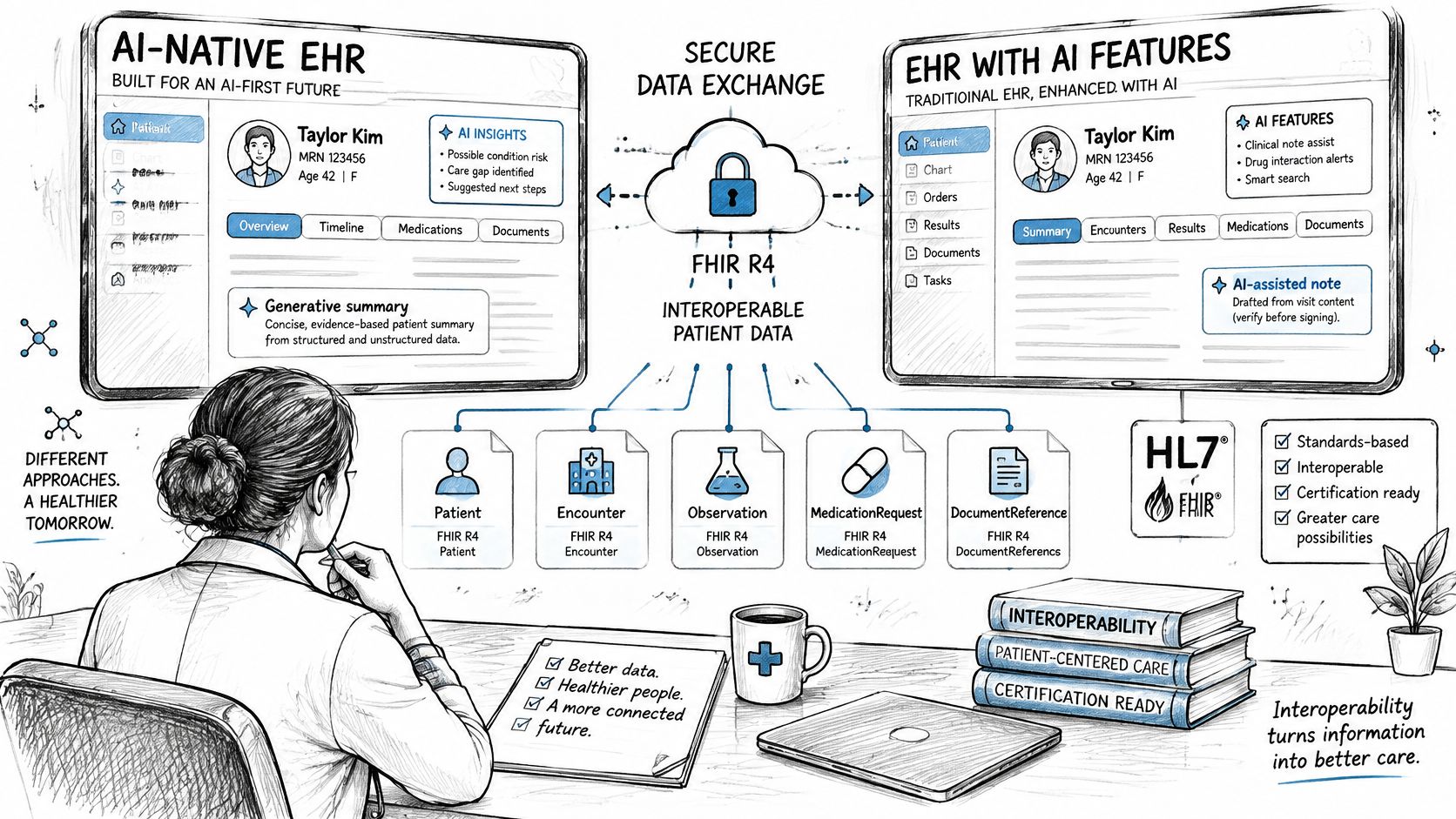
FHIR R4 resources such as Patient, Encounter, Observation, MedicationRequest, and DocumentReference are the usual read and write surface for clinical AI. HL7 v2 ADT and ORU messages still carry admissions and results across many provider networks. An AI-native platform has to map both into one clinical data path. A second store that only the model can see will drift from the chart the clinician signs.
An EHR with AI features inherits its interface engine, terminology maps, and API catalog. The model can read or write only what that catalog exposes. Missing DocumentReference writes, partial medication history, or a results feed that never leaves the interface engine will cap the feature even when the model itself is sound. Wider interface design is covered in our EHR integration and interoperability guide.
What certified decision support must disclose
HTI-1's transparency duty is tied to certified decision-support functionality, not to a generic "AI feature" label. For certified health IT that uses AI or other algorithms to support decision-making, developers must provide information about how the technology works, its intended use, and related risks or limitations, as set out in the ONC certification program regulations. ONC kept December 31, 2024, as the deadline to move from the earlier clinical decision-support criterion to the revised decision-support-interventions criterion.
The ONC HTI-1 decision support interventions fact sheet is guidance, not the rule text. It defines 31 source attributes for predictive decision support. An AI-native developer can keep model metadata, intended use, and risk records inside the product and the certification workflow. An attached model often needs a separate record, retrofitted around a service the certified EHR did not originally ship.
The HTI-1 Final Rule overview states the rule became effective March 11, 2024. By December 31, 2024, certified API developers had to publish customers' FHIR endpoint service-base URLs. By December 31, 2025, developers had to provide customers with certified health IT conforming to the new and revised criteria. The certified developer answers for certified behavior. The provider must confirm the deployed configuration matches that behavior and the approved workflow.
Compare three values on every release: certified version, endpoint base URL, and intervention version, against what production runs. A mismatch is a certification and safety finding, not a documentation nit.
Validating and monitoring AI features after go-live
An ambient scribe can shorten documentation while navigation, order entry, and history retrieval stay the same. Task time alone does not show that a feature works inside the episode of care.
Benchmark the episode, not only the note. Measure time to retrieve relevant history, clicks per clinical action, medication and order error rates, latency, provenance completeness, and the share of recommendations backed by source data. Derive time from the audit log, and split daytime documentation, after-hours work, and total EHR time so gains in one window cannot hide losses in another.
Published ambient studies show real, uneven gains inside existing workflows. In a 24-week stepped-wedge pragmatic trial reported in NEJM AI, 66 practitioners cut note time by 0.36 hours per day. A 2024 peer-reviewed study using simulated outpatient consultations found that consultations supported by an ambient documentation tool were 26.3% shorter on average than consultations using the standard EHR alone (PubMed Central). Savings without better care-process completion or lower error rates point to a successful add-on rather than a different operating model.
Study design and who owns the evidence
A controlled baseline-versus-intervention design is more informative than a simple before-and-after comparison, and safety outcomes belong in the same report as productivity gains. Ownership matters as much as method. The vendor publishes validation evidence and intended-use limits. The provider runs local validation on its own population and owns the decision to keep the feature enabled.
The same split applies when documentation volume changes billing work.
| Evidence |
Owner |
Checked |
| Validation report with dataset description and subgroup results |
Vendor clinical safety team |
Before go-live |
| Local baseline-versus-intervention study design |
Provider quality team |
Before go-live |
| Monitoring dashboard definition with override rates and drift thresholds |
Vendor and provider quality team |
Before go-live and at each release |
| Rollback test result |
Provider IT and vendor product owner |
Before go-live |
| Subgroup performance and override review |
Provider quality team |
Ongoing after go-live |
A local study can follow the published design directly. The provider's quality team records an audit-log baseline covering daytime documentation minutes, after-hours EHR time, order and medication errors, and the share of AI suggestions accepted unchanged, then enables the feature for a matched period in the same clinics and specialties and reruns the same measures. If note time falls while error counts and after-hours work hold steady, the deployment is behaving the way the vendor's validation said it would on that population. If documentation time falls while errors or overrides climb, the provider owns the call to narrow the rollout, reconfigure the feature, or roll it back.
Which option suits each type of organization
New practices and specialty clinics have no legacy schema to migrate. An AI-native EHR can cut interface work when clinic workflows match the vendor's design. The risk is turning on automation before the practice has measured its own documentation and billing path. Decision: choose native when the record, the note, and the workflow are all still unbuilt, and only after a short baseline of current work exists.
Health systems already on an EHR face migration, retraining, interface rebuilds, and downtime before any feature comparison is meaningful. In 2024, 71% of U.S. hospitals reported using predictive AI integrated with their EHR, up from 66% in 2023, according to the ONC hospital trends brief. Among hospitals using predictive AI, 80% sourced it from their EHR developer, 52% used third-party AI, and 50% developed AI themselves, in an analysis of federal hospital survey data (ONC data brief). Decision: add AI through built-in features or SMART on FHIR apps unless a replacement is already funded. How we approach that integration work is described on our healthcare engineering page.
Healthtech companies building a new care model choose build or integrate based on whether the model needs data and workflow control an incumbent chart cannot provide. Companies mapping that product space can start from our healthcare AI companies overview. Decision: build native only when the care model fails if the record, the workflow, and the model cannot be changed together.
Three conditions change the answer: a replacement that is already planned, a new specialty with no existing record, or a product that must control its own clinical workflow.
Adding AI to an existing EHR through SMART on FHIR
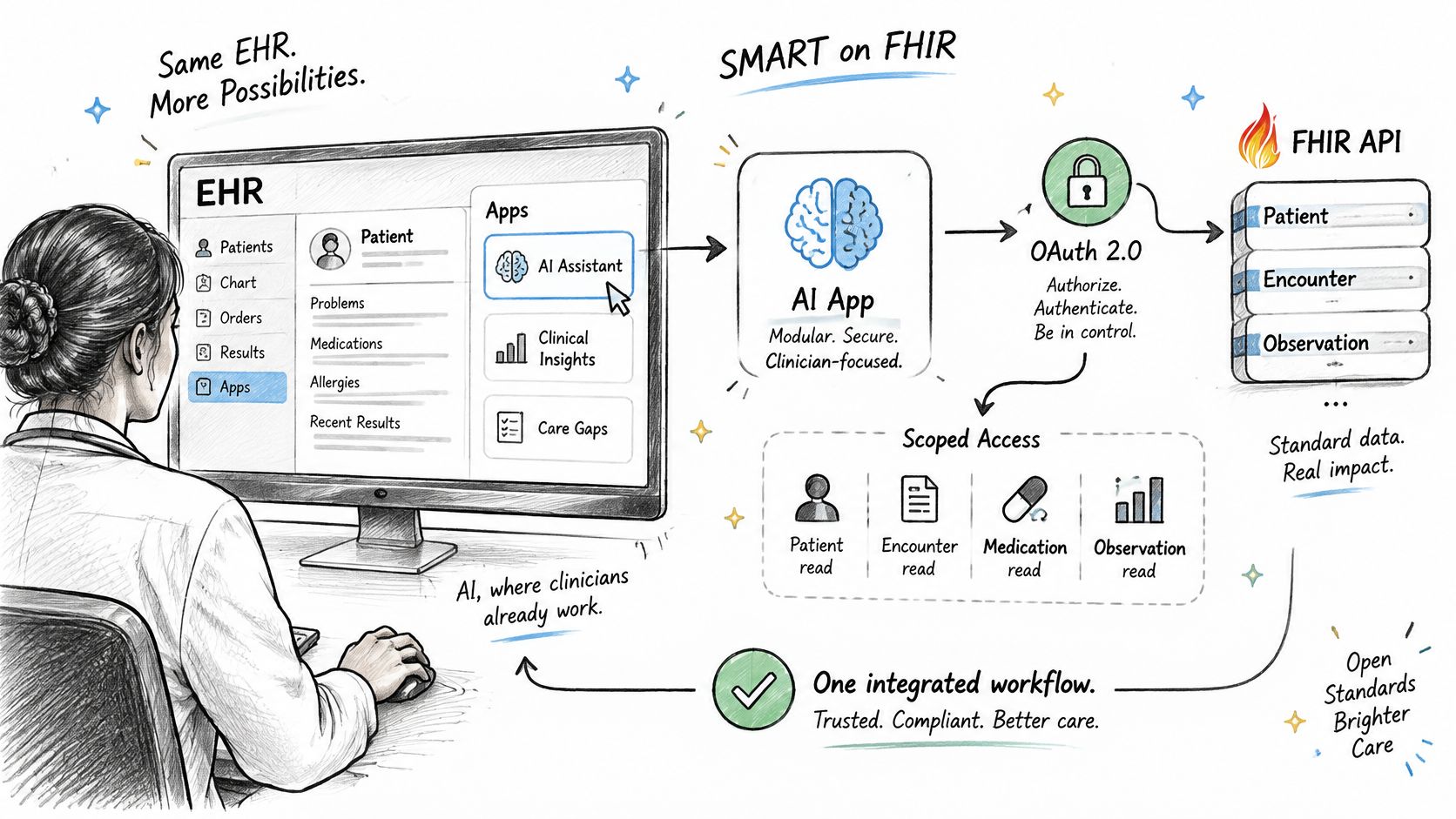
The third path keeps the host EHR and adds AI through SMART on FHIR apps and FHIR APIs. SMART App Launch has the app request authorization from an OAuth 2.0 authorization server, then use that authorization to read permitted FHIR resources. The guide is compatible with FHIR Release 4, and ONC identifies SMART App Launch version 2.0.0 as ready for adoption in certified health IT under HTI-1, per the ONC client application listing.
An embedded feature can use the EHR's user, patient, and launch context. An external app must handle token exchange, scopes, refresh, and failure on its own. EHR launch passes patient and encounter context from the chart. Standalone launch obtains that context through the app's own flow.
Production fails in ordinary ways: expired tokens, refresh that does not resume the session, revoked consent, a scope narrower than the UI implies, and FHIR resources the vendor does not expose. Least-privilege scopes, user identity, patient context, and revocation all have to be tested. A 200 from the endpoint is not that test. Patterns for this class of clinical assistant are outlined in our clinic AI assistant product notes.
Hypothetical discharge-summary app
This example is hypothetical. It traces one encounter, not a product we ship.
The EHR launches the app with context for one encounter.
The app requests launch/patient and read scopes for Encounter and DocumentReference.
The authorization server issues a token limited to that patient.
The app reads the encounter and two prior notes.
It writes a draft only if the vendor grants write scope, and the clinician reviews it before signing.
The audit log records each read and write.
Run scope tests, negative tests that the app cannot read another patient's resources, token revocation tests, and a reconciliation of app logs against EHR audit logs. The EHR vendor controls authorization and resource exposure. The app owner controls the model and its outputs. The provider controls which apps are enabled.
Certification, APIs, HIPAA and FDA limits when building an AI-native EHR
Four decisions, recorded in writing, determine how much of the compliance burden lands on the builder and how much the certified vendor or the provider produces. Do not set timelines or cost until certification scope and regulatory scope are on paper. Ekipa AI supports EHR/EMR integrations, HL7, FHIR, and API-based exchange, including workflow integration and third-party platforms and devices for SaMD products. That integration work is where the obligations stop being abstract, and where the split between builder-owned evidence and provider-owned decisions gets fixed. Product engineering context sits in our EHR software development guide and in SaMD engineering.
Decide whether customers need certified health IT. Certification fixes the criteria and the update cycle. Use the HTI-1 effective date and the conformance dates already set for certified products. If customers do not need certification, say so in the contract so transparency work is not confused with a certification claim. The party that claims certification owns the test results and the published transparency record. The party that declines it owes buyers a plain statement of what is and is not covered.
Set the FHIR API surface. Name the R4 resources and SMART scopes you will expose, how endpoint base URLs and API versions are published, and how read and bulk access are controlled. An unpublished base URL or an unversioned model breaks the comparison between certified behavior and production. The API owner produces the capability statement and the version policy; integrators build against those published documents.
Apply HIPAA Security Rule technical safeguards to the whole AI path. Under 45 CFR 164.312, covered entities and business associates implement access control, audit controls, integrity, person or entity authentication, and transmission security for electronic protected health information, and the Security Risk Assessment tool technical volume treats them as controls that run in production with an artifact to show for each. Apply them to prompt, retrieval, output, and feedback stores as well as the primary database. A business associate agreement applies when the product creates, receives, maintains, or transmits PHI for a covered entity, using the definition in 45 CFR 160.103. Ownership splits cleanly here. The covered entity runs the risk analysis and sets the policies. The business associate produces the artifacts: access-control tests, audit logs, encryption and key settings, incident exercises, backup restores, and documented review of model-generated content.
Map each feature to FDA clinical decision support rules. FDA's Clinical Decision Support Software guidance, together with the four criteria in section 520(o)(1)(E) of the FD&C Act, is the boundary between non-device CDS and a device function. The product owner runs this mapping feature by feature and keeps the written rationale for each call. Features that analyze medical images or signals, or that produce outputs a clinician cannot independently review, need the closest look. Ambient drafting that a clinician edits and signs is a different analysis from a recommendation the chart applies without that review.
Every artifact above has a named owner. A gap in that chain surfaces first in an audit, long before it surfaces in a spec review.
EHR and AI
Adding AI to your EHR or building your own?
We build SMART on FHIR apps, EHR integrations and AI-native clinical software with HIPAA safeguards and validation built in.
Buyer checklist for AI features in any EHR
Use one questionnaire and order for every vendor so answers can be compared. Mark an answer documented when the artifact is in the procurement file or the control is shown in the deployed build. Mark it promised when a named owner describes the evidence without supplying it, and missing when neither an owner nor an artifact exists. Recheck every promised item before signature.
A scripted demo leaves the evidence questions unresolved. Request the underlying documents, then review the live configuration in the buyer's environment because an admin guide can describe a control that is absent or disabled in the build. The same demo-to-evidence gap appears in our medical scribe buyer notes.
Each row pairs a procurement question with its evidence and accountable party.
| Question to ask |
Evidence to request |
Owner |
| Which certification listing and transparency record covers each AI feature? |
Current listing and the decision support intervention record, including source attributes |
Vendor regulatory lead |
| Which team owns validation, monitoring, and rollback for each feature after go-live? |
Feature-level validation report, monitoring plan, escalation path, and rollback procedure |
Vendor clinical safety and provider quality |
| Can provider staff disable each feature by site, user, or workflow? |
Live configuration change and the audit entry it creates |
Provider IT and vendor product owner |
| Which SMART on FHIR scopes and FHIR resources does each feature read or write? |
Scope and resource list, authorization configuration, and negative test results |
Vendor engineering and provider IT |
| Where are AI inputs, outputs, feedback, and logs stored, and who can access them? |
Data-flow record, storage location, retention policy, and access rules |
Provider compliance and vendor security owner |
| Does the vendor sign a business associate agreement covering AI processing and subprocessors? |
Signed agreement and current subprocessor list |
Provider legal and compliance |
| What changes when the vendor updates a model or workflow? |
Release notes, change log, and evidence of review before activation |
Vendor product owner and provider quality |
| What does it cost to replace one AI component without replacing the EHR? |
Written pricing, integration scope, and exit terms |
Procurement and CIO |
Worked example: a promised answer. Ask whether a site can disable ambient drafting. The vendor says its clinical safety team validated the feature, its quality team receives monitoring alerts, and site administrators can turn it off. It agrees to send the validation report and admin guide after the call. Score the response promised because it describes owners and artifacts without providing the report, alert rule, audit entry, or deployed toggle. It becomes documented when the report arrives and the buyer records a switch-off in its own environment. If those artifacts never appear, score it missing.
Conclusion
The choice comes down to evidence ownership after go-live. An AI-native EHR can place provenance, model metadata, and audit records closer to the core data path; an existing EHR can still qualify when added features show least-privilege scopes, validation limits, monitoring thresholds, and a working per-site switch-off.
Assign every record before purchase: the vendor owns certified behavior, dataset and subgroup evidence, rollback tooling, and subprocessor disclosures; the provider owns deployed configuration, enabled apps, log retention, access review, and quality escalation.
Pick the option whose production build can produce each artifact and name its owner. A control that exists only in a demo does not transfer risk.
For a wider view of the vendor landscape, see our guide to evaluating healthcare AI companies, and for documentation tools specifically, choosing an AI medical scribe. If you are deciding whether to build AI into your own EHR or add it to an existing one, book a consultation with Ekipa's HealthTech engineers.
Frequently asked questions
Is the 31-attribute transparency list a certification rule or guidance?
The underlying requirement is a rule. 45 CFR 170.315(a)(9), the certification criterion for decision support interventions, requires predictive interventions to disclose 31 source attributes covering how the intervention works, its intended use, and its risks or limitations. ONC's fact sheet on decision support interventions is guidance that explains those attributes. The distinction matters for buyers: the criterion is what certified health IT gets tested against, and the attribute list doubles as a checklist for reviewing what a developer supplies.
Who produces the transparency records, and who checks them?
The certified health IT developer produces them. Structured information on how a decision-support intervention works, its intended use, and its risks or limitations is a developer deliverable. Verification sits with the customer. Confirm the deployed configuration matches the certified behavior before go-live, and after go-live the provider side owns override rates, subgroup performance monitoring, and the decision to switch a feature off.
What must a SMART on FHIR app prove before clinicians use it?
It must run under least-privilege scopes, requesting only the resources its function needs. Negative tests must show it cannot read another patient's resources. Token refresh and revocation must be confirmed against the host's authorization server. The provider owns the enable decision, so a site should hold the app disabled until all three checks pass.
Which SMART App Launch version should a new app target?
ONC identifies SMART App Launch version 2.0.0 as ready for adoption in certified health IT under HTI-1, and that guide is compatible with FHIR R4. Build against the authorization server, scopes, and launch context the certified host exposes, because certified hosts can differ in what they support.