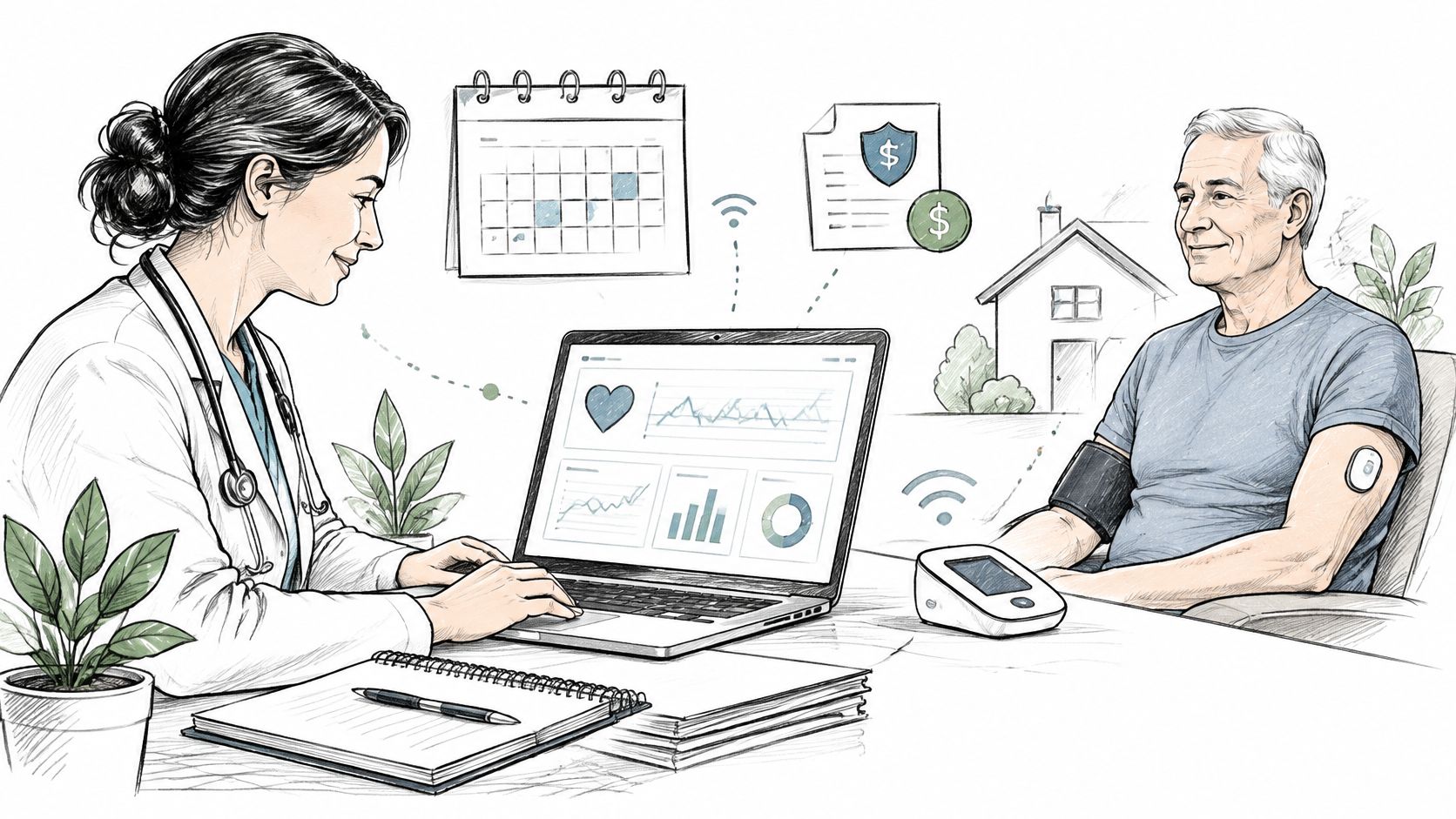
Medicare payments for remote patient monitoring grew from about $15 million in 2019 to more than $300 million in 2022, and about 43 percent of enrollees who received it did not receive all three components, according to the HHS Office of Inspector General. For engineering teams, remote patient monitoring CPT codes create a reconciliation problem: device events, clinical work, and billing periods must produce consistent evidence. The code descriptions below translate those requirements into product records, eligibility checks, and audit exports.
Core remote patient monitoring CPT codes and what each covers
| CPT code |
What it covers |
Threshold or unit |
When reported |
| 99453 |
Initial device setup and patient education |
Initial setup service |
Generally once at episode start |
| 99454 |
Device supply, transmission, and data collection |
Data recorded on at least 16 days in a 30-day period |
Each qualifying monitoring period |
| 99457 |
Treatment management with interactive communication |
First 20 minutes in a calendar month |
Qualifying calendar month |
| 99458 |
Additional treatment-management time |
Each additional 20-minute block |
Add-on to 99457, never independently |
| 99091 |
Collection and interpretation of physiologic data by a physician or qualified professional |
30 minutes |
Applicable collection-and-interpretation reporting period, subject to current reporting rules |
The CMS RPM coverage page describes the setup, device-supply, and treatment-management components and their thresholds. For 99091, confirm the current descriptor, reporting period, and code-combination rules before implementation; interpretation work needs a distinct evidence record rather than an assumed mapping from general monitoring activity.
These categories should become separate objects in remote patient monitoring software. An onboarding record supports setup, a device-period ledger supports supply, and a clinical time ledger supports treatment management. A patient-level “active” flag can't establish which services were completed.

The useful distinction is service evidence versus claim status. A clearinghouse acceptance response doesn't establish that the underlying record supports the selected service. Review coding completeness separately from rejection handling, because a claim that was never denied can still lack support.
Product teams should maintain code definitions as versioned configuration. The expanded code set requires more than adding another option to a billing dropdown.
Codes added for 2026 and when they apply
The CY 2026 Medicare Physician Fee Schedule final rule, effective January 1, 2026, added 99445, covering device supply with 2 to 15 days of data in a 30-day period, and 99470, covering treatment management of 10 to 19 minutes in a calendar month that doesn't reach the 20 minutes 99457 requires. 99445 and 99454 cannot be reported for the same period, and Noridian's 2026 RPM update describes the shorter management option. Store these thresholds as versioned rules, because CMS can revise remote monitoring codes and values in each annual fee schedule.
Short episodes need an explicit classification. The HHS remote patient monitoring billing guide addresses short-duration monitoring, which makes retaining transmission-day evidence particularly important.
Hypothetical eligibility trace
Consider an episode with nine transmission days. The ingestion service preserves each upload, the period ledger derives qualifying dates, and the eligibility engine evaluates the applicable payer and service-year rules. It rejects the standard-duration device-supply candidate, evaluates the short-duration candidate, and sends the evidence package for billing review.
Hospitalization, device failure, language barriers, low digital literacy, or early clinical resolution should have distinct exception states. They shouldn't all become “nonadherent.”
Preserve why an episode ended alongside the readings it produced. A short clinically appropriate episode and an unfinished onboarding workflow require different operational responses.
Engineering owns reproducible classification. Qualified billing advisors own interpretation and approval of the applicable billing policy.
Device, data-day, communication and consent requirements
Device provenance starts with the assigned equipment and its data path. Record the device identifier, manufacturer documentation reference, assignment dates, and whether readings arrive through automatic electronic upload. An architecture review should distinguish device-originated observations from manually entered values.
Communication evidence requires its own record. CMS guidance on treatment management defines interactive communication as real-time, synchronous, two-way communication and explains that qualifying management time can include other care-management work when the required interaction occurs. A text notification, dashboard review, or automated alert doesn't independently establish that interaction.
Enrollment and practitioner evidence
The CMS remote monitoring guidance requires an established patient relationship, medically reasonable and necessary monitoring, and consent when services are provided. It also limits billing to physicians and nonphysician practitioners eligible to furnish evaluation-and-management services, while allowing auxiliary personnel to work under general supervision.
Translate those conditions into enrollment fields:
- A consent event with timestamp, method, recorded explanation, and responsible staff member.
- A relationship and medical-necessity attestation linked to the clinical record.
- A billing-practitioner identifier, eligibility verification, and supervision relationship.
- A communication event with participants, modality, timestamps, and clinical context.
These are recommended implementation fields, not a claim that CMS mandates a particular database schema. Digital patient monitoring design should connect enrollment, consent, and clinical workflows without making staff re-enter the same evidence.
When assessing a clinician-facing interface, including an HCP engagement co-pilot, require traceability to the underlying encounter and practitioner record. Interface activity alone shouldn't establish a billable service.
Software can verify missing fields, upload provenance, credential-record completeness, and period boundaries. Clinicians must attest to clinical necessity and the substance of care.
Remote patient monitoring versus remote therapeutic monitoring
RPM centers on physiologic measurements, while RTM centers on therapeutic monitoring associated with a treatment plan. Their service descriptors and device requirements need separate configuration; a shared dashboard doesn't make their billing logic interchangeable. CMS also allows only one practitioner to bill remote monitoring for a patient's period and doesn't allow RPM and RTM to be billed for the same period. Our guide to Medicare requirements for an RPM program covers those program rules in more detail; the software question is how to enforce them.
Model enrollment as a period-scoped program assignment, with program type, responsible practitioner, organization, start and end boundaries, and conflict status. A local database can prevent duplicate enrollment inside its own tenant, but it can't prove the absence of an external program, so route unresolved conflicts to operational review and record what was checked, who confirmed ownership and what remained unknown.
What RPM software must capture to support billing
A claim should reconcile to a connected evidence chain. CMS billing guidance separates onboarding, device/data services, and treatment management, supporting a design that stores those activities independently.
Records in claim-building order
Onboarding record. Store setup completion, education completion, consent provenance, interpreter involvement, caregiver participation, and responsible staff. Keep corrections as attributable amendments rather than replacing the original event.
Device and transmission records. Maintain device assignment history and an upload log containing source timestamp, ingestion timestamp, reading count, event type, and failure reason. Preserve raw events separately from derived qualifying-day counts so engineers can reproduce a billing decision after correcting ingestion logic.
Period ledger. Store the monitoring window, qualifying dates, applicable rule version, payer, candidate code, exclusion results, and review status. Calendar-month management accounting should remain separate from device-service periods.
Time ledger. Capture start and stop times, activity, staff identity, credentials, practitioner association, and communication modality. Separate the occurrence of qualifying interactive communication from the total eligible management time; don't require every counted minute to be synchronous conversation.
An equity analysis in npj Digital Medicine examines assumptions that can exclude patients from RPM. Add connectivity type, shared-device use, accessibility accommodations, alternative workflows, and nontransmission reasons so operational teams don't equate missing uploads with unwillingness to participate.
Processing and audit evidence
If on-device or gateway processing filters readings, record the processing version, decision, and disposition. The implications discussed in edge AI in remote patient monitoring make this provenance important: a downstream counter can only evaluate the events it receives.
Treat generated summaries from a clinic AI assistant as derived artifacts, with references to source records and human review where applicable. Don't let a summary overwrite the evidence ledger.
Engineering should deliver an export containing the claim candidate, source events, derived counts, rule version, amendments, and approving reviewer. Compliance should verify applicable HIPAA audit-control requirements, including 45 CFR 164.312(b), against the deployed system rather than treating a billing export as proof of compliance.
Compliance risks that cause billing errors
Duplicate and overlapping claims require ownership controls. The prevention record is the period-scoped enrollment assignment; the audit export should show practitioner ownership, conflict checks, and resolution. Where external enrollment can't be verified automatically, preserve the manual confirmation and its scope.
Consent and practitioner gaps require evidence before claim release. Export the consent event, practitioner eligibility record, and supervision assignment, with amendments visible. A completed checkbox without provenance gives a reviewer little basis to determine what happened.
Test controls against specific claim failures
Use negative test cases rather than checking only that a claim can be generated:
- Attempt release with missing consent evidence and verify that the workflow blocks approval.
- Introduce overlapping program assignments and verify conflict routing.
- Enter asynchronous activity without qualifying interaction and verify that management eligibility remains unresolved.
- Change an upload's assignment or timestamp and verify that derived counts are recalculated with an audit history.
Denial monitoring should remain separate from evidence validation: an accepted claim still needs support.
Access-related exceptions deserve operational review too. A technically complete claim export won't explain exclusion from enrollment unless the platform also retains setup failures, accommodations, and discontinuation reasons.
This article isn't medical, legal, or billing advice; confirm decisions with qualified clinical, billing, compliance, and legal advisors.
Remote patient monitoring
Building RPM software that has to stand up to a billing audit?
We build monitoring platforms with device-period ledgers, time and consent records, and claim exports a reviewer can trace back to raw readings.
Prefer to pick a time? Book a call directly
Conclusion
Treat every RPM claim as the output of a rules engine. For each code, the record should let a reviewer rebuild the decision from raw events: which policy year applied, which device supplied readings, which days counted, who consented, who supervised, which interaction qualified, and how minutes were totaled. If any step needs a manual explanation outside the log, the control is incomplete.
That standard matters more as 2026 pathways turn eligibility into explicit threshold checks. Store clinical attestations beside calculated facts, keep amendment history visible, and preserve exception states so a short episode, a failed setup, or an unresolved overlap remains explainable after submission.
If you're turning these checks into product requirements, our healthcare software team builds the workflow automation and integrations behind them, so talk to our team about scope before the next fee schedule cycle.
Frequently asked questions
Can an RPM device that transmits on 10 days support billing?
Yes. Use the short-duration device-supply pathway from the CMS CY 2026 final rule only when the record still passes the same rules check for consent, device eligibility, practitioner ownership, transmission evidence and required management work. Ten transmission days can change which code family applies, but they cannot substitute for a missing input.
What should the system do with staff time that is not tied to the live exchange?
Do not count it toward the 99457 interaction. CMS requires a real-time synchronous two-way exchange for that code; other eligible management work can contribute only when that interaction occurs. Store each entry with performer, role, timestamps and the linked communication event so nonqualifying work stays out of the claim candidate.
Can nonphysician practitioners bill RPM?
Yes, when they are eligible to furnish evaluation-and-management services under CMS guidance. The claim record should carry the billing practitioner, the performing user and that user's eligibility or enrollment status as separate fields, so review can trace who did the work and who is responsible for the claim.