
Compliance
Healthcare Software Development Outsourcing Guide
Healthcare software development outsourcing explained: models, HIPAA and BAA duties, EHR integration, FHIR scopes, security ownership and partner red flags.
November 22, 2026Read more
Learn how FDA medical device cybersecurity rules under Section 524B shape SBOMs, threat models, and patching for SaMD teams.

In practice, FDA medical device cybersecurity means the team designs controls, records why they exist, and keeps them effective after the device ships. FDA's final guidance, Cybersecurity in Medical Devices: Quality Management System Considerations and Content of Premarket Submissions, was issued in February 2026 and supersedes the June 2025 version. It treats security as work that runs from concept through retirement. For products that meet the cyber device definition in Section 524B of the Federal Food, Drug, and Cosmetic Act, the statute adds submission duties on top of that guidance. The engineering problem is that threat models, controls, and vulnerability processes must exist in the design before submission and keep working after launch. This guide covers the cyber device criteria, what a premarket submission for a cyber device must contain, and the engineering work behind threat modeling, risk management, the medical device SBOM, testing, labeling, and postmarket patching.
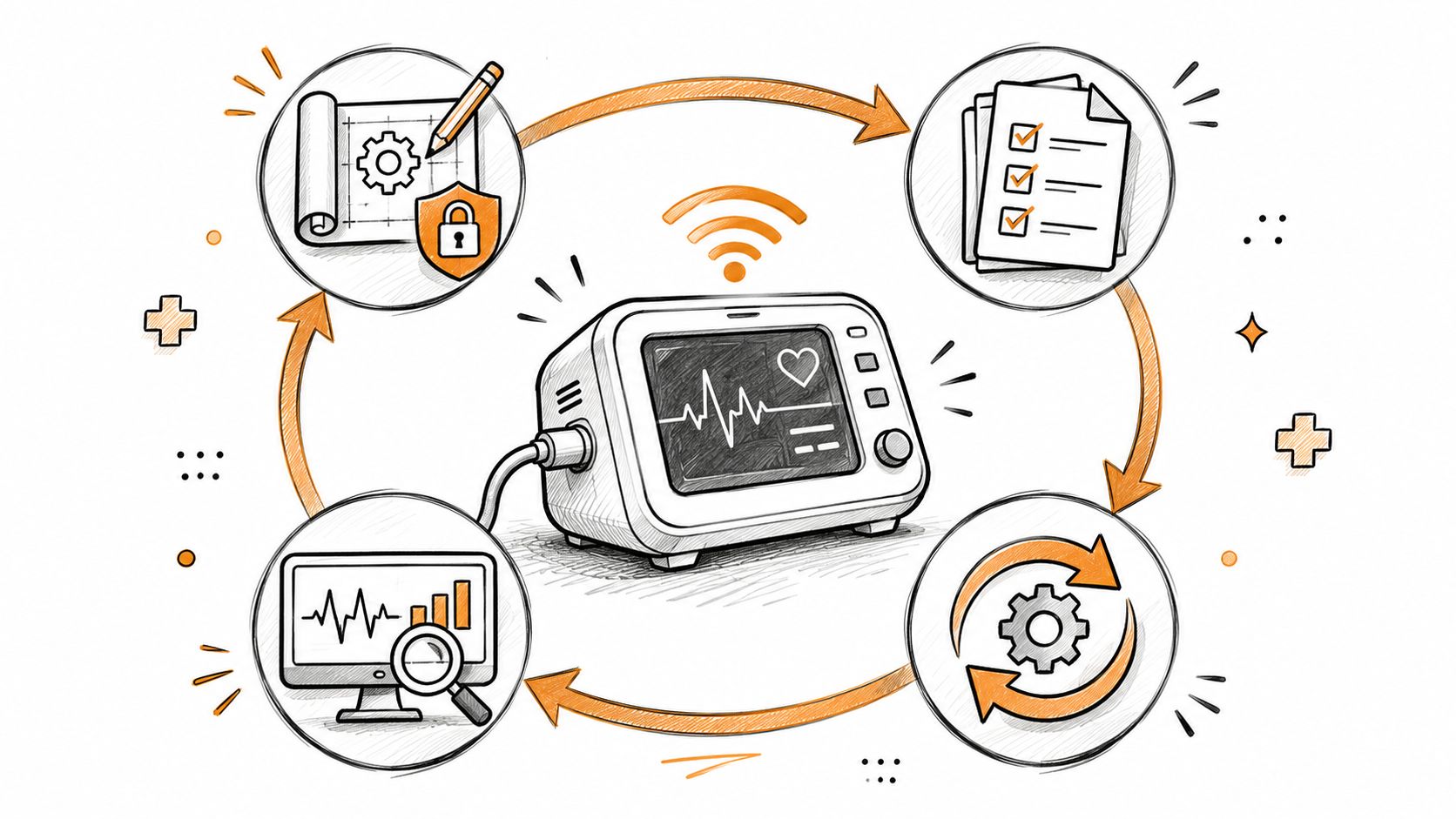
Security cannot be a final checkpoint when architecture, threat models, access control, logging, update paths, and incident response sit beside clinical and functional requirements. Each of those areas affects the others, so they need to be planned together.
The distinction between law and guidance matters for planning. Section 524B creates obligations for qualifying cyber devices. FDA guidance explains the methods and documentation the agency expects reviewers to see, and it presents those as recommendations rather than statutory duties.
The guidance describes a Secure Product Development Framework, in which security is built into design, change control, and maintenance. Risk management, architecture, testing, labeling, and vulnerability handling feed one another. Evidence for each should be planned across design, implementation, verification, deployment, and maintenance so the submission describes capabilities the manufacturer can sustain.
The control categories in the guidance work well as review prompts:
For each applicable control, name an owner, a requirement, and the verification evidence. Before design freeze, record open decisions, such as who maintains the control after deployment and which customer configuration assumptions it depends on. That gives reviewers a traceable path from product behavior to submission claims.
Broader context on how these obligations fit the regulatory picture is in the medical device software regulation guide. Before submission, regulatory leads should confirm the guidance revision currently posted on FDA's site and reconcile the evidence index against that version's recommendations and the applicable statutory obligations.
Section 524B, titled "Ensuring Cybersecurity of Medical Devices," was added to the Federal Food, Drug, and Cosmetic Act by Section 3305 of the Consolidated Appropriations Act, 2023. The act was signed on December 29, 2022. Section 3305 made the amendments effective 90 days after enactment, which was March 29, 2023. Confirm the transition provisions in the statute itself before deciding whether a specific submission falls under them.
The statute applies to premarket submissions for covered device types, including 510(k), premarket approval, De Novo, product development protocol, and Humanitarian Device Exemption submissions. FDA's medical device cybersecurity page explains how the agency applies these requirements.

Under the Section 524B definition, a cyber device is a device that includes software validated, installed, or authorized by the sponsor as a device or within a device, that can connect to the internet, and that contains technological characteristics that could be vulnerable to cybersecurity threats. All three characteristics must be present. Document each answer against the real product boundary and the way the system is deployed.
The table below applies those three tests to a hypothetical cloud SaMD. The example is for applicability reasoning only and makes no claim about a marketed product.
| Test | Application to the hypothetical product | Engineering evidence |
|---|---|---|
| Software | The sponsor authorizes the hosted application as device software. | Software inventory and release baseline |
| Connectivity | The hosted application communicates with the EHR over the internet. | Connectivity inventory and network interface list |
| Vulnerability | API access, third-party dependencies, and software updates create characteristics that need cybersecurity assessment. | Threat model and update channel design |
Those artifacts support the determination. Engineering should surface interfaces and deployment assumptions, and regulatory should explain how those facts drive the applicability decision. Classification is a separate assessment, covered in the SaMD classification guide.
Record the reasoning with the submission pathway, device version, assessment owner, and date. Reopen the determination when connectivity, deployment boundaries, or update mechanisms change, so the rationale continues to match the software being submitted.
Section 524B sets out specific content for a premarket submission for a cyber device. The statute names three core areas and also includes other requirements, so teams should check the full text of the statute and FDA's current guidance rather than relying on summaries.
The first area is a plan to monitor, identify, and address postmarket vulnerabilities and exploits. The statute specifically calls for coordinated vulnerability disclosure processes as part of that plan. In engineering terms, this is a standing operation with an intake channel, triage steps, and named owners that continue working long after launch.
The second area requires processes that provide reasonable assurance that the device and its related systems are cybersecure. Those processes must also make postmarket updates and patches available. The statute ties that cadence to a reasonably justified regular schedule, with out-of-cycle releases when critical vulnerabilities are found.
The third area is a software bill of materials covering commercial, open-source, and off-the-shelf components. That scope extends well beyond code the manufacturer wrote, so dependency data has to be captured during the build. The workflow for building a medical device SBOM and keeping it current is covered later in this guide, and our SaMD engineering services apply the same pipeline to client products.
The table below maps each requirement area to an engineering artifact, an owning function, and the evidence a reviewer will look for.
| Requirement area | Engineering artifact | Primary owner | Reviewer evidence |
|---|---|---|---|
| Postmarket vulnerability plan | Monitoring procedure and coordinated vulnerability disclosure process | Product security | Written plan, intake channel, triage and response records |
| Reasonable assurance processes | Threat model, security architecture views, security test reports | Engineering, with product security | Test results traceable to identified threats |
| Updates and patches | Update governance and patch release procedure | Engineering and quality | Defined update cycle, critical patch procedure, change control records |
| Software bill of materials | Component inventory for each released version | Engineering | Components with versions, suppliers, and dependency relationships |
None of these artifacts can wait until design freeze. Dependency inventories, vulnerability handling, and update governance are difficult to reconstruct after the design is locked. Gaps in these areas are a common source of reviewer questions, because reviewers end up reading about controls that the released software cannot demonstrate.
Threat modeling ties each security control to a specific asset, entry point, and trust boundary. Reviewers walk the chain from threat to control to test, and they expect every link to hold. A control list without that chain reads as a statement of intent.
Many teams start with a structured method such as STRIDE, which provides a checklist of threat categories. Attack trees then help analyze the paths where a successful attack would cause the most harm. A reviewer will usually expect three views:
Consider a hypothetical clinician-facing SaMD that reads patient observations through a FHIR R4 API. On the data flow view, the hospital-to-cloud boundary is the first place to examine. Each crossing needs TLS for transport, OAuth 2.0 scopes under SMART on FHIR for authorization, and audit events that record each access to a patient resource. Each threat then maps to a control category in the FDA guidance.
| Threat | Control category | Test evidence |
|---|---|---|
| Spoofed clinician token | Authentication | Token replay and expiry tests |
| Read beyond granted scope | Authorization | Scope enforcement tests |
| Intercepted FHIR traffic | Cryptography | TLS configuration checks |
| Untracked record access | Event detection and logging | Audit event assertions |
| Unsigned update installed | Firmware and software updates | Signature rejection tests |
ISO 14971 governs the safety risk management file. That file should also hold security threats that could alter device output or disable a clinical function. Record each one as a hazardous situation: the threat scenario, the potential harm to a patient or clinician, the probability estimate, the control, and the residual risk.
Engineering verifies each control with test evidence. The accountable risk owner then accepts the residual risk after quality has reviewed it. The depth of lifecycle activity for each control depends on the software safety class under IEC 62304, which is covered in the IEC 62304 software safety classification guide.
FDA guidance expects the security risk assessment to appear in the premarket submission. Confirm the current editions of ISO 14971 and IEC 62304 from the standards publishers before citing them in a submission.

Test evidence follows the same chain as the threat model. It usually includes static analysis, software composition analysis checked against known vulnerability records, dynamic testing, and fuzzing of parsers such as HL7 v2 message handlers and FHIR endpoints. Penetration testing completes the set, with scope drawn directly from the threat model.
A penetration test report should state:
Every threat should link to at least one test, and every result should trace back to a requirement or risk control. Ownership usually divides cleanly: engineering owns the architecture diagrams and pipeline tests, product security owns the threat register and penetration test scope, and quality confirms traceability and archives the evidence.
A medical device SBOM should trace component identities to the software that customers actually run, not to a list that only exists in a source repository. Build the inventory from release artifacts whenever possible. Source manifests help, but shipped binaries, containers, and packages describe what was delivered. A baseline should record component names, versions, suppliers, dependency relationships, licenses, hashes, and generation timestamps, and it should flag gaps rather than guess.
A machine-readable format such as SPDX, which is standardized as ISO/IEC 5962, records package identities, relationships, checksums, and licensing fields in a form other teams can query. Those details speed up investigation, but they do not show whether a vulnerability is reachable or clinically meaningful.
| Build input | Recommended inventory treatment |
|---|---|
| Application packages | Capture direct and transitive dependencies. |
| Container base images | Include operating system packages and image identifiers. |
| FHIR and HL7 client libraries | Record resolved versions, including nested dependencies. |
| Third-party cloud services | Track service dependencies separately when internal components are not visible. |
Generate the SBOM inside the build pipeline for every release, regenerate it when dependencies change, and archive it with the exact artifact that shipped. Engineering should tie the inventory to the release identifier and artifact digest, and quality should keep the approved baseline on record.
Hypothetical worked example: an advisory reports a flaw in a transitive HTTP client library used by a SaMD application.
This workflow fits the lifecycle view in FDA's guidance without treating every advisory as carrying the same patient risk. The manufacturer remains responsible for evaluating third-party code, even when the component came from another source.
SaMD cybersecurity
Preparing a cyber device submission?
We build threat models, SBOM pipelines and vulnerability handling into SaMD products, so the submission evidence matches the software you ship.
Prefer to pick a time? Book a call directly
Postmarket monitoring and vulnerability handling continue across the supported lifecycle, so the work cannot end at clearance or approval. Name an owner for each of these activities:
Reachability and clinical impact should drive response urgency, not the headline severity score alone. Document patch prioritization decisions and keep them separate from statutory duties.
FDA's labeling recommendations cover customer security responsibilities, update instructions, software version information, vulnerability reporting contacts, and how long the manufacturer will support the device. The table below separates responsibilities by function.
| Function | Responsibility after launch |
|---|---|
| Product security | Vulnerability intake, triage, and disclosure coordination |
| Engineering | Patch development, SBOM regeneration, and regression testing |
| Quality | Change control, release records, and documented risk decisions |
| Regulatory | Assessment of whether changes affect the submission or require notification |
| Customer-facing teams | Deployment instructions, labeling updates, and support timelines |
The broader healthtech security and compliance guide connects release evidence, testing, and disclosure governance across the wider security program.
Teams that also sell into the EU should plan for the Cyber Resilience Act as well. Our compliance partner MedQAIR explains how the CRA applies to health software.
FDA medical device cybersecurity review depends on evidence that existed during design and remains current after release. A final penetration test can support the file, but it cannot replace documented design decisions, verified controls, a current SBOM, or a working process for handling vulnerabilities. Engineering, quality, and regulatory teams should keep the threat model, architecture views, SBOM, and vulnerability plan synchronized with the software version that ships, and each security claim in the submission should have a named owner and a clear link to the released configuration. Where a control could affect patient safety, the security assessment should feed into the ISO 14971 risk file, and that link should be reviewed whenever a patch or dependency changes. If your team is preparing a cyber device submission, talk to Ekipa's SaMD engineers to review your architecture, release evidence, and submission readiness.
No. Section 524B applies to a cyber device, which is a device that includes software, can connect to the internet, and contains technological characteristics that could be exposed to cybersecurity threats. A device that runs software but never connects to the internet falls outside that definition. Confirm the definition in the statute and on FDA's medical device cybersecurity page.
Section 524B requires a plan to monitor, identify, and address postmarket vulnerabilities and exploits, including coordinated vulnerability disclosure. It also requires processes that provide reasonable assurance that the device and related systems are cybersecure, a path for postmarket updates and patches, and a software bill of materials. The statute contains additional requirements, so the full text should be checked before the submission is assembled.
Not automatically. Section 524B requires an SBOM only when the product also meets the cyber device definition. Make that decision for each product using the real deployment model, the connectivity design, and the software stack, and record the reasoning with the assessment owner and date.
Use the SBOM to find every released version that contains an affected component, then check whether the vulnerable code path is reachable in the deployed configuration. Assess possible effects on clinical, privacy, and safety functions, then patch, validate, and document the change. Communicate fixes and customer actions through labeling and disclosure channels. FDA's guidance on postmarket management is available on the FDA cybersecurity page.
Security threats belong in the ISO 14971 risk management file when exploitation could create patient harm, such as altering device output or removing a clinical function. Each entry should record the threat scenario, the possible harm, the estimated probability, the control, and the residual risk. FDA guidance expects the security risk assessment to appear in the premarket submission, so confirm the current edition of ISO 14971 with the standards publisher before citing it.
Healthcare software development outsourcing explained: models, HIPAA and BAA duties, EHR integration, FHIR scopes, security ownership and partner red flags.

RAG development services for healthcare: architecture, ingestion, retrieval, evaluation, PHI safeguards, delivery phases and how to choose a partner.

Learn how to hire AI engineers for healthtech: define scope, test EHR and HIPAA skills with work samples, and choose the right engagement model.
Connect with our team to explore how AI expertise can transform your business.