
AI in Healthcare
Hire AI Engineers for Healthcare: A Decision Guide
Learn how to hire AI engineers for healthtech: define scope, test EHR and HIPAA skills with work samples, and choose the right engagement model.
November 19, 2026Read more
RAG development services for healthcare: architecture, ingestion, retrieval, evaluation, PHI safeguards, delivery phases and how to choose a partner.

Healthcare RAG systems need measurable retrieval controls: a fluent answer can still rest on an irrelevant passage, an expired policy, or a record the user shouldn't see. For engineering leaders evaluating RAG development services, the procurement problem is deciding who will build those controls and what evidence will prove they work. A useful delivery scope connects every pipeline stage to a named owner, an acceptance artifact, and an operating responsibility after launch.
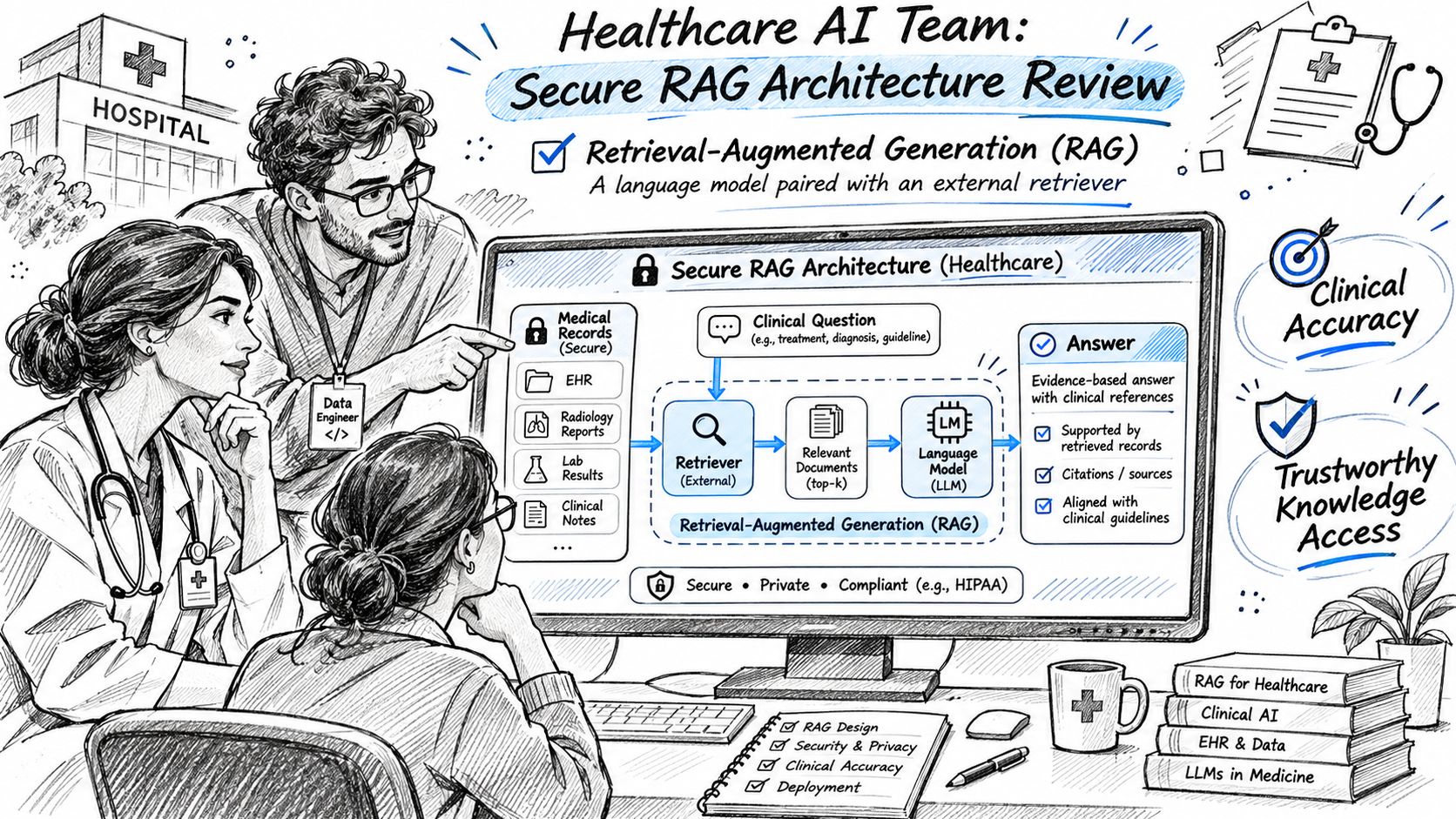
Retrieval-augmented generation pairs a language model with an external retriever so the application can consult documents when answering. In healthcare, that makes the source inventory, document lifecycle, and retrieval configuration part of the product's clinical and operational behavior.
The service scope should cover the complete path from approved sources to reviewed outputs. Treat the following as a proposed acceptance checklist, with responsibilities confirmed during contracting.
| Stage | What is built | Typical owner | Evidence produced |
|---|---|---|---|
| Use case and data scoping | Intended use, user population, source inventory, out-of-scope questions, proposed risk classification | Product owner with clinical lead; partner facilitates | Scoping document and source register |
| Document ingestion and parsing | Connectors for PDFs, notes, and policies; text, table, and heading extraction; OCR for scans | Partner builds; customer grants source access | Parser test set with extraction error review |
| Chunking and metadata | Section or clause boundaries; document ID, version, date, owner, and permission tags | Engineering | Chunk samples and metadata schema |
| Embeddings and indexing | Embedding selection, index build, refresh, and deletion jobs | Engineering | Index manifest and model version record |
| Retrieval and reranking | Dense, sparse, and hybrid search; reranker; candidate and top-k settings | Engineering | Retrieval logs with recall at k results |
| Prompt and answer design | Grounded templates, citation format, and abstention behavior | Engineering with clinical reviewers | Prompt versions and citation test results |
| Access control | Identity-aware filtering before retrieval; tenant and role boundaries | Customer identity team; engineering enforces | Permission tests and denial logs |
| Evaluation | Recall, faithfulness, citation resolution, and unanswerable-question tests | Partner and customer clinical staff | Versioned evaluation report |
| Security and AI risk management | Injection defenses, OWASP LLM risk coverage, and NIST AI RMF mapping | Partner engineering; customer security and risk | Threat model and risk register |
| Deployment and monitoring | Release gates, freshness checks, alerts, and audit logging | Shared; customer operations owns runbooks | Dashboards and incident records |
| Cost control | Token budgets, context limits, policy-approved caching, and index management | Engineering with named budget owner | Cost-per-answer reports |
The MIRAGE medical benchmark evaluated 7,663 questions across 41 configurations and reported accuracy improvements of up to 18% over chain-of-thought prompting alone across the evaluated models. Its practical implication is configuration-specific: corpus, retriever, and model choices need evaluation together.
The customer's product and clinical owners approve intended use and acceptance criteria. Engineering produces the implementation and reproducible test results; a development partner shouldn't implicitly become the authority on acceptable clinical risk.
The evidence column should become part of the statement of work for healthcare AI and integration delivery. An artifact counts as delivered only when its designated reviewer can inspect and accept it.
Choose RAG when knowledge changes, the answer needs inspectable source passages, and the organization can govern the corpus. That's a delivery recommendation, not a reason to put a language model in every information workflow.
Fine-tuning is a candidate when the problem is consistent behavior, terminology, or output structure. It doesn't replace a source retrieval interface, and it shouldn't be the default mechanism for maintaining frequently revised policies. A fine-tuned model can still sit behind retrieval when both behavior and current evidence matter.
Search is preferable when users need to locate and read an authoritative document themselves. Adding generated synthesis introduces another output to validate. If the workflow ends with opening a policy, a permission-aware search interface may meet the requirement with fewer components.
For a discrete clinical value, prefer a structured query where possible. An active medication list, observation date, or recorded result calls for a defined resource query and explicit handling of status and missing values, rather than inference from loosely related passages.
| User need | Starting architecture | Acceptance focus |
|---|---|---|
| Find the applicable policy | Search | Ranking, permissions, and document freshness |
| Explain an answer across approved documents | RAG | Evidence coverage and claim support |
| Produce a consistent specialized format | Prompt design, then assess fine-tuning | Format compliance and task performance |
| Retrieve an exact recorded field | Structured API or database query | Query semantics and data provenance |
A production application can route different questions differently. A medication-record question can use a structured query, while a policy explanation uses retrieval and a document-location request returns search results without synthesis.
The fine-tuning versus RAG guide addresses the broader maintenance and architecture comparison. For procurement, require the partner to explain why generation is necessary for each proposed workflow.
Data-platform readiness belongs in that decision too. Inspect your own source ownership, access mappings and refresh process before committing to a design; our guide to enterprise health data platforms covers that foundation.
A sensible discovery outcome can be a smaller build. If approved documents are unavailable, permissions can't be reproduced, or the user only needs exact fields, resolve those constraints before committing to a generated-answer interface.
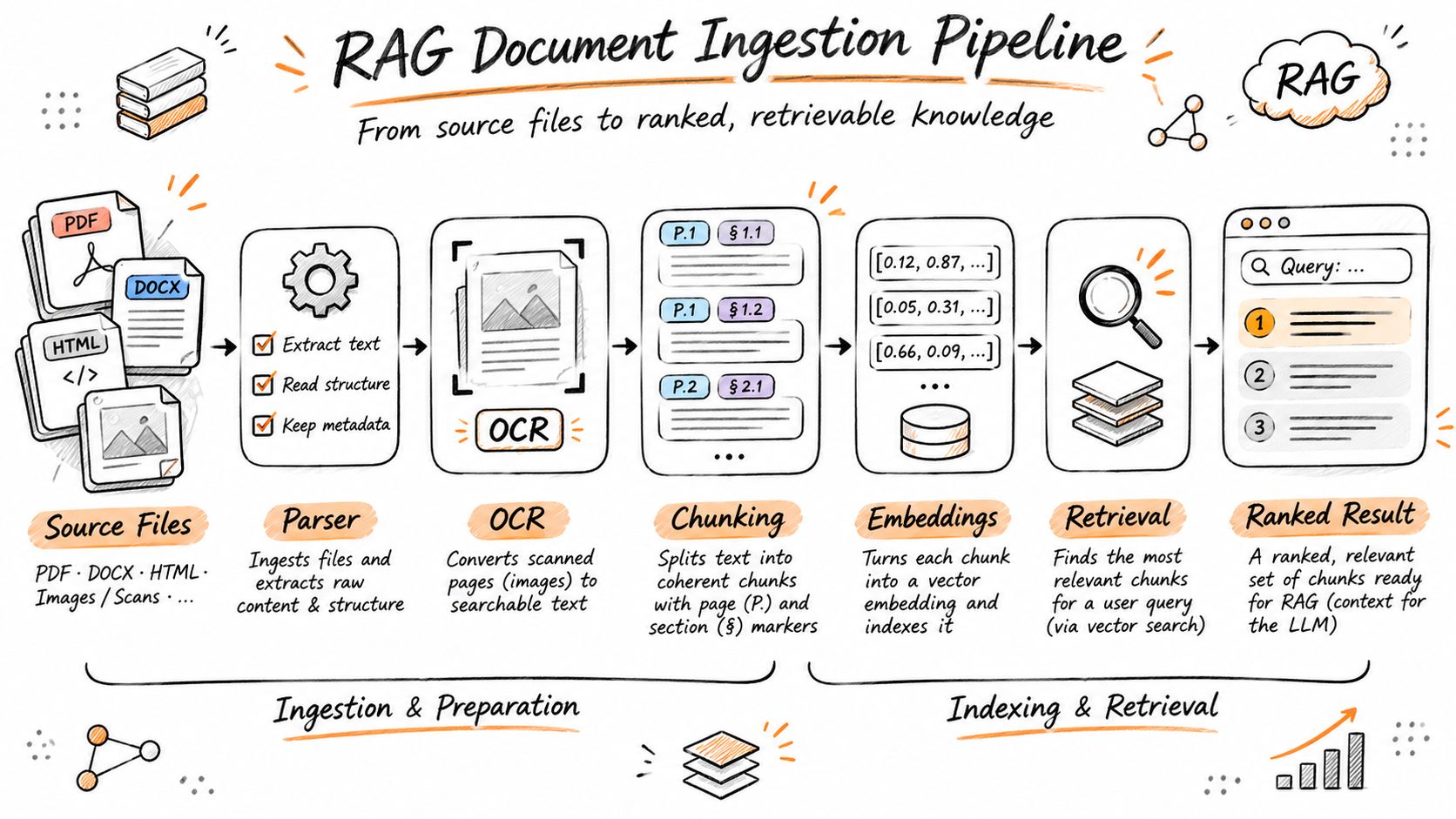
Follow a document through the proposed pipeline before approving the architecture. Ask engineering to demonstrate how its structure, authority, and permissions survive every transformation.
Parse the source without losing relationships. Extract text, tables, headings, and page identifiers; use OCR for scanned files. Review extraction errors against representative documents, especially tables where a condition, exception, and recommendation occupy different cells.
Choose boundaries around meaning. Start with sections, clauses, or headings rather than arbitrary character counts. Test whether the retrieved unit includes the recommendation and its qualifying language; allow parent-section expansion when a narrow chunk lacks necessary context.
Attach operational metadata. Record the document identifier, version, effective date, owner, specialty, and permission tags. Reject or quarantine documents whose required metadata is missing rather than assigning permissive defaults without notice.
Build a reproducible index. Record the embedding configuration and index manifest. When changing embedding models, plan compatibility checks and rebuilding affected indexes; make supersession and deletion explicit jobs with verification results.
Compare retrieval strategies on labeled questions. Test dense retrieval for paraphrased questions and sparse, BM25-class lexical retrieval for exact terms, codes, and abbreviations. Compare both with hybrid retrieval, then assess whether a cross-encoder reranker improves candidate ordering enough to justify its additional processing.
Limit the final evidence bundle. Tune passage selection and context budgets together. Keep enough context to preserve qualifications, but don't fill the prompt with weak matches merely because capacity remains.
A retrieval versus long-context benchmark reported 56.34% hallucination-detection accuracy for the evaluated strong model under long-context processing. The benchmark also found advantages for long-context processing on some comparison and reasoning tasks, so selective retrieval shouldn't be assumed superior for every question.
The engineering acceptance artifact should show results by question type and retrieval configuration. Keep parser errors separate from ranking errors: changing the reranker won't repair text that ingestion extracted incorrectly.
The clinical-document RAG guide addresses these concerns for guidelines and chart text. For a services engagement, require representative extraction samples, difficult retrieval cases, and a documented procedure for retiring source versions.
Define the answer contract before writing prompts. A proposed contract should require a short answer, supporting passages, source identifiers, available version and effective-date information, and a clear indication when the evidence cannot support the requested conclusion.
Label each retrieved passage inside the prompt and separate it from application instructions. Ask the model to use that evidence, but verify its output independently: a prompt instruction alone doesn't establish that a claim is supported.
The interface should resolve a citation to the exact supporting passage, not merely open a document's first page. Keep a stable passage identifier and enough source context for the reviewer to inspect qualifications.
The FDA's clinical decision support guidance describes independent healthcare-professional review of the basis for recommendations as a condition relevant to the non-device CDS exclusion. Intended use and the full software function matter; adding citations doesn't automatically establish exclusion from device oversight.
If the RAG system becomes part of a medical device, our compliance partner MedQAIR explains the QMS implications of third-party LLMs.
A citation validator should check that the referenced passage exists and matches the indexed source. Clinical review must separately assess whether it supports the claim.
Specify abstention or review behavior for these conditions:
No authorized supporting passage is retrieved.
Retrieved passages fail the validated relevance criteria.
Conflicting source versions remain unresolved.
The question falls outside the declared intended use.
Hypothetical worked example: An operational assistant receives a question about an institutional preparation policy. The application authenticates the user, filters authorized policy sources, and retrieves passages with document versions. If conflicting effective versions remain, it returns the conflict and source passages for review rather than generating a combined instruction.
The reviewer's correction should record the reason and affected source identifiers. Product pages such as the Clinic AI Assistant can provide workflow context, but acceptance should still rest on the agreed answer contract.
For assistants that can invoke tools, the AI agent architecture guide addresses the additional orchestration layer. Keep permission to retrieve evidence separate from permission to perform an action.
Apply authorization before candidate passages enter the model context. This is an engineering design choice for enforcing access boundaries, supported by the access, authentication, audit, integrity, and transmission safeguards in 45 CFR 164.312.
The application should derive retrieval filters from trusted identity and source-system permissions, covering tenant, patient, role, and applicable care relationships. Don't accept permission tags supplied by the user, and don't rely on the model to conceal restricted text it has already received.
For EHR-connected applications, the SMART App Launch scope specification defines resource access scopes: patient/*.rs supports current-patient read and search, while user/*.cruds requests broader actions on resources available to the user. Backend indexing needs appropriate system authorization, and SMART scopes don't override the EHR's underlying policies.
The following is a control-review checklist, not a claim that HIPAA prescribes a particular RAG architecture. Privacy counsel should validate minimum-necessary applicability and business associate obligations for the actual data flows.
| Control | Citation | Owner | Evidence |
|---|---|---|---|
| Minimum necessary, where applicable | 45 CFR 164.502(b), 164.514(d) | Product owner with privacy officer | Scope definitions and retrieval filter tests |
| Unique user identification | 45 CFR 164.312(a)(2)(i) | Customer identity team | Mapping from EHR user to application user |
| Emergency access procedure | 45 CFR 164.312(a)(2)(ii) | Customer security with engineering | Documented procedure and tested emergency path |
| Automatic logoff | 45 CFR 164.312(a)(2)(iii), addressable | Engineering | Session timeout settings and tests |
| Encryption and decryption | 45 CFR 164.312(a)(2)(iv), addressable | Engineering with customer key management | Key configuration and encryption records |
| Audit controls | 45 CFR 164.312(b) | Engineering | Retrieval and answer logs with sampled review records |
| Integrity | 45 CFR 164.312(c)(1) | Engineering | Source checksums and change records |
| Person or entity authentication | 45 CFR 164.312(d) | Customer identity team | Authentication configuration and token validation tests |
| Transmission security | 45 CFR 164.312(e)(1) | Engineering | Transport configuration and endpoint tests |
| Business associate agreement | 45 CFR 164.502(e), 164.504(e) | Customer legal and privacy | Executed agreements where the business associate relationship applies |
Addressable specifications require a documented assessment, rather than being treated as automatically optional. Keep the implementation decision and supporting rationale in the security evidence package.
Map what each parser, embedding endpoint, model endpoint, logging service, and support process receives. Have counsel document whether each relationship requires a business associate agreement, including subcontractor arrangements; a deployment label alone doesn't resolve that question.
The customer's privacy and security review should approve the actual PHI flow, retention settings, and contractual boundaries.
Build the evaluation set from the approved documents, with clinical reviewers defining answerable, partially answerable, unanswerable, and adversarial questions. Preserve expected source passages and reviewer rationale so another engineer can reproduce the assessment.
Measure retrieval separately from generation. A correct-looking answer can cite the wrong passage, while a failed answer can result from either missing evidence or misuse of evidence that was retrieved correctly.
In a prospective benchmark using questions derived from a German S3 guideline for oral cavity carcinoma, the guideline-retrieval study reported content-level hallucination falling from 42% to 4%, with recall@5 reaching 92%. Improvements were concentrated among weaker base models, so those findings support testing each configuration rather than borrowing a published result as a product guarantee.
| Metric | What it measures | How to test it | Release gate |
|---|---|---|---|
| Retrieval recall at k | Questions whose answer-containing passage appears in the top k results | Labeled questions with known source passages | Threshold approved in scoping and reported each release |
| Faithfulness | Generated claims supported by cited passages | Clinical scoring, with automated checks as support | Clinical review for every release |
| Citation resolution | Citations resolving to an existing passage with matching text | Automated link and text matching | Citation checks pass before release |
| Abstention on unanswerable questions | Unsupported questions where the system declines to answer | Out-of-scope questions and deliberately removed sources | Clinical owner reviews results each release |
| Prompt injection resistance | Whether embedded instructions alter intended behavior | Adversarial documents and user inputs | Release-blocking failures tracked to closure |
Set thresholds before selecting the preferred configuration. Otherwise, engineering can inadvertently adjust the acceptance criteria around whichever system performs best on the current test set.
Keep a held-out set under customer control. Review failures by source type, specialty, permissions, and question category so aggregate results don't conceal a dangerous subgroup.
Include prompt injection through both user input and retrieved documents. Test attempts to override application instructions, reveal restricted information, contaminate citations, or invoke tools outside the intended workflow.
Use the OWASP Top 10 for LLM Applications as a threat-model checklist, including prompt injection and vector-and-embedding risks. Request a trace from each relevant risk to a test case, observed behavior, mitigation, and retest result.
Organize the risk register around the NIST AI Risk Management Framework functions Govern, Map, Measure, and Manage. The customer risk owner should approve the mapping and residual-risk decisions; framework terminology without test evidence shouldn't satisfy the release gate.
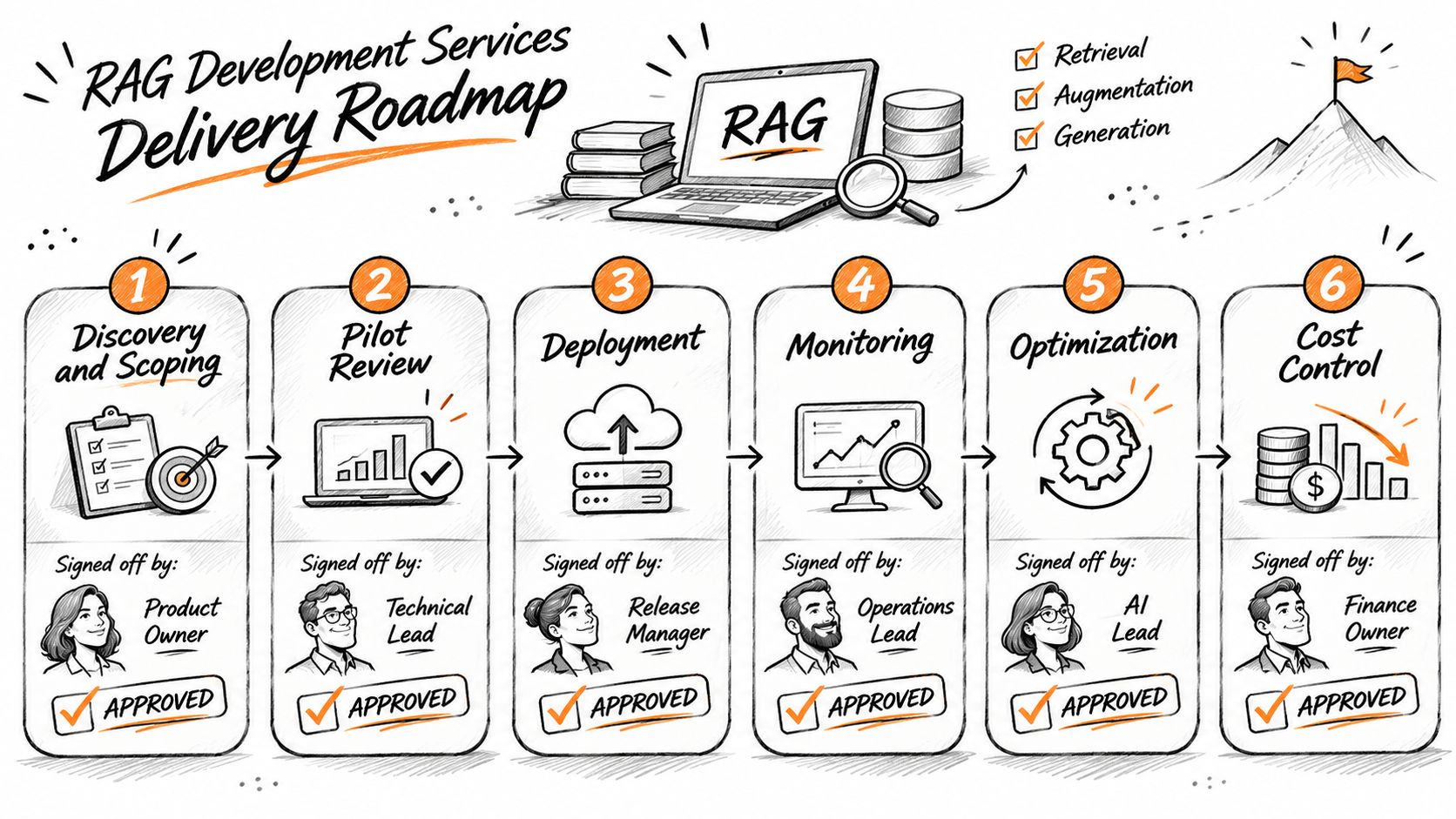
A pilot should advance on accepted evidence rather than a successful demonstration. Put exit criteria into the delivery plan and name the customer reviewer before engineering starts each phase.
Discovery and scoping. Product and clinical owners approve intended use, user population, source inventory, exclusions, and proposed risk classification. Exit evidence is the signed scope and source register.
Data audit and pilot corpus. Engineering produces parser results and metadata checks; clinical reviewers assess the labeled questions and expected evidence. Source owners confirm which documents are authoritative.
Pipeline build. Deliver ingestion, indexing, retrieval, and answer code alongside configuration records. Exit evidence includes the metadata schema, index manifest, and retrieval results on the pilot corpus.
Evaluation and security testing. Produce the evaluation report, access-denial tests, and injection-test results. Named clinical, security, and risk owners accept remaining issues in writing or block progression.
Controlled pilot. Restrict rollout to the approved users and workflow. Review usage logs, corrections, latency, and cost per answer, then verify fixes against the affected tests.
Production and monitoring. Operations accepts dashboards, alerts, rollback procedures, runbooks, and change control. Every alert needs an owner and a defined response.
In 100 synthetic contrast-media consultations, a radiology study reported hallucinations falling from 8% to 0% with RAG under controlled conditions, while the locally deployed model still trailed cloud models in overall capability. That result illustrates why a specific improvement doesn't establish readiness for the full intended workflow.
After launch, review index freshness, citation failures, latency, and clinician corrections. A guideline revision should trigger an impact assessment covering the index, affected questions, and approval records.
For cost control, first remove redundant passages and unnecessary generation. Then tune request budgets, reranking candidates, and policy-approved caching; keep caches separated by authorization context and invalidate them when relevant sources or permissions change.
Ekipa AI works alongside customer teams through phased delivery and integration with existing development processes. Our AI delivery framework and implementation support provide context for that approach, including fitting AI-enabled software into established healthcare workflows.
Healthcare RAG
Planning a RAG system for clinical or operational content?
We build retrieval pipelines with permission-aware search, inspectable citations, evaluation reports and handover your team can run.
Prefer to pick a time? Book a call directly
Evaluate a partner through artifacts the buyer can inspect. A polished demonstration gives little evidence about source retirement, denied access, reproducibility, or operations after handover.
Turn the selection process into a request list. Red flags should trigger a documented review, with unresolved access, PHI, or ownership problems preventing approval.
| Criterion | Evidence to request | Red flag |
|---|---|---|
| Healthcare data handling | PHI terms, business associate position, residency, retention, and subcontractor details | Required agreement refused or PHI subcontractors unexplained |
| Evaluation practice | Sample report with metric definitions and named test-set ownership | Accuracy figures without a described test set |
| Access control design | Authorization-before-retrieval diagram and denial tests | Filtering applied only in the prompt |
| Security testing | Injection cases mapped to OWASP LLM risks, with results | No threat model covering documents, tools, and input |
| Regulatory boundary | Written intended-use analysis and CDS or SaMD assessment plan | Exemption claimed without written analysis |
| Traceability and ownership | Code, prompts, index manifests, and documentation handover | Essential artifacts outside customer control |
| Integration experience | Resource-level data flow, authorization design, error handling, and replay tests | Vague EHR connection claims without technical detail |
| Staffing and knowledge transfer | Named roles and rehearsed handover plan | One engineer holds all design knowledge |
Ask the proposed delivery lead to explain a failed question from ingestion through answer generation. They should distinguish parser loss, poor candidate retrieval, reranking error, unsupported synthesis, and incorrect citation resolution.
Confirm who owns the labeled test set and who can modify expected answers. Give the customer access to the test runner and results, including failures, rather than only a summary presentation.
For integration evidence, request the actual resource and authorization boundaries proposed for the workflow. A read-only assistant needs a different permission and failure-handling design from software that writes back to an EHR.
Specify handover of source code, prompts, configurations, index manifests, deployment definitions, and runbooks. Include a rehearsal in which customer engineers rebuild an index, investigate a failed answer, and execute rollback without relying on undocumented partner knowledge.
A separate regulatory specialist can support classification and documentation, but the regulated organization must retain accountability for its intended use and operating controls. Record who approves changes that affect the regulatory analysis.
Verify references and claimed results independently. If a partner can't show the test conditions, source boundaries, and responsible reviewer behind a claim, don't count it as acceptance evidence.
Treat retrieval as a controlled part of the healthcare application, with authorization before evidence reaches the model and traceable records for generated outputs. Evaluate unsupported questions, citation support, and adversarial behavior alongside answer accuracy. Map PHI handling and contractual responsibility across the complete processing chain.
The strongest delivery contract also covers what happens after launch. Source revisions, prompt changes, index rebuilds, and model changes need an impact assessment, regression tests, and an accountable approver. Operations should know who responds when evidence disappears, permissions change, or reviewers identify an unsafe answer.
The acceptance package is the lasting deliverable: reproducible tests, inspectable controls, customer-controlled artifacts, and named owners who can operate the system without depending on a demonstration.
Talk to our team to scope your healthcare RAG application, integration boundaries, and acceptance evidence.
An agreement is required when the vendor relationship falls within HIPAA's business associate requirements. Have legal and privacy reviewers assess every organization handling PHI, including relevant model, embedding, hosting, and support subcontractors, and document the determination.
No. Retrieval can return irrelevant or incomplete evidence, and generation can misrepresent a correct passage. Acceptance testing should distinguish retrieval success, supported claims, valid citations, and appropriate abstention.
Choose RAG when answers depend on changing, governed documents and users need to inspect supporting passages. Assess fine-tuning when the main requirement concerns consistent behavior or output structure. Use structured queries or search when they satisfy the workflow without generated synthesis.
The application derives authorization from trusted identity and source permissions, then applies those restrictions before returning candidate evidence. Test tenant, patient, and role boundaries with denied-access cases, including stale permissions and cached results.
Prompt injection occurs when untrusted input attempts to redirect the application's intended behavior. Test malicious instructions in user messages and retrieved documents, including attempts to disclose data, alter citations, or misuse tools. Preserve the inputs, observed behavior, mitigation, and retest results in the release evidence.
Learn how to hire AI engineers for healthtech: define scope, test EHR and HIPAA skills with work samples, and choose the right engagement model.

A practical guide to intelligent document processing healthcare teams use to classify, extract and validate referrals, prior authorizations and claims.

Internal tools development explained: use cases, SaaS versus custom build, AI safeguards, a step-by-step process and healthcare controls.
Connect with our team to explore how AI expertise can transform your business.