
Compliance
FDA Medical Device Cybersecurity for SaMD Submissions
Learn how FDA medical device cybersecurity rules under Section 524B shape SBOMs, threat models, and patching for SaMD teams.
November 21, 2026Read more
Healthcare software development outsourcing explained: models, HIPAA and BAA duties, EHR integration, FHIR scopes, security ownership and partner red flags.

Healthcare software development outsourcing works when the contract settles three things before the first sprint: who handles protected health information and under which agreement, who owns clinical correctness and regulatory evidence, and who operates and patches the product after launch. The last item is usually the least specified line in the agreement, and it decides what the arrangement costs over five years. For connected medical device software, Section 524B of the Federal Food, Drug, and Cosmetic Act requires processes for postmarket updates and patches, and FDA's premarket cybersecurity guidance, most recently revised in February 2026, explains the evidence reviewers expect. That work lands on whoever runs the software.
The engagement models are well understood: project work, dedicated teams, staff augmentation, offshore or nearshore delivery, and hybrid setups with an internal product owner. What differs between them in healthcare is where the accountability for patient data, clinical correctness and regulatory evidence sits once the contract is signed, and whether the vendor can prove it with artifacts rather than assurances.
This guide compares the models, sets out the compliance duties that have to be settled before any protected health information reaches a vendor, scopes the FHIR and HL7 integration work, assigns post-launch security duties to named owners, and lists the red flags that predict trouble.
Hospitals have long bought engineering capacity from outside firms. In a peer-reviewed survey of 103 general hospitals in South Korea, 55.34% outsourced at least one information-systems function and 88.35% outsourced at least one managerial function, and the main reason given for information-systems outsourcing was access to outside experts rather than cost savings (Park, Healthcare Informatics Research).
The vendor supplies capacity and specialist skills. The customer keeps the product decision, the patient data and the regulatory file. Each model below has to be judged on how cleanly it preserves that split, because the model determines who can say no to a release.
| Model | How work is directed | Best fit | Main trade-off |
|---|---|---|---|
| Project-based | Vendor delivers against a fixed scope and plan | A defined module with stable requirements | Scope changes are slow and knowledge can leave at handover |
| Dedicated team | Customer product owner sets the daily backlog | A long-running product roadmap | Needs a strong internal owner and steady coordination |
| Staff augmentation | Customer engineering manager directs each engineer | Filling a specific skills gap | Customer keeps HIPAA and quality accountability |
| Nearshore or offshore | Any of the models above, across time zones | Access to talent or overlapping working hours | Overlap hours and review cadence determine delivery speed |
| Hybrid with internal product owner | Internal owner and vendor engineers share one backlog | Regulated products with changing clinical workflows | Requires written decision rights and documented architecture |
Nearshore and offshore describe location, not engagement type, so they combine with any row above. What they change is the review cadence: a four-hour overlap window forces decisions into writing, which helps documentation and hurts discovery.
The order of operations changes first. A vendor engineer with access to production or to real patient data needs a business associate agreement executed before anything is shared, and a dedicated team inherits the customer's access policy, review cadence and audit obligations rather than bringing its own. Skills change second, because EHR work needs HL7 v2 and FHIR fluency, a narrower hiring pool than general application engineering. Regulatory status changes third: a product that meets the definition of Software as a Medical Device carries design-control and clinical-evidence obligations that outlive the build phase.
Accessibility and customer security reviews add calendar time that proposals rarely show. Organizations that receive HHS funding must make their web content and mobile apps meet WCAG 2.1 Level AA under the HHS Section 504 rule (HHS has moved the compliance date for organizations with 15 or more employees to May 11, 2027), and provider customers often run their own questionnaire and penetration-test review before go-live. The engineering scope healthcare products need, from integration through SaMD documentation, is broader than a web build of the same size, and the healthtech software engineering scope we work from reflects that.
Specialist hiring is what pushes teams outward in the first place, so test a vendor's engineers on domain knowledge (HL7 v2 message structure, FHIR profiles, HIPAA safeguards) before trusting them with an interface.
At Ekipa AI we run several engagement models for SaMD work: dedicated engineers or teams, module-based development, time-bound technical support, and long-term product engineering partnerships, scaled to the product phase and the regulatory stage.
Three things stay with the buyer whatever the contract says. Clinical workflow knowledge decides whether a feature is correct, and it sits with the people who watch the workflow. Decision rights over risk acceptance belong to the covered entity or the manufacturer of record. The regulatory file for any device claim is the manufacturer's to submit and defend. Our compliance partner MedQAIR explains what FDA expects from software validation evidence, which is the record an outsourced team has to produce in a form the manufacturer can defend.
The rule of thumb: the more the product depends on evolving clinical workflows and regulated evidence, the more the model needs an internal product owner with written decision rights. Staff augmentation with no internal owner produces code nobody can defend in a security review.
Sequence matters more than scope. A vendor cannot create, receive, maintain or transmit protected health information for a covered entity until a business associate agreement is in place, as required by 45 CFR 164.502(e), with the contract terms themselves set out in 45 CFR 164.504(e). The agreement defines permitted uses, safeguards, breach reporting duties and how obligations flow to subcontractors. The business associate agreement guide for software vendors covers the clauses engineering teams have to operate against.
Sign it before sandbox credentials, before a sample data export, before a screen share of a production record. A vendor that proposes starting with a small real dataset ahead of the paperwork is asking the customer to accept a disclosure risk the customer's compliance officer owns.
The HIPAA Security Rule sets technical safeguards for electronic PHI at 45 CFR 164.312. Access control requires unique user identification, an emergency access procedure and automatic logoff where appropriate. Audit controls must record and examine activity in systems that contain or use ePHI. Person or entity authentication and transmission security complete the set. Encryption and decryption, integrity authentication, automatic logoff and transmission security are addressable, which means the organization assesses whether each is reasonable and appropriate and documents that reasoning. Addressable requires a decision record either way.
| Safeguard | What 45 CFR 164.312 requires | Vendor implements | Customer decides or approves |
|---|---|---|---|
| Access control | Unique user identifier, emergency access procedure, automatic logoff (addressable) | Role checks, session expiry and emergency access code | Access policy, role definitions and risk acceptance |
| Audit controls | Record and examine activity in systems that use ePHI | Audit event capture and tamper detection | Log review cadence and retention period |
| Person or entity authentication | Verify that a user or system is who it claims to be | Authentication integration and credential handling | Identity proofing and provisioning rules |
| Transmission security | Integrity controls and encryption for ePHI in transit (addressable) | Encryption configuration and transport settings | Documented decision on each addressable specification |
Minimum necessary under 45 CFR 164.502(b) applies to vendor engineers as much as to employees. An engineer debugging a scheduling interface does not need oncology notes. Test environments are the usual leak point, which is why synthetic or de-identified data under 45 CFR 164.514 belongs in the statement of work rather than in a side conversation.
Two obligations sit outside HIPAA and get missed in procurement. If the software meets the definition of a medical device, the FDA's clinical evaluation guidance for Software as a Medical Device ties the evidence package to the intended use, so the manufacturer of record defines the claims and the supplier produces traceable verification evidence. Accessibility requirements under WCAG 2.1 Level AA apply to the patient-facing web and mobile surfaces of HHS-funded customers, and provider customers layer their own security questionnaire on top, so review time belongs in the plan.
Teams that want safeguards built into the pipeline rather than audited afterwards can work from our HIPAA compliance guide for software development. Automated policy-as-code checks complement it: encode access and logging rules as tests so a regression fails the build instead of surfacing in an audit six months later.
Integration is where outsourcing estimates fail most, because statements of work name endpoints instead of conformance. The scope has to start one level lower.
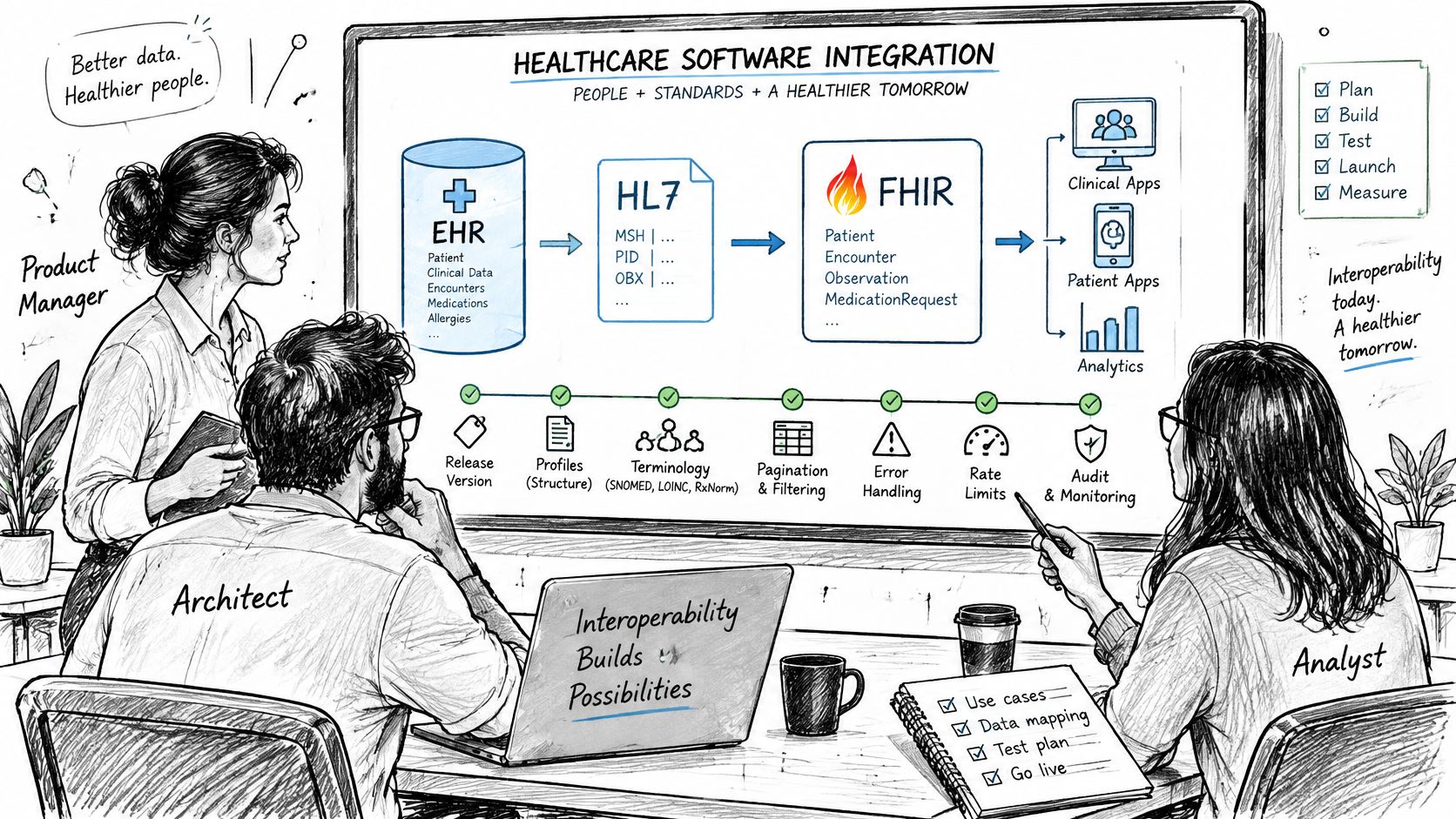
The ONC describes FHIR as an API-focused standard for exchanging clinical and administrative data, and the U.S. Core ecosystem constrains FHIR R4 resources while SMART App Launch supplies OAuth 2.0-compliant authorization servers (ONC standards and technology). That description contains four scope decisions a contract must make explicitly: the FHIR release, the implementation guides and profiles, the terminology bindings, and the authorization model. Add the operational details that decide whether an interface holds up in production: required resource fields, pagination behavior, error responses, rate limits, audit events and the conformance-test evidence that closes the work.
A payload can be syntactically valid FHIR and still fail. A mandatory profile element is missing, a code comes from the wrong terminology system, or the app requests more authorization than the workflow needs. During acceptance testing each failure looks like a partner problem; in production each looks like a data problem, which is more expensive to diagnose.
| Scope | What it grants | Design check |
|---|---|---|
| launch | Context supplied when the app is launched from the EHR | Confirm the context the EHR returns before use |
| launch/patient | Patient selection when the app launches outside the EHR | Test the patient selection flow end to end |
| patient/*.rs | Read and search any resource for the current patient | Limit to the resource types the feature needs |
| user/*.cruds | Create, read, update, delete and search resources the user can access | Restrict to required resource types and actions |
| openid fhirUser | Identity of the authenticated user | Map the identity to an internal account |
| offline_access | Refresh token usable after the user is no longer online | Protect and rotate tokens and test revocation |
Those scopes decide who the patient is, who the user is, what can be written and how long access survives, which is a different negotiation from handing over an API key (SMART App Launch scopes and launch context). Request the narrowest set the feature needs, validate the patient and user context the authorization server returns, protect and rotate refresh tokens, and test what happens when the EHR denies, narrows or expires access.
HL7 v2 interfaces need their own inventory. List every message type in scope (ADT for admissions and demographic updates, ORU for results, and whatever else the workflow touches), the segments and fields each side populates, and the reconciliation process for messages that fail to parse or arrive twice. A v2 interface with no reconciliation plan fails: the message is accepted, nothing processes, and the clinical team discovers it at the point of care.
Write the acceptance gate as automated tests against a vendor sandbox and against production-like payloads, including malformed data, revoked tokens, duplicate resources, delayed events and partial outages. An interface tested only on happy-path data has not been verified. Our EHR software development work starts from that inventory, and the scope list belongs in design review rather than in an integration ticket.
Draft the interface inventory before the first sprint. It is the document that turns a vague integration estimate into a scope both sides can test.
Development ends and the software keeps running. The distance between a signed acceptance certificate and a maintained product is where most long-term risk accumulates, and proposals rarely describe it.
HHS healthcare-sector Cybersecurity Performance Goals name the practices that belong in delivery governance: vulnerability discovery through penetration testing and attack simulations, prompt mitigation of prioritized findings, and regularly drilled incident-response plans, alongside foundational work on reducing attack exposure and improving resilience (HHS Cybersecurity Performance Goals). Translated into a contract, those goals become release criteria: threat modeling for every material architecture change, software composition analysis and secret scanning in continuous integration, authenticated dynamic testing before release, severity-based remediation service levels, immutable audit logs, tested backup restoration, and named owners for incident triage, evidence preservation, notification and recovery.
FDA's premarket cybersecurity guidance pushes the same expectations into countable form for devices containing software or firmware. It recommends documenting the percentage of identified vulnerabilities that are patched, the time from vulnerability discovery to remediation, and the time required to deploy available patches to devices already in the field (FDA premarket cybersecurity guidance). Each of those numbers requires an owner, a process and a record.
The software bill of materials is the input to all three. Produced once, it is a document. Maintained per release, it is the only way to answer which fielded devices contain a library disclosed this week. Normalizing dependency data across build systems and sources is standing engineering work, and it has to be funded as such.
| Activity | Vendor duty | Customer duty | Evidence kept |
|---|---|---|---|
| Vulnerability monitoring | Track components and disclose findings | Confirm severity and approve risk | Scan reports and triage tickets |
| SBOM maintenance | Update the software bill of materials each release | Review the inventory for exposure | Versioned SBOM per release |
| Emergency patch decision | Build, test and deliver the patch | Approve deployment timing | Patch record with approval |
| Regression testing | Run automated and manual test suites | Define acceptance for clinical workflows | Test results per release |
| Incident response | Triage, contain and recover | Notify and manage regulatory reporting | Incident timeline and post-incident review |
A HIPAA attestation describes a control set at a point in time. It says nothing about how fast a critical dependency gets patched next quarter, which is why patching capability needs its own evidence.
Get the responsibility matrix signed before the first release, with a named owner on each side for emergency patch approval and incident triage. The lowest development rate produces the highest maintenance cost when these duties have no owner.
HealthTech engineering partner
Outsourcing a healthcare product build?
We scope dedicated teams and long-term product partnerships around interface inventories, release evidence and named owners for post-launch patching.
Prefer to pick a time? Book a call directly
Evaluate a partner on evidence that is hard to fake, in the order the evidence is hardest to produce. Healthcare delivery experience comes first: ask for EHR integration examples, HL7 v2 and FHIR work, and products that survived a customer security review, rather than a client logo list.
Compliance readiness comes next. Ask who owns each HIPAA safeguard, whether the vendor will sign a business associate agreement before any PHI access, and how minimum necessary access is enforced in practice rather than in a policy document.
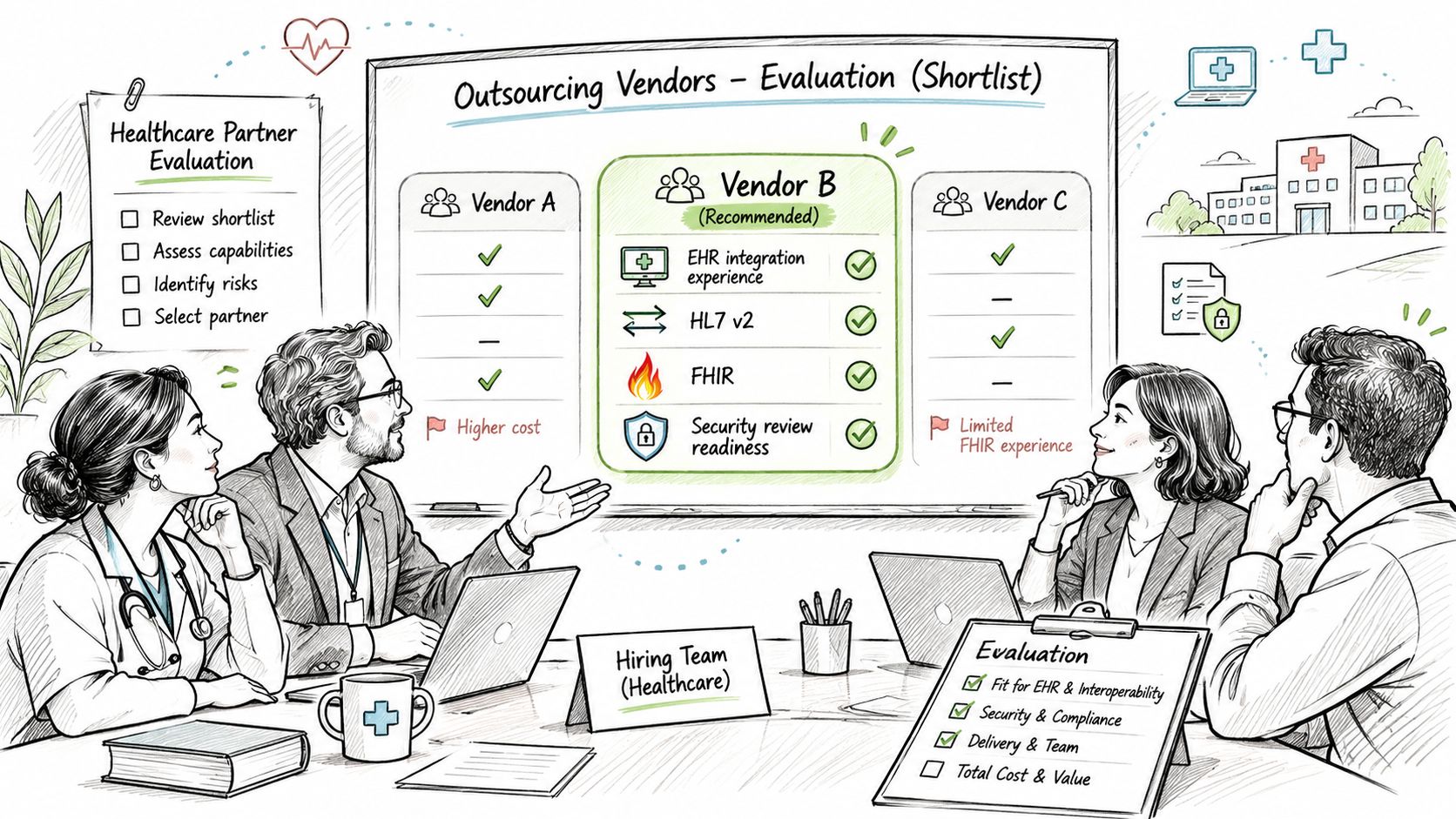
Engineering practice is the third filter: code review rules, test coverage expectations for integration code, threat modeling as a scheduled activity, and traceability from a change back to a requirement. Communication reduces to named overlap hours, a cadence both sides can keep, and a decision maker on each side who can settle a scope question without escalation. IP ownership and handover belong in the first contract draft: source code, infrastructure as code, documentation, test data governance, and administrative control of repositories, cloud accounts and secrets. References should include healthcare customers who can discuss post-launch support, since that is the part of the relationship a sales deck never covers.
Ask which party operates production, who holds on-call duty, how long a critical patch takes from approval to deployment, and who signs the patch record. A partner that cannot name those owners will not carry the operating model the product needs after launch, regardless of how strong the initial build is.
Our healthcare AI and integration work is scoped around that split.
Red flags to treat as disqualifying rather than negotiable:
The same third-party risk lens applies to a software vendor as to any other supplier, and the HHS Cybersecurity Performance Goals list vendor and supplier cybersecurity requirements among their essential goals. For AI-specific vendor questions, see our guide on how to choose an AI implementation partner in healthcare.
Each step has an owner and produces evidence. The sequence matters because later steps depend on records created earlier.
Our implementation support work follows that order, with the pilot and acceptance suite treated as the decision point on whether the model is working.
Write the contract in four parts. The responsibility split names the manufacturer of record for any SaMD, the party holding the business associate role, and the person who approves each risk decision. IP and handover give the customer ownership of source code, infrastructure as code, test data governance and documentation on a defined schedule, with administrative access to repositories, cloud accounts and secrets from day one.
Release gates combine the security criteria with two additions: the interface inventory for integration releases, and, for AI model changes in SaMD, the versioned specification and validation results that connect the change to the intended use. Governance is a monthly review of defects, security findings and open change requests with one named decision owner per item.
Keeping knowledge in-house takes deliberate structure:
Write the handover checklist before signing the contract. It is the only document anyone reads on the last day.
Four decisions carry most of the risk in a healthcare outsourcing engagement. Choose the model by how much the product depends on evolving clinical workflows and regulated evidence, and give the internal product owner real decision rights. Settle the business associate agreement and the minimum necessary access model before any PHI reaches the vendor, with test environments built on synthetic or de-identified data. Scope integrations by FHIR release, profiles, SMART scopes and an acceptance suite that includes malformed data, revoked tokens and partial outages. Sign a post-launch responsibility matrix that names an owner for patching, SBOM maintenance and incident response, and keep the evidence each side is expected to hold.
Partner selection belongs to engineering, not procurement. The questions that separate candidates are technical and operational, and the answers are artifacts.
If you want a second opinion on a shortlist, an interface inventory or a post-launch responsibility matrix, talk to Ekipa's HealthTech engineers.
Yes. A vendor that creates, receives, maintains or transmits protected health information on behalf of a covered entity or another business associate is a business associate, and the agreement has to be executed before access, test access included. Subcontractors that touch the same data need agreements that flow the same obligations down to them.
They can, but there is rarely a reason to. Synthetic or properly de-identified data under 45 CFR 164.514 covers most testing needs, and any environment holding real PHI inherits the same safeguards as production, including access control, audit logging and encryption in transit.
It is an inventory of the software components in a release, including open-source dependencies and their versions. A version produced once answers nothing about a vulnerability disclosed six months later. Section 524B requires an SBOM for cyber devices, and FDA's premarket cybersecurity guidance, most recently revised in February 2026, expects manufacturers to maintain the inventory across releases so they can identify which deployed devices contain an affected component.
Yes. 45 CFR 164.502(b) limits disclosure to the minimum necessary for the purpose, and a vendor engineer is a recipient like any other. Set the access model in the contract, scope each role to its tasks, and review entitlements whenever the engagement or the feature set changes.
The manufacturer of record does. The FDA's clinical evaluation guidance for Software as a Medical Device ties the evidence package to the intended use, and the supplier's job is to produce traceable verification artifacts the manufacturer can rely on. Contracting the engineering out doesn't move the submission obligation.
Learn how FDA medical device cybersecurity rules under Section 524B shape SBOMs, threat models, and patching for SaMD teams.

RAG development services for healthcare: architecture, ingestion, retrieval, evaluation, PHI safeguards, delivery phases and how to choose a partner.

Learn how to hire AI engineers for healthtech: define scope, test EHR and HIPAA skills with work samples, and choose the right engagement model.
Connect with our team to explore how AI expertise can transform your business.