
Compliance
Healthcare Software Development Outsourcing Guide
Healthcare software development outsourcing explained: models, HIPAA and BAA duties, EHR integration, FHIR scopes, security ownership and partner red flags.
November 22, 2026Read more
How AI assistant development works: assistant types, build options, step-by-step process, integrations, evaluation and HIPAA safeguards for healthcare teams.
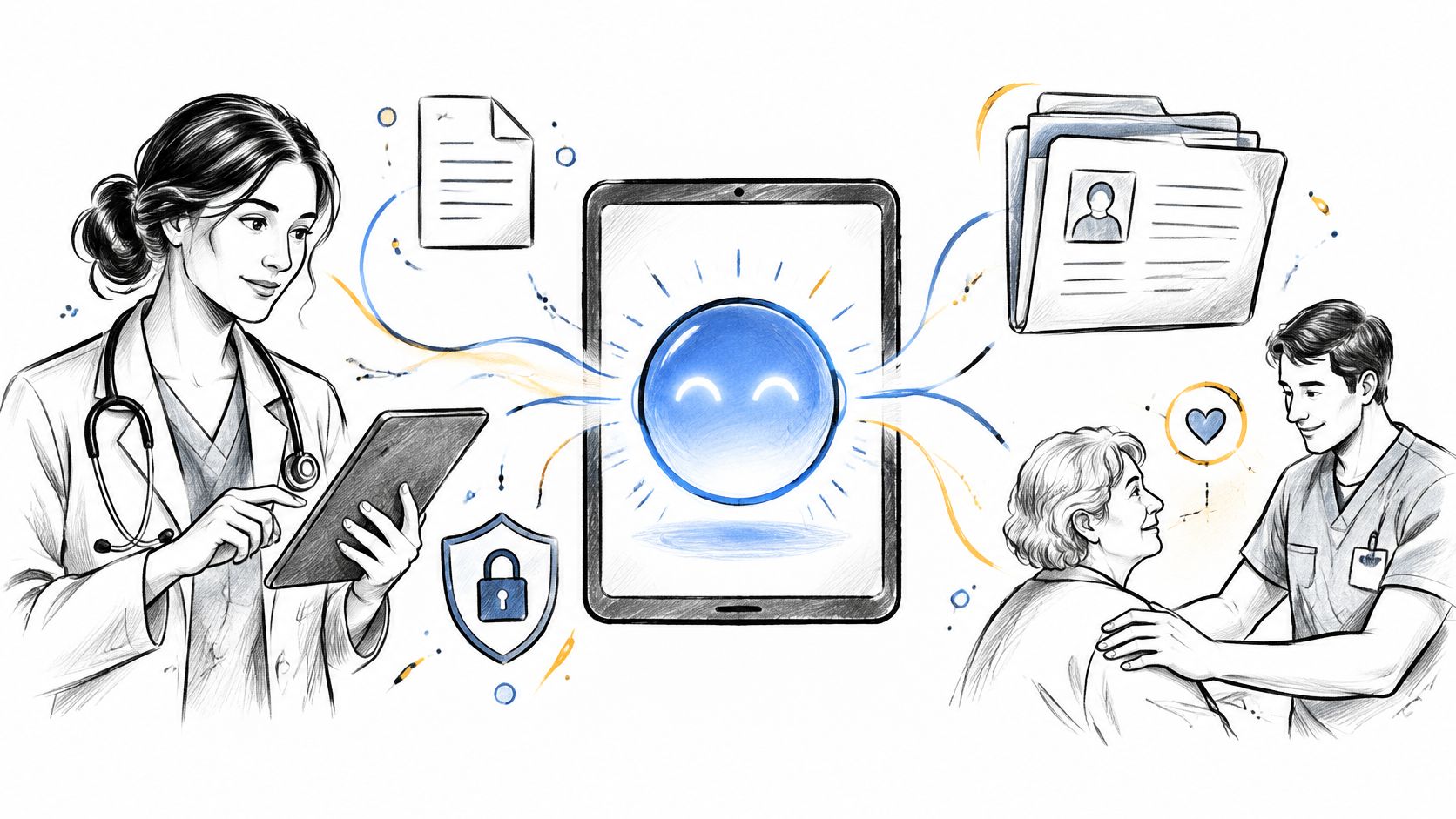
AI assistant development is the work of turning a language model into a dependable product: an assistant that answers from approved sources, acts only within the permissions it has been given, hands over to a person when it should and leaves an audit trail. The conversation is the easy layer. The permission model, the retrieval layer and the evidence trail decide whether the assistant reaches production.
This guide covers the three assistant types, the build options and their trade-offs, the development steps from scoping through evaluation, and the metrics that show the assistant is helping. Healthcare is the worked example throughout because it is the hardest case: the HIPAA Security Rule at 45 CFR 164.312 requires access controls, audit controls and transmission security from any system that handles electronic protected health information, and an assistant that reads a chart or writes a note is that kind of system.
Each step below has its own section in this guide. The order matters: decisions made in the first three steps set what the later steps have to prove.
The NIST AI Risk Management Framework 1.0 puts mapping the context, purpose and risk of an AI system ahead of any design or build decision. Applied to an assistant, that maps to one choice first: which of three types you're building, because the type fixes the data the assistant may read, the permissions it needs and the cost of a wrong answer.
Demand is no longer the constraint on adoption. Pew Research Center's 2025 survey found that 34% of U.S. adults had used ChatGPT, roughly double the 2023 share, with usage at 58% among adults aged 18 to 29 against 10% among adults 65 and older. Your users arrive with different expectations, and your organization's tolerance for a wrong answer varies just as widely.
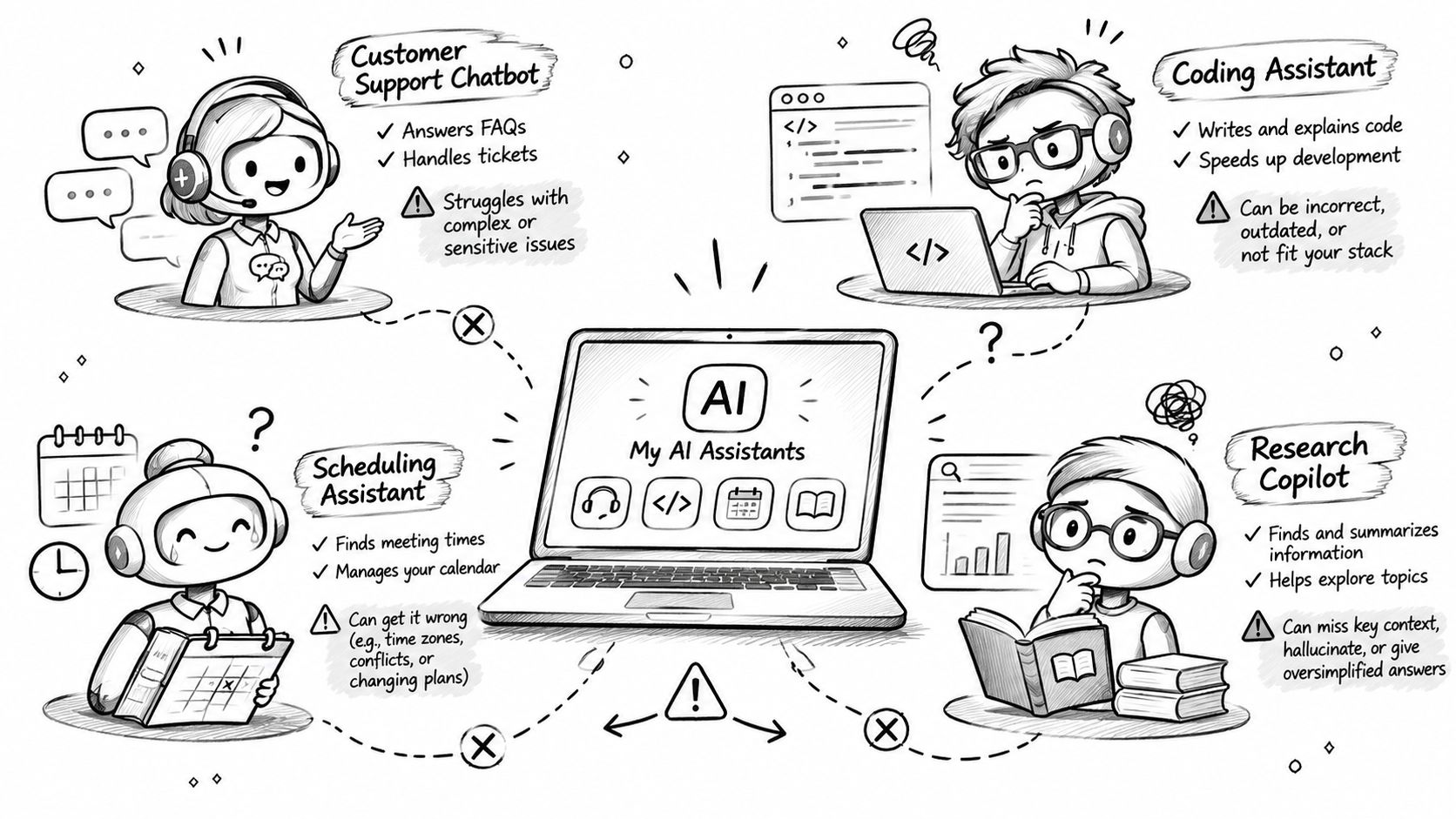
Customer-facing support assistants answer from public content and the caller's own record: coverage rules, claim status, appointment options, case history. The risk concentrates in open-ended chat, where a confident answer about eligibility, or a mixed-up account, erodes trust faster than a queue ever did. Product and support operations own that risk because they own the content and the escalation policy.
Internal knowledge assistants retrieve policy manuals, clinical protocols, HR rules and internal documentation for staff. Permission-aware retrieval decides whether they're safe. Filter by the user's role and entitlement before ranking documents, not after the answer is assembled. IT and knowledge management own the corpus, the review dates and the access rules.
Task assistants act. They open tickets, book appointments, update a CRM record or write into a chart, and each of those is a write against a system of record that a bad sentence can trigger. Treat them as the highest-risk type, built as a permissioned tool with a narrow action list. The agent architecture breakdown covers how the planner, tool layer and permission checks stay separate.
| Assistant type | Primary users | Knowledge and actions | Main risk | Typical owner |
|---|---|---|---|---|
| Customer-facing support assistant | Patients, members or customers | Public content, account status, case creation | Confident wrong answers and privacy leaks in open chat | Product and support operations |
| Internal knowledge assistant | Staff and clinicians | Policies, protocols, internal documents, retrieval with access control | Stale or unauthorized content surfacing to the wrong role | IT and knowledge management |
| Task assistant with tool actions | Staff acting on records or workflows | Read and write calls to CRM, help desk, scheduling or EHR APIs | Unintended writes and excessive agency through tools | Engineering with compliance review |
Four questions settle the type before you compare build options. Who are the users and what do they already expect from a chat window? Does the assistant read patient data, which pulls in HIPAA and a business associate agreement? Does it write to any system, which makes every tool call a permission decision? And who signs off when it's wrong, by name and role, because that person is the one who'll approve the rule table later. Interface conventions carry a lot of this too, because users judge the whole system by how the chat window shows sources, waiting states and the handover to a person.
All three build options can produce a fluent answer. What separates them is evidence: who owns the log trail, the scope list and the reproducible test results a reviewer will ask for. Run that comparison before you compare features.
| Build option | Control over data and prompts | Integration depth | Validation burden | Main trade-off |
|---|---|---|---|---|
| Configure an off-the-shelf assistant | Limited to product settings | Usually prebuilt connectors only | Vendor documentation plus customer testing | Fastest start, least control over logs and data flow |
| Build on a platform | Team owns prompts, retrieval and tools | Custom connectors on the platform's APIs | Team owns evaluation sets and release gates | Faster build, dependence on platform roadmap and terms |
| Custom development | Full control of pipeline, permissions and audit logs | Any system with an accessible API | Full evidence burden owned by the team | Highest effort and maintenance, strongest auditability |
Configuring an off-the-shelf assistant gets you a working interface in days for FAQ content and public pages. What you give up is depth of evidence. Log retention, prompt-level control, retrieval configuration and integration points are limited to what the product exposes, so a large part of your validation file ends up being vendor documentation you cannot test yourself. For a pilot with public content and no patient data, that is a reasonable trade.
Building on a platform moves the model and orchestration into a managed layer while your team keeps ownership of prompts, retrieval settings, tool definitions and the evaluation set. That is usually the right trade for a first production assistant, provided you accept dependence on the platform's roadmap, rate limits and terms, and you keep a regression suite you can run against a candidate model before any upgrade reaches users.
Custom development is the only option that gives you full control of the retrieval pipeline, the permission model and the audit log, and the only one where your team owns every validation artifact. It costs the most to build and to maintain. It earns that cost when the assistant reads patient data, writes to a system of record, or has to survive a regulatory review of its change control.
Model choice stopped being the cost driver. Stanford's 2025 AI Index reports that inference for a model at GPT-3.5-level MMLU performance fell from about $20 to $0.07 per million tokens between November 2022 and October 2024, a reduction of more than 280-fold, driven by smaller capable models and better serving efficiency. That makes a two-tier design affordable: compact models for intent classification, extraction, summarization and routine steps, and a stricter, more capable path for ambiguous or patient-specific requests.
Price the work in cost per completed task, not cost per model call. Retries, handovers, long retrieved contexts and abandoned conversations all sit between a model call and a resolved case, and a cheap model that escalates twice can cost more than a mid-tier model that resolves on the first attempt. Context limits, conversation summaries and cached retrieval results are engineering controls on that number as much as budget levers.
Ekipa AI's Custom AI Chat Framework is one example of the middle path: a secure, customizable chat assistant trained on the client's own data to automate tasks. Hold any framework in that row to the same standard as a platform build: who owns the evaluation set, where the logs live, and how quickly a permission change propagates.
The verdicts follow the risk. A pilot with public content and no patient data can start with configuration. An assistant that reads EHR data or takes actions usually needs a platform or custom build, with evaluation evidence the team owns and can reproduce.
The artifact that prevents most scope arguments later is a one-page use case statement. It names the users, the tasks in scope, the data sources the assistant may read, the actions it may take, and the tasks it must not attempt. Everything downstream, from retrieval filters to the evaluation set, inherits from it.
From there, split traffic into request categories and give each one its own response rule, handover trigger and approver. The set below is the minimum for a patient-facing assistant. A customer support assistant drops the clinical rows and adds billing disputes and cancellation requests.
| Request category | Assistant response | Handover trigger | Rule owner |
|---|---|---|---|
| General information from approved content | Answer with citation to the approved source | Source missing or content older than the review date | Content owner |
| Account, case or appointment status | Read only, scoped to the verified user | Identity check fails or record mismatch | Product and operations |
| Clinical or medication question | Refuse diagnosis and dosing, point to approved guidance | Any patient-specific clinical wording | Clinical lead and compliance |
| Request to change a record | Confirm intent, then call tool with permission check | Any write outside the approved action list | Engineering and product |
| Urgent or safety language | Stop normal flow and show emergency instructions | Always | Clinical lead |
A general-purpose model answers a medication question cheerfully, because answering is what it was trained to do. The refusal has to live in a rule layer that classifies the request first, then chooses between answering from approved content, answering with a record lookup, refusing with a route to a human, or stopping for safety language. Test each category the way you test accuracy, including paraphrases that try to slide a clinical question into the general information bucket.
A refusal that leaves the user with no next step is a failed answer, not a safe one.
Handover design decides whether users trust the assistant after the first escalation. The transfer should carry the conversation summary, the sources the assistant cited, the user's stated intent and the record or case identifiers it worked from. The interface should say what happens next and how long the wait usually is.
Patients expect that review. In a Pew Research Center survey fielded in June 2026, 29% of U.S. adults were open to AI scheduling an appointment on its own and 44% were open to it with a human final review. For prescription refills the split was 17% and 53%, and for explaining lab results it was 8% and 53%. The closer a task gets to clinical judgment, the more people expect a person to check the result, which is the same line the rule table draws.
Take a hypothetical patient portal assistant that receives the question "Why was my refill denied?". The intent classifier tags it as a medication question, the rule table routes it to refusal and handover, and the assistant tells the patient a clinician will follow up. The packet that reaches the clinical queue carries the conversation summary, the case identifier and the expected wait, so nobody on the clinical side has to reconstruct the chat. Record the rule set, with owners, in the same risk documentation you keep for the rest of the system. For a patient-facing chatbot specifically, healthcare chatbot development covers scoping, clinical safety rules and scheduling integration in more depth.
Start with the inventory, not the model. List every document store, knowledge base, ticket history and policy library the assistant may use, with an owner, a review date, the roles entitled to see it and the identifier that will survive into a citation. Content without an owner or review date goes to quarantine, because an answer that cannot point to an approved version is already an audit problem.
Clinical sources need normalization before ranking. Notes, lab results and outside records arrive in different structures, then use different words for the same fact. Decide what the model should learn and what it must fetch: stable phrasing and terminology can be tuned, while policies, formularies and patient-specific facts belong in retrieval so entitlements and versions stay current.
Assistant programs usually lose schedule in integration, because each target has its own access model and its own evidence expectations. Use least privilege per target, name the owner of the permission grant, and write one test that proves the control before launch.
SMART on FHIR scopes and launch context define what an assistant can reach and in which patient context. The launch/patient scope requests the FHIR Patient context, launch/encounter requests the Encounter context, and the authorization server can return a patient identifier alongside the access token. Scopes such as patient/*.rs allow reading and searching resources for the current patient, user/*.cruds grant broad access to whatever the current user can see, and offline_access requests a refresh token that outlives the session. Request the narrowest scope the task allows, validate patient and encounter context on every data path, and treat refresh tokens as high-risk credentials with their own lifecycle. EHR vendors may restrict or extend scopes, so run conformance tests against each authorization server instead of assuming a syntactically valid scope will be granted.
A clinical assistant typically reads Observation, Condition, MedicationRequest and DiagnosticReport. Each returned resource has to be matched against the intended patient before it influences an answer, and server-side authorization still applies after launch. The failures that reach production are mundane: missing launch context, mismatched identifiers on a shared device, expired tokens mid-conversation, denied scopes, pagination that truncates a result set, and vendor-specific search behavior. Write a test for each one. Integration into systems you do not control carries most of the schedule risk, so put the authorization owner, evidence owner and fallback path in the plan before build starts.
If the assistant also answers the phone, the telephony layer adds constraints on latency, barge-in and call recording, and recordings that contain patient details fall under the same retention and business associate rules as chat transcripts.
The OWASP Top 10 for LLM Applications starts with prompt injection because it defeats almost every control written into a prompt. A user message or a retrieved document containing instructions can redirect the assistant, and in a tool-enabled assistant that redirection becomes an action. Sensitive information disclosure covers the answer that exposes another patient's record or recites the system prompt, and excessive agency covers a tool granted more permission than its task needs.
Four controls carry most of the weight. Keep tool scopes at the minimum the action requires. Separate retrieved text from instructions in the prompt structure and label retrieved content as data. Put the permission check in the tool layer, where it can't be argued out of a decision, rather than in the prompt. And log every tool call with the user, session, arguments and result, plus an output filter for identifier patterns so a cross-patient answer is caught before it renders. Design on the assumption that someone will override the instructions, so that overriding them changes the tone of an answer and nothing else.
The HIPAA Security Rule at 45 CFR 164.312 sets the technical safeguards an assistant handling electronic protected health information has to meet. Access control requires policies and procedures restricting system access to authorized persons or software programs. Audit controls require mechanisms that record and examine activity in systems containing or using ePHI. Transmission security requires technical measures protecting ePHI sent across networks. Integrity is a required standard, while its authentication mechanism and the encryption specifications are addressable, which means you assess each one and document why the chosen control is reasonable and appropriate rather than citing a product name.
The rule doesn't prescribe a product or an algorithm, so the deliverable is a mapping between each control, the evidence it produces and the person accountable for it.
| Control | Evidence to keep | Owner |
|---|---|---|
| Least-privilege tool and data scopes | Scope list per tool and access review records | Engineering with security |
| Permission checks in the tool layer | Test results for injected instructions | Engineering |
| Audit logs of user, session, data and tool calls | Log samples and retention settings | Engineering and compliance |
| Integrity of stored content and records | Checksums or version history for indexed documents | Engineering |
| Encryption in transit | TLS configuration and certificate records | Engineering and infrastructure |
| Output filtering for sensitive data | Red-team results on cross-patient prompts | Security and clinical lead |
| Business associate agreement with each vendor touching PHI | Signed agreement on file | Legal and compliance |
A business associate agreement is required when a vendor creates, receives, maintains or transmits protected health information on a covered entity's behalf, and 45 CFR 164.502(e) and 164.504(e) set out when an agreement is needed and what it has to cover. Audit the whole data path. The model host, the vector store, the monitoring tool that captures prompts and the logging service all sit inside that agreement or outside the PHI flow, and there's no third option that a reviewer will accept.
A written checklist keeps contract review from stalling, and HHS's sample business associate agreement provisions are a reasonable starting point for what the document should contain. Healthcare deployments carry more of these obligations than assistants in other sectors, and healthcare AI and integration work covers how these constraints shape delivery in regulated environments.
Privacy is a data-handling question, decided separately from the security controls that protect the data once it exists. Data minimization comes first: retrieve only the fields the current intent needs, and pass identifiers plus a short summary into the prompt instead of a full record. A prior authorization question needs the payer, the service and the denial reason, not the whole chart.
Transcripts are the quiet risk. Individually identifiable health information held or transmitted by a covered entity or business associate is protected health information under 45 CFR 160.103, so a transcript containing a patient's details, or a tool-call log that carries record identifiers, falls inside that definition. Treat embeddings derived from either as PHI as well, unless you can show they can't be linked back to a patient. Classify them, protect them and delete them on a schedule.
Set a retention period for transcripts, tool-call logs and retrieval traces, name an owner for each, and test the deletion job before launch. Draw a data-flow diagram listing every system that stores or processes a prompt, including model hosts and monitoring tools, and mark which vendors sign a business associate agreement. Tell users what's recorded and who reviews it, and give them a route to a person. For assistants outside HIPAA, state privacy law and your own notice set the requirements, and legal review should confirm which statutes apply before launch.
Being open about this is part of earning use. In the same Pew survey, 51% of U.S. adults said AI will make the security of patients’ health information worse, against 8% who said better.
Fluent output is not evidence of anything. The NIST Generative AI Profile, NIST AI 600-1, recommends measuring output accuracy, quality, reliability and authenticity against known ground-truth data, using both automated tests and human oversight. What produces that evidence is a versioned evaluation set built from real user intents, the hard edge cases support already knows about, policy constraints and the domain's own vocabulary.
For retrieval-based assistants, score retrieval and generation separately, because a wrong answer can come from either layer.
Run the suite after any change to prompts, embedding models, chunking, data sources or model versions. A tuning change that lifts answer accuracy can drop refusal behavior, and the regression run is the only place that shows up before a user finds it.
Define the gate before the first build sprint, not after the evaluation set exists. Each metric gets a threshold and an owner, safety-critical scenarios get review by clinical staff, and every release version keeps its archived results next to the artifact that produced them. That archive is what turns assistant work into software quality engineering, and it's the first thing a compliance reviewer asks for. A structured delivery process keeps intake, build and regression in one traceable line, which is what the AI-assisted delivery framework is for.
An assistant is a web or app interface before it's a model, so it inherits accessibility obligations. Test against WCAG 2.2 at level AA: full keyboard operation for the send control and any tool confirmation dialog, labels on icon-only buttons, contrast on status and citation text, and screen reader announcements for streamed responses. Streaming is the part teams miss, because a live region that announces every token produces noise instead of comprehension.
Count what ties to a task outcome. Task completion rate, handover rate with a reason code, unsupported-answer reports from users, cost per completed task and time to resolution for handed-over cases all describe the work. Message volume doesn't, since a spike can mean engagement or confusion, and without completion and handover data beside it you can't tell which one you're looking at.
A high message count is the most flattering metric an assistant can produce and the least informative.
For staff assistants, measure time on the target task with a before-and-after time study rather than self-reported savings, and include rework caused by a wrong answer in the comparison. A tool that saves four minutes and creates a six-minute correction is a net loss that usage dashboards will report as adoption.
Review failed conversations weekly, add the failures to the evaluation set, run the regression suite and record each change with an owner and an approval. When the assistant touches a regulated function, model updates become a change-control question. The FDA's Software as a Medical Device materials include the December 2024 final guidance on Predetermined Change Control Plans for AI-enabled device software functions, which lets manufacturers define in advance which modifications are planned, how they'll be implemented and validated, and how their impact will be assessed. Check intended use and claims before shipping a model upgrade, since architecture alone won't tell you whether a function is regulated.
AI assistants
Building an assistant that has to pass a security or compliance review?
We build AI assistants with permission-aware retrieval, access checks in the tool layer, audit logging and an evaluation suite your team owns.
Prefer to pick a time? Book a call directly
An assistant reaches production when someone can point to the evidence that said it was ready. That means the release gate belongs at the start of the project, defined before the first build sprint: which tasks the assistant may complete alone, what groundedness and refusal results a reviewer must see, who signs off and what triggers a rollback. Type, build option and integration pattern then fall out of that gate, since each assigns ownership of validation, access control and the audit trail to a named party. Healthcare adds the HIPAA Security Rule's access, audit, integrity and transmission controls and a business associate agreement for every vendor that touches PHI. A gate written early gives every later decision a fixed target. A gate written late means retrofitting evidence onto a system that was never designed to produce it. If you're scoping an assistant that reads patient data or writes to a system of record, talk to our team about the release gate before the first sprint.
A chatbot usually answers questions in a conversation from a script or a fixed knowledge base. An AI assistant, in the sense used in this guide, also retrieves from permissioned sources and can take actions in other systems, such as booking an appointment or updating a record. Those actions are why permissions, audit logs and handover rules matter more for an assistant than for a chatbot.
Configuration or a platform build, with a team-owned evaluation set and a named owner for the release gate; NIST AI RMF 1.0 is a workable way to assign governance roles on a small team. A platform takes the serving and orchestration burden while your team keeps prompts, retrieval settings and the tests that prove behavior, which is the part that cannot be delegated.
It depends on intended use, claims and the role the function plays in clinical decision-making, so the answer comes from the regulatory function rather than from the model architecture. Review the FDA's Software as a Medical Device materials and the December 2024 final guidance on predetermined change control plans for AI-enabled device software functions before committing to a feature's claims.
Groundedness on the release evaluation set, reported next to the refusal-correctness rate, since together they show whether the assistant answers from approved sources and stays inside its scope. The pre-launch evaluation section covers how to assemble and run that set.
Large enough to cover every intent on the scope list, every refusal rule and every integration path the pilot exposes, with several phrasings per case instead of a fixed count. Coverage sets the size, and the set grows each time a real conversation produces a failure the suite did not anticipate.
The organization deploying the assistant owns the evaluation set, the release-gate sign-off and the audit evidence, because those artifacts define what the assistant is permitted to do. A partner can run test execution and engineering work, but handing over the gate hands over the definition of acceptable behavior.
Healthcare software development outsourcing explained: models, HIPAA and BAA duties, EHR integration, FHIR scopes, security ownership and partner red flags.

Learn how FDA medical device cybersecurity rules under Section 524B shape SBOMs, threat models, and patching for SaMD teams.

RAG development services for healthcare: architecture, ingestion, retrieval, evaluation, PHI safeguards, delivery phases and how to choose a partner.
Connect with our team to explore how AI expertise can transform your business.