Approximately two-thirds of US non-federal acute-care hospitals used a FHIR API for patient access through apps in 2022, according to the ONC hospital API data brief. Engineering leads conducting a FHIR server comparison now have to distinguish widespread interoperability adoption from the capabilities their own backend must deliver. This comparison covers operating models, conformance, authorization, ingestion, compliance boundaries, and exit risk.
For a shortlist, start with HAPI FHIR when runtime control justifies operating the server yourself, or a managed service when your team accepts the provider's infrastructure boundaries. Commercial options deserve evaluation when contractual support or packaged capabilities matter, but every candidate must pass your actual integration tests.
Open-source and managed FHIR servers at a glance
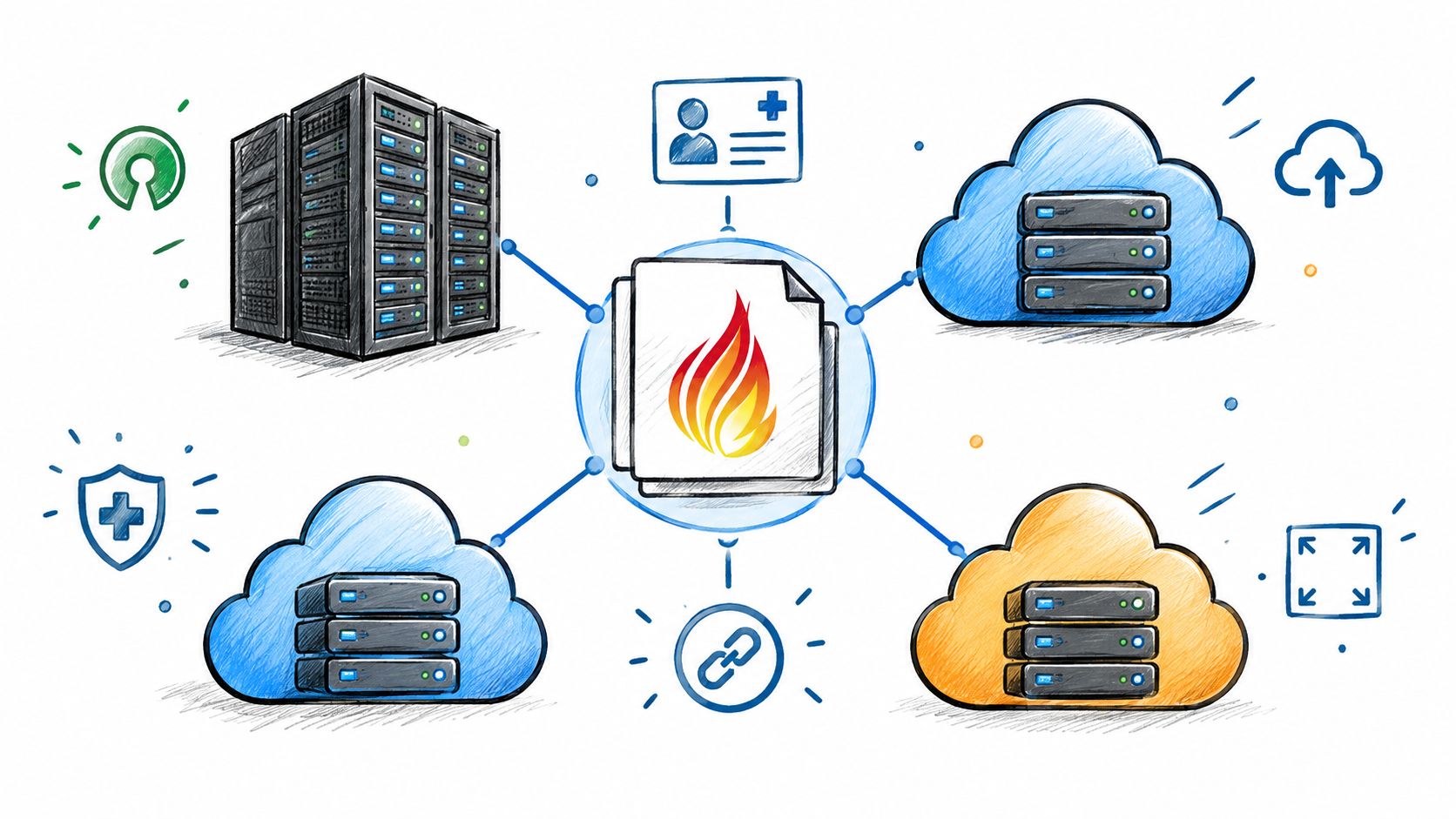
AWS HealthLake is a HIPAA-eligible managed FHIR R4 data store, while HAPI FHIR is an open-source Java FHIR server and library operated in the customer's environment. Those descriptions come from the AWS HealthLake developer guide and the HAPI FHIR project, respectively.

FHIR server options by model, FHIR version and HL7 v2 scope
| Option |
Model and operator |
FHIR version documented |
HL7 v2 scope |
HIPAA-eligible managed path |
| HAPI FHIR |
Open-source Java server and library; customer-operated |
Confirm selected release |
Verify separately; plan an interface engine |
Customer-operated compliance boundary |
| AWS HealthLake |
AWS-operated managed data store |
R4 |
No native HL7 v2 conversion; C-CDA and CSV conversion to R4 (Data Transformation Agent, in preview) |
AWS BAA and eligible services only |
| Azure Health Data Services |
Microsoft-operated managed service |
R4 |
Confirm ingestion and conversion scope |
Microsoft BAA and eligible services only |
| Google Cloud Healthcare API |
Google-operated managed stores |
Confirm store version before creation |
HL7 v2 stores included |
Google Cloud BAA and eligible services only |
| Smile CDR |
Commercial server; operator set by contract |
Obtain release-specific confirmation |
Obtain written module scope |
Confirm hosting, BAA, and service coverage |
| Medplum |
Commercial platform; operator set by contract |
Obtain release-specific confirmation |
Obtain written ingestion scope |
Confirm hosting, BAA, and service coverage |
Microsoft's Azure Health Data Services documentation describes FHIR alongside DICOM and MedTech device-data services, with Entra ID and Microsoft analytics integration. Google Cloud Healthcare API documentation describes FHIR, HL7 v2, and DICOM stores, de-identification, and integration with BigQuery and Vertex AI.
Treat this as a 2026 evaluation baseline, not a dated verification of every current feature. Confirm service scope, eligibility, release support, deployment, and license terms in current documentation or the contract.
Self-hosting assigns patching, scaling, backups, observability, and incident response to customer engineering. Managed services transfer server operations to the provider, while customers retain configuration, access policy, mapping, and evidence.
For budgeting, see our EHR integration cost guide. Our FHIR platform engineering approach starts by assigning those responsibilities before selecting infrastructure.
FHIR version support and conformance testing
A version label establishes the resource model; conformance evidence establishes whether an implementation supports your workflow. The HL7 conformance module defines the role of CapabilityStatement, profiles, OperationDefinition, SearchParameter, terminology bindings, and implementation guides.
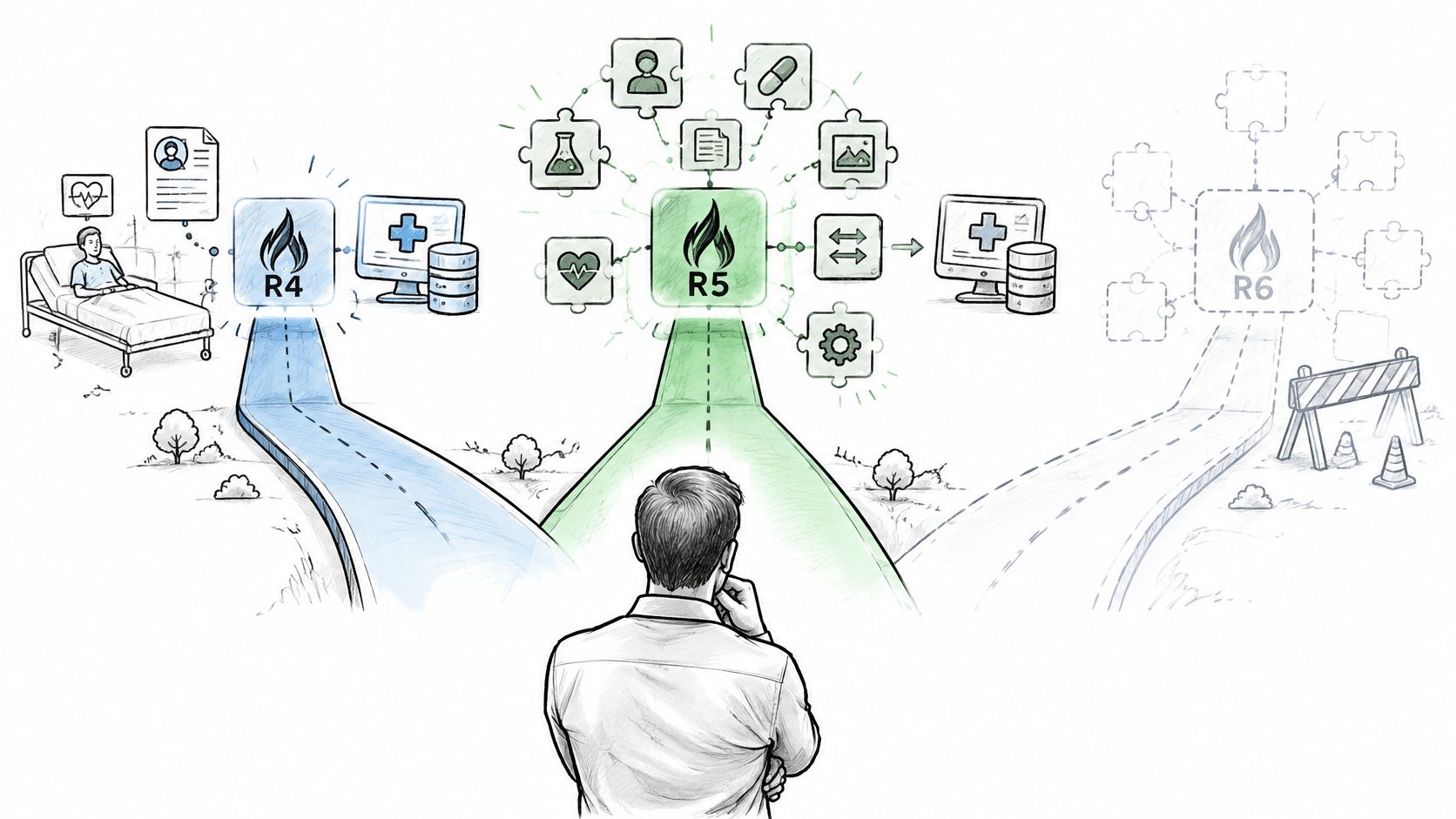
HealthLake and Azure document R4 support. Confirm Google's selected store version and HAPI's selected release; this comparison makes no R5 support claim for any platform.
Use the following acceptance sequence:
Validate representative Patient, Observation, DiagnosticReport, and other required resources against the target implementation guide.
Compare the server's CapabilityStatement with required interactions, conditional writes, validation, and terminology behavior.
Exercise named search parameters, modifiers, chaining, and pagination.
Check error responses, unsupported parameters, and OperationOutcome content.
Retain test fixtures, responses, configuration, and release identifiers beside throughput and latency results.
A server can accept R4 resources yet fail a required US Core, AU Core, or payer workflow. Include Inferno where its selected conformance tests apply, but don't treat a passing subset as proof of every production requirement.
Search behavior needs explicit assertions
Test GET [base]/Patient?name=Smith against expected matches, rather than accepting an HTTP success status. Storing Patient JSON doesn't establish the required search semantics.
The FHIR R4 HTTP specification constrains cross-type searches such as GET [base]?_type=Condition,Observation to parameters shared by both resource types. Verify Bundle pagination links, actual matches, included resources, and unsupported-parameter handling.
Retain expected resource identities in search tests. Matching counts alone can conceal incorrect results.
SMART authorization and bulk data export
A backend-service token that passes every read test in staging can still fail the first time it tries to kick off a system-level $export. Read authorization and export authorization are granted through different scopes, often through different configuration paths, so treat them as separate acceptance criteria.
For SMART on FHIR implementation, require agreement on OAuth behavior, supported SMART version, and scope syntax. Check whether the deployment expects older scopes such as patient/*.read or granular scopes such as patient/Patient.rs; don't assume they're interchangeable.
Test identity and export independently
Engineering verifies SMART configuration discovery, token validation, resource-level restrictions, and backend-service client authentication. The identity team owns the identity provider and trust configuration. Compliance reviews whether the resulting audit evidence supports organizational policy. When a token fails, the failure report should name which of these three parties owns the fix.
For every candidate, record these answers rather than filling the matrix with an unsupported yes:
| Candidate group |
SMART evidence |
Bulk evidence |
| HAPI FHIR |
Deployed authorization layer and negative-access tests |
Enabled export implementation and completion test |
| HealthLake, Azure, Google |
Current service authentication documentation and configured identity flow |
Supported export mechanism, permissions, retention, and failure responses |
| Smile CDR, Medplum |
Contracted version and configured authorization behavior |
Licensed feature scope and demonstrated export result |
Bulk acceptance should cover kick-off, polling, NDJSON retrieval where supported, download expiration, throttling, and partial failure. Verify whether export requires system-level authorization and whether the identity provider supports the required integration. Entra ID, AWS IAM Identity Center, and a self-managed provider aren't interchangeable configuration choices.
The FHIR R4 SearchParameter definition establishes named search semantics. For export-adjacent queries, include _count maximum-page behavior, allowing fewer returned results, and test _since and _at in their applicable history or synchronization contexts rather than assuming universal support.
For incremental export, test the supported _since behavior against known resource versions and timestamps. Include negative cases: a token that reads Patient but cannot export, an expired download URL, and a completed job with missing output.
HL7 v2 support and interface engine pairing
A FHIR backend and an HL7 v2 interface engine perform separate jobs. For an incoming ADT or ORU feed, design the engine to receive messages, map identifiers and segments, validate resulting resources, and write them to the backend.
HealthLake requires a separate HL7 v2 conversion path. Google's HL7 v2 store provides message storage, but don't equate storage with your required Patient, DiagnosticReport, and Observation mappings; confirm transformation behavior separately.
| Failure |
Recommended control |
Replay evidence |
| Duplicate ADT messages |
Idempotent upsert keyed on EHR identifier |
Stable Patient count after replay |
| EHR identifier mismatch |
Integration-owned identifier mapping |
Correct references and patient association |
| Out-of-order updates |
Source-aware event ordering and stale-write protection |
Expected final patient state |
Use MSH-10 for message identity and deduplication, not as a guaranteed sequence number. Evaluate EVN-2 with the sender's event semantics before using it for ordering; timestamps alone may not resolve every conflict.
Hypothetical worked example: An engine receives an ADT message, resolves the EHR identifier, validates a mapped Patient, and performs an idempotent write. It then receives an ORU message and writes linked DiagnosticReport and Observation resources; replaying both messages must preserve the expected counts and final state.
Our insights compare Mirth Connect alternatives, including Open Integration Engine, BridgeLink, commercial engines, and cloud services. For a downstream application such as a clinic AI assistant, keep that ingestion contract separate from application behavior.
HIPAA eligibility and shared responsibility
Ask this in the architecture review: which HIPAA control can the customer prove today, with an owner and an artifact? A HIPAA-eligible label answers whether a service can be brought into scope; the agreement, approved boundary, configuration, and risk acceptance still sit with the customer.
The HHS encryption FAQ states that encryption under 45 CFR 164.312(a)(2)(iv) and 164.312(e)(2)(ii) is an addressable implementation specification. The regulated organization must assess whether encryption is reasonable and appropriate, then document the decision and any equivalent alternative safeguard.
Assign controls before collecting evidence
A responsibility split becomes defensible when each control names an owner and an artifact. Vendor documentation establishes service scope and BAA terms; the risk-owner mapping and evidence standard here are Ekipa's engineering view.
| Control |
Self-hosted deployment |
Managed deployment |
Evidence |
| Infrastructure patching |
Customer |
Provider within contracted boundary |
Change tickets plus provider assurance reports |
| Access configuration |
Customer |
Customer |
IAM exports, policy review sign-off |
| Keys and TLS |
Customer-configured boundary |
Shared, per service configuration |
KMS policy, TLS settings, rotation log |
| Backup recovery |
Customer |
Shared, per service capabilities |
Restore-test output with completion status |
| Risk analysis |
Customer compliance function |
Customer compliance function |
Approved risk register and decisions |
On any cloud, sign the provider's BAA and run PHI only on HIPAA-eligible services. Check the current eligibility list at procurement and renewal, retain the result, and give every adjacent analytics or automation service its own eligibility check.
For AWS-specific configuration planning, use our HIPAA compliance on AWS discussion. For audit preparation, our HIPAA compliance audit guide works as an operational checklist alongside the HHS requirements.
Collect signed agreements, configuration exports, access logs, key-rotation records, recovery evidence, and risk-analysis decisions. The customer's compliance function owns the legal position.
Ecosystem fit and lock-in risk
A migration can move every resource cleanly and still fail at cutover, because SMART scopes, access policies, and identity mappings live outside the exported data. Ekipa's view: the exposure ratings below are engineering judgment, not vendor claims.
Ecosystem coupling and exit checks by option
| Option |
Adjacent services |
Lock-in exposure |
Exit check |
| HAPI FHIR |
Customer-selected infrastructure |
Limited provider coupling; customer operating burden |
Export and restore into another server |
| AWS HealthLake |
AWS account and surrounding services |
Data-store and service coupling |
Verify export path and format |
| Azure Health Data Services |
Entra ID, DICOM, MedTech, analytics |
Identity and analytics coupling |
Exercise identity migration and export |
| Google Cloud Healthcare API |
BigQuery, Vertex AI, DICOM, HL7 v2 |
Pipeline and schema coupling |
Validate export and downstream mapping |
| Smile CDR |
Record contracted integrations |
Assess proprietary configuration and extensions |
Inventory every proprietary configuration and extension that must be recreated elsewhere |
| Medplum |
Record contracted integrations |
Assess application and identity dependencies |
Rebuild application dependencies and identity mappings on the target |
A portable resource export doesn't carry authorization policies, operational dashboards, custom transformations, or downstream schema assumptions. Assign an owner to rebuild each dependency before declaring migration feasible.
Require another server to load the export and pass the same clinical search assertions before accepting the exit plan.
Set an acceptable recovery window and inspect resource references, identifiers, attachments, and required history. A successful file download alone doesn't prove application portability.
When to self-host and when to choose managed
Choose self-hosting when your team needs runtime control and can sustain operations. Choose managed infrastructure when reducing server-operation responsibilities outweighs restrictions on configuration and extension.
FHIR backend decision matrix by situation
| Situation |
Leans toward |
Risk owner |
Evidence to collect |
| Runtime control, custom behavior, chosen hosting environment |
Self-hosted HAPI FHIR |
Customer engineering and security |
Architecture, patch and backup runbooks |
| Small team without platform on-call |
Managed service |
Provider infrastructure; customer configuration |
BAA, configuration export, access review |
| AWS-first estate needing R4 storage |
AWS HealthLake |
Shared |
Current eligibility check and signed BAA |
| Existing Azure or Google analytics platform |
Same-cloud managed service |
Shared |
Data flows and identity-policy review |
| Strict national or payer guide |
Candidate passing required tests |
Engineering and vendor |
Retained conformance results |
| High-volume HL7 v2 feed |
Engine/server pair passing replay |
Integration team |
Counts, final states, replay results |
Two columns carry the weight in this matrix. "Risk owner" names the party that answers when something fails, and "evidence to collect" names what must exist before that answer is credible. A row missing either one is still an assumption.
Public, private and hybrid hosting choices matter, but the backend decision still requires workload-specific evidence.
Run a time-boxed proof before commitment: target-guide tests, production-volume export, HL7 v2 replay, and audit-log review. Record latency at actual page sizes and concurrency, and benchmark analytics separately from transactional retrieval.
Conclusion
The decision is a written boundary: who runs the server, who owns each control, and which evidence was retained. Pick the option whose gaps fall on an owner staffed to carry them. For the standards and vendor programs around these choices, see our EHR integration and interoperability guide.
If you want help choosing or running a FHIR server, book a consultation with Ekipa's HealthTech engineers.
Frequently asked questions
Which FHIR server should a small engineering team choose?
Start with a managed service in the existing cloud if its conformance and authorization behavior meet requirements. Reject it if the proof exposes gaps your team can't safely maintain around.
Does an HL7 v2 store replace an interface engine?
Not automatically. Verify message transport, mapping, acknowledgments, retries, and reconciliation before assigning those responsibilities to a storage service.
What evidence should exist before procurement sign-off?
The artifacts named in the matrix's evidence column for the chosen row: a signed BAA and access review for a managed service, patch and backup runbooks for self-hosting, retained conformance results where a guide applies, and replay results where an HL7 v2 feed exists. Sign-off is premature while any required artifact is missing.
What should trigger a re-evaluation?
Revisit the decision when the workload outgrows what the proof covered: a new national or payer guide, a second HL7 v2 feed, a change of hosting provider, or a major server version upgrade. Rerun the affected proof rather than the entire matrix.